

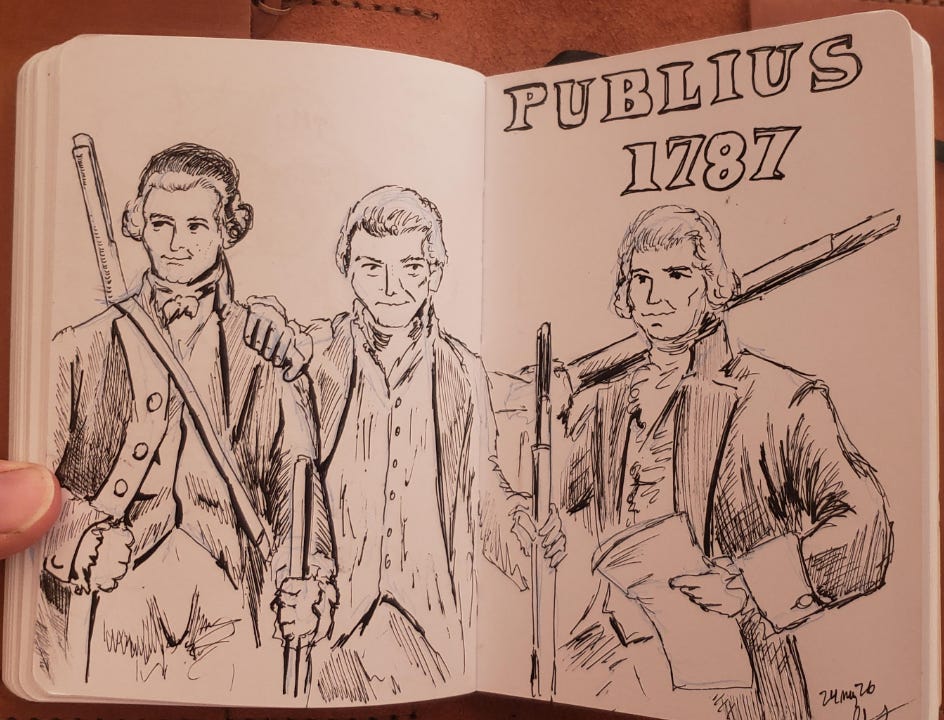
This concludes my reading of The Federalist Papers in advance of our country’s 250th birthday. Thank you for reading these.
Prior installments: 1 | 2 | 3 | 4 | 5
I. Am. Mentally exhausted from this exercise.
Let me tell you:
I started this project with a lot more enthusiasm than I had when I ended it, and anyone who says they enjoyed this is just trying to flex on you because you won’t shut up about the Hamilton musical. (Very good and simultaneously overrated. Also racist.)
Nevertheless, arduous tasks are only undertaken because they are necessary, or at the very least, the desired result is on the other side. Hamilton, who penned 51 of the 85 Papers, had a deep and broad understanding of the history of republics, especially the Achaian League of old Greece, the Holy Roman Empire, and others.
America could have started with all the promise in the world and it wouldn’t have mattered if our doom and failure were baked into the cake from the get-go, and he foresaw that the ultimate outcome of the Articles of Confederation could only be the dissolution of the United States. He stated his case pretty clearly in these papers, along with a future president and the first chief SCOTUS justice. These men knew what they were talking about—they quite literally wrote the book on the mechanisms of the Constitution.
While the Papers were front-loaded with history and essays on parallel examples, the back end was concerned primarily with justifying the built-in powers of each branch of government. I’m going to speed run all of these because once again, I am tired, the Papers are verbose, and a summary would be meaningless beyond one or two lines per.
And before anyone asks, I will not be reading the Anti-Federalist Papers this year. I don’t have it in me. I will be digesting these for another six months and I need a break. I will tackle the AFP in 2027.
Lightning Round
75: Why the Executive can make treaties with two-thirds of the Senate
76:Why the Executive can appoint department heads who must be confirmed by the Senate
77: A continuation of 76 (he often breaks up his points into multiple essays because he considers multiple scenarios where a plain reading of the statutes would create uncertainty or an imbalance of power)
78: Barriers between the Judiciary and the Legislature as pertains to term length, pay, and conduct
79: Safeguards for judicial independence (right around here I started to get annoyed because let’s just say Hamilton’s views were a little bit idealistic when contrasted with some of the stuff we’ve seen from the bench in our history)
80: Proper jurisdiction of federal courts compared to state courts
81: Expands on different elements of paper 80
82: Relationship between state courts and federal courts
83: Mainly pertains to trials by jury (recall what I said about the Bill of Rights, that most of the rights enumerated have to do with a citizen’s rights in court. This was a big concern then and remains one today.)
84: Grab bag of other points that he hasn’t addressed yet but has heard in public and read in the papers. The Bill of Rights didn’t exist yet and a lot of what he writes here will be covered by them, so it’s all good.
85: Closing remarks, Hamilton urges ratification. He says it’s better to adopt it now and amend it later than to go back to convention, which would open the Union up to a much more devastating fracture.
Conclusion
“I never expect to see a perfect work from imperfect man…”
-Alexander Hamilton, Federalist No. 85
Earlier in this series I used the analogy of a surgeon trying to excise a tumor with an extremely precise cut of a mighty sharp blade. The specific allotment and limitation of powers as regards individual liberties is like that surgeon’s effort to cut away that tumor with a minimal impact on healthy tissue.
After reading these Papers I have a much greater appreciation for the magnitude of the task the Founders undertook. There’s a reason almost half of the Signers of the Declaration were lawyers. Those of us without a legal background seldom appreciate the advanced Western philosophies that govern pretty much everything we do, especially in a constitutional Republic where our rights are understood to come from God and not government.
These Papers are a sharp legal surgery with an ever-focusing microscope and a careful application of the blade before every cut. I joked a lot about agreeing with Aaron Burr every time I had to read one of Hamilton’s run-on sentence marathons. Honestly though, I think the last twenty Papers or so revealed who he really was and why he was doing this. (Madison is still my favorite Federalist, don’t get it twisted.) But this was definitely a Hamiltonian project en masse.
Whatever his flaws—and he was only as human as you or I—he was indispensable in making the case for our divinely inspired Constitution, and these Papers should form as much of a study about our Founding as any other series of documents to come out of that era.
I am looking forward to the arguments in the other direction. Just not right now. The 4th of July is tomorrow. Let me rest.
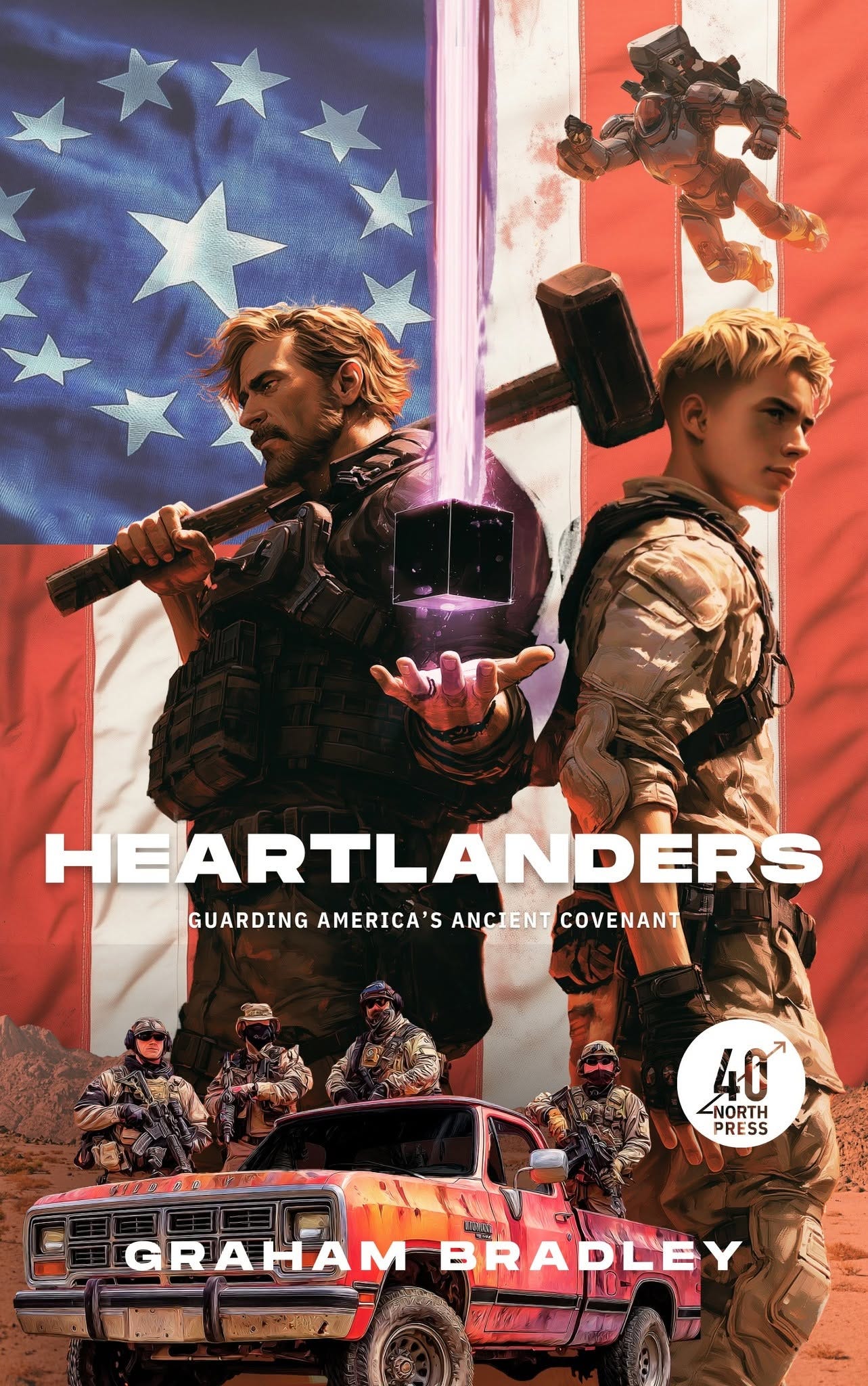
Visit Nauvoo Supply to order HEARTLANDERS, the most American novel I’ve ever written. It’s like if National Treasure happened during Fallout with G.I. Joes.
My Amazon page has my other books, including FOSSIL FORCE for young boys and Engines of Liberty for all ages.
I post several times per week on YouTube.
Subscribe here for more book reviews and for articles on what I continue to learn as I read.