

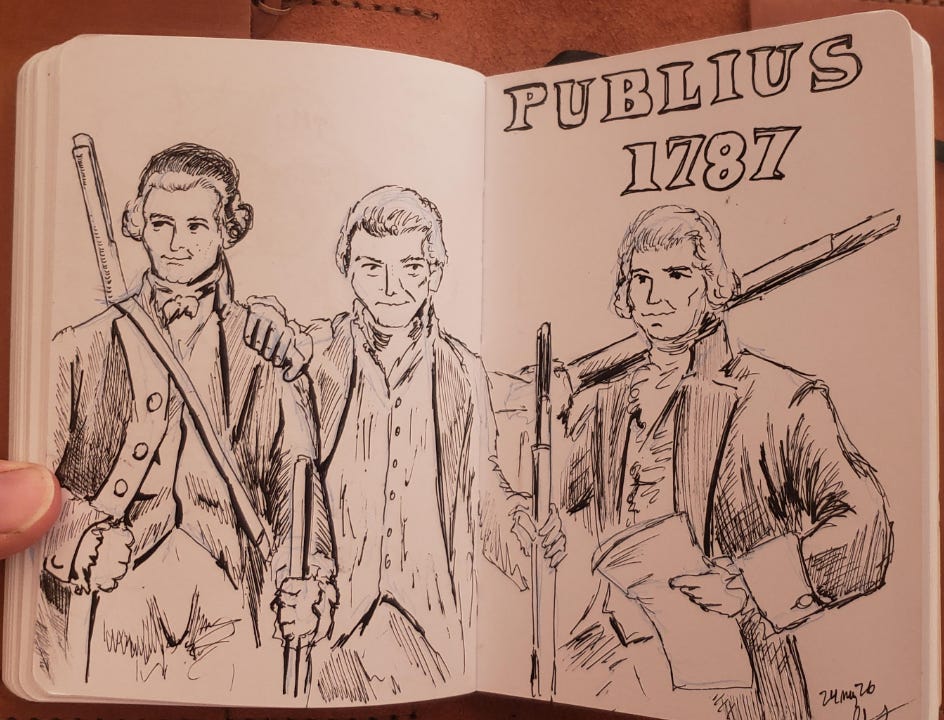
“Federalist Friday” is a six-part series wherein I share what I’m learning as I read the Federalist Papers in their entirety. Per the recommendation of my resident Ph.D., I’m using the Kesler edition, but I can’t seem to find a link to it on the ‘Zon. So I guess just follow along with whichever edition you prefer.
Twenty-two papers left! And we kick off with number 64, straight out of the pen of future SCOTUS Justice John Jay! LET’S RIDE!
Paper 64: The Powers of the Senate
The focus of these papers oscillates between the “how” of the Constitution and the “why” of it. The document sits at the crossroads of legal philosophy and legal mechanics, and John Jay is the engineer with sweat-steeped coveralls and greasy fingertips behind the counter, telling you why the radiator needs coolant and the engine needs oil, please don’t be stupid.
Bicameral legislation exists for a reason. The House gives each State a voice based on population (and other metrics), while the Senate gives each State a voice based on statehood. Power is divided up between these Article 1 institutions for very deliberate reasons, and men who qualify for the offices of either chamber will have to meet different criteria.
By excluding men under thirty-five from the first office, and those under thirty from the second, it confines the electors to men of whom the people have had time to form a judgment, and with respect to whom they will not be liable to be deceived by those brilliant appearances of genius and patriotism which, like transient meteors, sometimes mislead as well as dazzle.
Senators and Congressmen were supposed to be older so that voters could have a solid assessment of them and delegate power accordingly. Adjacent to this principle is the fact that young people are usually stupid and flamboyant, and shouldn’t be entrusted with power based on little more than juvenile idealism.
On the subject of establishing treaties, the President has the power to do so along with two-thirds of the Senate; the fact that they’re older and their terms are longer ought to (generally) give them a longer view of the impact of a treaty and whether it will benefit the Republic. They shouldn’t be made through a myopic lens of youth.
Paper 65: Continued, but by Hamilton.
It’s Hamilton. He bores me. Nevertheless, he’s on target here with the subject of impeachments, and how the Senate has a role in them. The House has the power to file articles of impeachment, at which time the Senate then convenes to hold a trial. He doesn’t trust common courts to hold this power as they can be too isolated, too local, and thus too political. Congress is meant to be a broader and wiser body and, while not perfect, is a superior alternative to other courts. (Even SCOTUS.)
Paper 66: Hamilton keeps going.
Right out of the gate, Hamilton acknowledges popular resistance to the congressional power of impeachment, and while he highlights that giving judicial power to congress under extremely limited circumstances is still a conflation of two separated powers, Congress is a far more numerous body than the Supreme Court, which ought not have so much say in matters legislative. He’s balancing the separation and I think that makes sense.
Paper 67: Hamilton talks Article 2.
Having hammered Congress in his writings for a while, Hamilton talks about executive powers for a minute, and dare I say it…he gets a little bit spicy (for 1787) with his haters.
Remember, there are Anti-Federalists at this time, and the ratification of the Constitution is still up for debate. There are concerns about what powers the Executive will have, and whether the government is creating a king under another name.
There is hardly any part of the system which could have been attended with greater difficulty in the arrangement of it than this; and there is, perhaps, none which has been inveighed against with less candor or criticized with less judgment. Here the writers against the Constitution seem to have taken pains to signalize their talent of misrepresentation.
Get ‘em Alex! Honestly guys, just…go read paper 67. I’ll just end up copying half of it here if I keep going. It is a complete unmasking of Hamilton where he takes down the barrier between his passion and his intellect to unleash on the Anti-Federalists. He’s had enough of their crap and he finds the most diplomatic (yet energetic) way of calling them liars and whores. My final note in my copy simply reads Hamilton doesn’t suck?
Paper 68: Bring it back down
Okay. Hamilton’s talking about how we elect presidents, and I’m cutting him some leeway here because he was dealing with a different caliber of electorate. After breaking it all down, he says:
This process of election affords a moral certainty that the office of President will seldom fall to the lot of any man who is not in an eminent degree endowed with the requisite qualifications.
Look, you can read that and say Trump, I can read that and say Obama, and we’re both right. But that has a lot more to say about the voters now (and our laws today) than it does about Hamilton’s cognitive powers in the 1780s.
Paper 69…you know what? Lightning Round.
Paper 69: Hamilton explains how the President is not a king. (It’s funny because the stupid No Kings protesters-for-hire are probably Lin Manuel Miranda fans but have never actually read Hamilton. Anyway…) He contrasts the office of President with that of the Governor of New York, highlighting how the President can’t declare war (well…), can’t impose taxes unilaterally, is subject to impeachment, has a limited veto, and also a limited term.
Paper 70: Hamilton again. Separation of powers is important between the branches but within the branches—and especially under the Article 2 Executive—unity is important, and the President, while limited, does need the power to do some things without being impeded all the time.
Paper 71: Hamilton defends the four-year term of president. It’s more than the House but less than the Senate. Previous iterations had proposed a single seven-year term, so a shorter term (with, at the time, limitless numbers of terms) was once again a display of balance.
Paper 72: Hamilton continues this subject and actually defends the idea of re-electing an executive without term limits. Tradition set by Washington would eventually see the two-term practice carry on for a while (although Grant did try to stand for a third in the 1880s), but the abuses of FDR showed in the long term that limits were ultimately necessary. (My opinion.) This could have been mitigated with greater restrictions on the franchise; Hamilton makes frequent appeals to the qualifications of voters in an time when the right to vote was not universal. If you look at the current state of politics at the state and national level, you cannot earnestly conclude that the franchise should be granted upon reaching an arbitrary age marker. (Again, my opinion.)
Paper 73: Hamilton talks more about the veto power and how it was structured in the interest of power balance; he also talks about presidential compensation (executive salary) and how there has to be SOME so that the President isn’t reliant on Congress’s whims for his livelihood. Congress can still vote to change the presidential salary but it can’t be implemented during that same president’s term.
Paper 74: In an interesting mix of subjects, Hamilton addresses both the President’s power to pardon as well as his role as Commander-in-Chief of the military (or militia as the case often was.)
Conclusion
You want to know just what the president can and can’t do? Well, there’s the second Article of the Constitution in all its dry glory, but there’s a great deal of expansive text by Hamilton from the same time period to make sense of it all. These papers are where you’ll find it.
One more, guys. One more Federalist Friday. It will drop on July 3rd, 2026. We’re in the home stretch now.
Drive safe, see you out there. BUY MY NOVELS.