

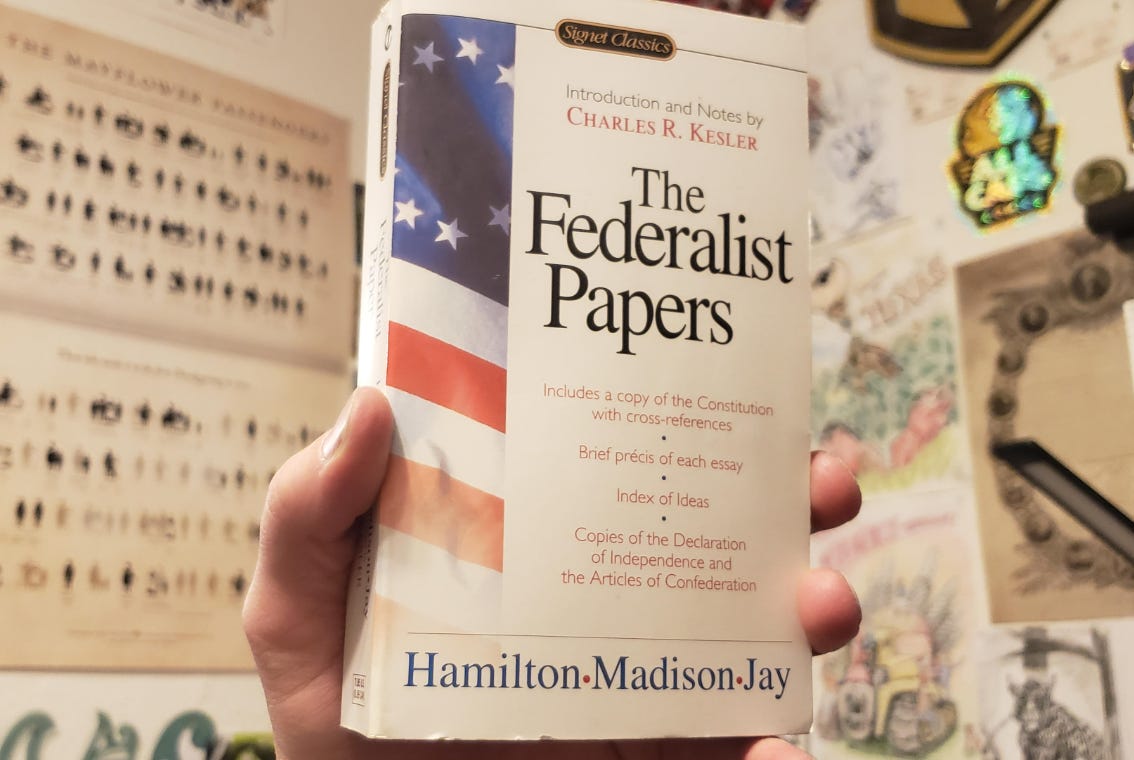
“Federalist Friday” is a six-part series wherein I share what I’m learning as I read the Federalist Papers in their entirety. Per the recommendation of my resident Ph.D., I’m using the Kessler edition, but I can’t seem to find a link to it on the ‘Zon. So I guess just follow along with whichever edition you prefer.
Federalist #15-17
Unlike the first 14 Papers, I’m grouping these whenever they’re “The Same Subject, Continued,” because this happens often. Why does it happen often? Because Alexander Hamilton was basically a woman, and couldn’t say anything in ten words if he had the option to say it in eighty-six.
Thus I had to swim through some mental mud to make sense of just WTF he was talking about in these three articles. As a continuation of previous themes, Hamilton keeps making the case for the inadequacy of the Articles of Confederation because the centralized government (Congress) only had power over the states as a cluster, but couldn’t make laws that demanded anything of individual citizens.
If Congress sent a law to the States and the States said “Lol no,” Congress was SOL. This effectively made it worthless as a body. Generally I would cheer for this, but in the context of all the other arguments made by Publius, there’s a logical progression to other, bigger problems: without a centralized government, individual States become as inimical toward each other (first economically, then culturally, then militarily) and thus become ripe for the picking by outsiders.
Europe has this problem with small countries like Spain, France, Germany, Italy, and Poland all living in the same landmass, but they’re separated by natural barriers, by languages, and by culture. The American States all had similar cultures, generally the same religion, and the same language. (Publius makes this argument in the very beginning of the Papers.)
With the Confederated Congress being a paper tiger—yet one with jurisdiction over the Continental Army—the only way to enforce orders on individuals in the States was martial compulsion, and that would just piss everyone off and we’d be back where we started.
Conclusion: the Articles were worthless, a central government was necessary, a federal system was the solution.
Federalist #18-20
Since we like to be students of history, Hamilton looks to past examples of similar breakdowns in clusters of nation-states, city-states, or otherwise decentralized places in Europe that had similar languages and cultures but nothing else to tie them together—and plenty of small borders to break them apart.
Federalist 18 examines this phenomenon in Greece, while 19 and 20 look at how it played out in the Holy Roman Empire/Germany, and the Netherlands. It would be exhaustive to explore and summarize the specifics here, but these papers are actually readable…
…because Madison wrote them alongside Hamilton.
In Greece, the Amphictyonic Council started around 590 BC and lasted roughly 800 years, before decaying under internal squabbles and foreign influence. The States, under the Articles of Confederation, had a legal system that paralleled that Council and would thus likely end the same way.
By contrast the Achaean League lasted around 130 years, starting in 280 A.D.; the Council lasted longer but those centuries were, by Hamilton’s reckoning, tumultuous and marked by weakness. The short-lived League was apparently stronger? And the Constitution he proposed would have had more in common with their inter-city legal bonds.
He repeats this analysis with comparison to the Holy Roman Empire (Germany, etc) and the Netherlands, but you get the picture. Apes, together, strong. Personally I think he shot his argument in the foot by comparing an eight-century institution to another that didn’t even last one and a half, but I’m sure someone smarter than me knows the specifics of why it’s valid. (No sarc, I admit I probably don’t get it.)
Federalist #21-23
The next leg of the Papers takes us through a comparison to the then-current Articles of Confederation, which “technically” created an institution at the core of the States’ intercourse, but that institution was toothless and impotent. Everything it was supposed to do was more of a guideline, or in practice, a sarcastic suggestion.
The Confederated Congress couldn’t issue any orders to the States, which sounds nice, except when you consider issues of law enforcement. One State could enact a policy or practice that would weaken the others (take the current immigration issues, for instance) and Congress wouldn’t have the means to stop them. The same problem existed when it came to collecting revenue, guaranteeing a republican form of government to each state, and so on.
This problem bled over into military preparations. Congress couldn’t raise an effective militia for the nation (the Confederation) at large if it couldn’t enforce requirements. Suffrage (at scale) was another problem: small states had as much of a say in Congressional matters as large ones. \
Hamilton closes this arc of his argument by proposing a short list of what a Federal government should be able to do, as well as what it shouldn’t, and then empowering it to actually execute on its duties: provide for defense, encourage commerce, and promote beneficial foreign relations.
Federalist #24-26
The concern in this leg of the Papers is standing armies, and the conditions under which they exist. Historically the existence of a standing army in peacetime has led to problems, especially when the monarch (or executive) has absolute control over them. Monarchs aren’t accountable to the citizens the way that elected officials are, and even a single elected executive can damage a republic if he can just command an army into existence without any legal mechanism to impede him.
Hamilton makes to assuage these concerns by explaining that under the proposed Constitution, the executive would not have the power to raise armies; only the legislature would, and they were directly elected by the people, and an army could only stand for two years before needing to be renewed. The need to maintain an army was apparent in their situation due to the borders they shared with antagonistic nations on all sides (the Indians, the English, the Spanish, and the French.
Since the States collectively faced these threats, it made sense for a federal legislature to have jurisdiction over just such an army—even if Pennsylvania wasn’t threatened by the Spanish, or Georgia wasn’t threatened by the French. These hazards existed against the nation as a whole. Each state could have a decentralized militia but these would be ineffective, unequal, and thus provide a vulnerability to the whole nation.
The sum result of this specific issue is a sampling of the larger focus of the Papers: there’s an extremely fine line in the gray gulf between anarchy and tyranny, where SOME government is necessary, but RIGID limits must be in place to prevent it from falling too far toward one end or the other. Hamilton does some heavy lifting here to find that line.
Federalist #27-28
It’s hard to get into the extreme fine details of what he’s saying in 27 and 28 as far as they contrast with anything he said in 24-26; he just continues to expound upon the need for laws regulating a standing army and the role one would play in a federal system, as compared to the obvious weaknesses inherent to the confederated system and the problems such a cluster of armies would breed.
This is where the “Hamilton is a deep thinker” notion rears two different heads. The excess of his thought process means he’s thorough. It also makes his works resistant to summary and digestion. As long as you understand that his writings are trying to convince you that “federalism good, confederation bad” and that he’s analyzing this hypothesis in the context of several other facts of life in America (commerce, military, foreign policy, stability, etc) you’ll get the gist of what he’s weighing.
Drive safe, see you out there. BUY MY NOVELS.