

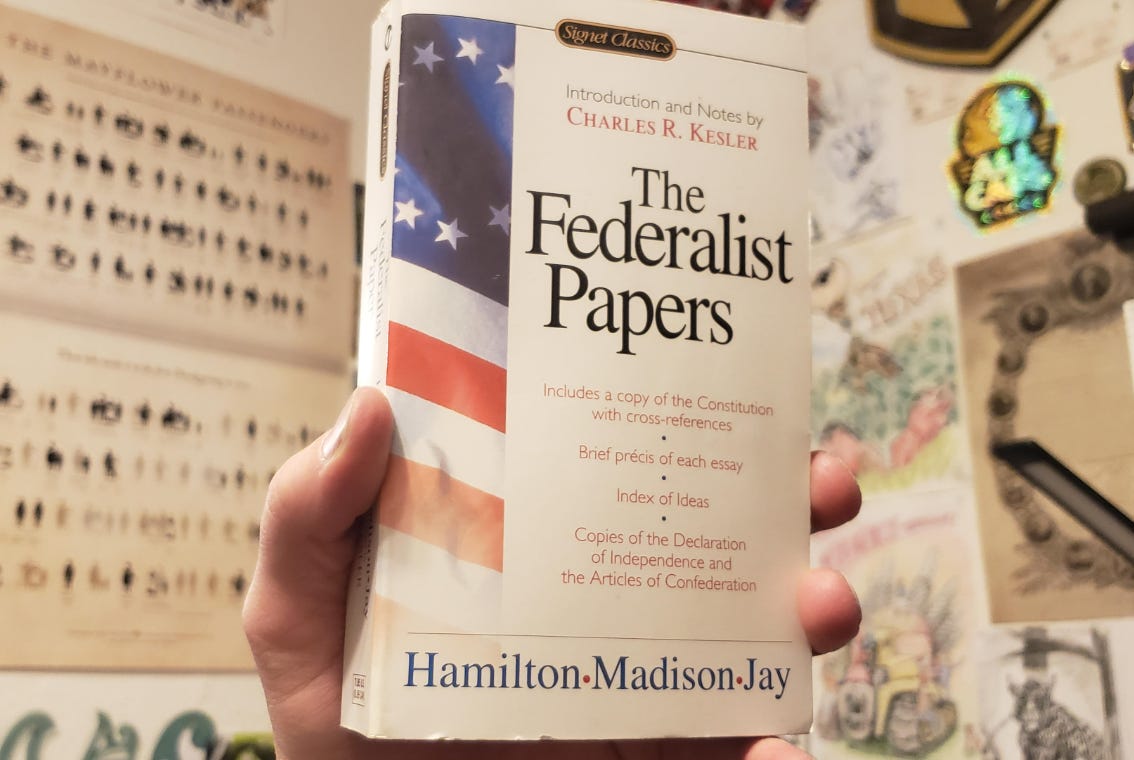
“Federalist Friday” is a six-part series wherein I share what I’m learning as I read the Federalist Papers in their entirety. Per the recommendation of my resident Ph.D., I’m using the Kessler edition, but I can’t seem to find a link to it on the ‘Zon. So I guess just follow along with whichever edition you prefer.
Gentlemen and gentlewomen: I have superb news.
We are about to put this hog in 4L and wrap the winch around the Liberty Tree, wherewith we may finally free ourselves from the gelatinous bog of Hamiltonian Publii, and cruise joyously into the writings of Madison.
But not just yet.
Federalist 29
To render an army unnecessary will be a more certain method of preventing its existence than a thousand prohibitions upon paper.
With better foresight I may have covered this Paper last month, as Hamilton was writing about the role of Federal oversight in state militias. He opposed the idea of standing armies and with good reason; here he lays out the reasons why militias were preferable, but Federal regulation was also necessary.
Local or state-level militias were preferable because they weren’t likely to turn on their own people and their own lands. (Robert E. Lee cited this exact reason for leading the Army of Northern Virginia after they seceded.) The Constitution would provide better legal framework for the existence of these things than the Articles did.
Hamilton points out that haters of the Constitution had nothing to go off of but demagoguery.
In reading many of the publications against the Constitution, a man is apt to imagine that he is perusing some ill-written tale or romance, which, instead of natural and agreeable images, exhibits to the mind nothing but frightful and distorted shapes—Gorgons, Hydras, and Chimeras dire—discoloring and disfiguring whatever it represents, and transforming everything it touches into a monster.
Nothing ever changes. Not really.
Federalist 30-36
This is where I’ll cut Hamilton some slack about his prose: first, he’s covering one of the topics everyone hates, but can be useful, and second, it needs to be hit from multiple angles to address the various issues with it. That’s right baby: taxation of outlying systems.
In this case, the outlying systems are the States.
Why is Hamilton arguing for the Fed’s unlimited ability to tax individuals? Well, as always, his pitch for the federal system is in contrast with the failures of the Articles of Confederation, which kept sending bills to the States that were often ignored. We see this same thing today: people want low taxes and high spending (except for the people who know where that spending comes from) and it just can’t work that way. You can’t kill the laws of mathematics no matter how hard you try.
Paper 30 outlines the ineffective model under which the nation then operated (States weren’t paying into the confederated coffers).
I believe it may be regarded as a position warranted by the history of mankind that, in the usual progress of things, the necessities of a nation, in every state of its existence, will be found at least equal to its resources.
31 points out that States can tax their citizens within their own borders, so the Federal government will need that same power for the nation at large, though he naively declares that abuse was impractical in a large republic. (Or maybe he wasn’t naïve—that was technically true, so long as you protect the franchise and retain a united culture, which over time, we have not.)
…there is greater probability of encroachments by the members upon the federal head than by the federal head upon the members. [Would that this were true today but I don’t believe that it is.—GB]
…Everything beyond [the powers delineated to the Constitution] must be left to the prudence and firmness of the people; [This I do agree with.—GB]
32, at length, cites the provisions in the Constitution that create the power to tax. (Which is still the power to destroy.) He echoes the fact that States already have the power to do this within their own borders.
…States should possess an independent and uncontrollable authority to raise their own revenues for the supply of their own wants.
I suspect we can have a lot of arguments about what that means.
33 outlines the specific Necessary and Proper Clause, as well as the Supremacy Clause of the Constitution.
The propriety of a law, in a constitutional light, must always be determined by the nature of the powers upon which it founded. […] If individuals enter into a state of society the laws of that society must be the supreme regulator of their conduct.
Oh my. This one here isn’t just about taxes. That single line could pop up and fit every single law enforcement issue we’ve had in this country for a looooong time. But I digress.
34 gives us another example of a past Republic, namely Rome, and how the state governments are supposed to deal with internal needs while the federal government takes care of foreign affairs. I like this paragraph, you’re getting all of it:
To argue upon abstract principles that this co-ordinate authority cannot exist, is to set up supposition and theory against fact and reality. However proper such reasonings might be to show that a thing OUGHT NOT TO EXIST, they are wholly to be rejected when they are made use of to prove that it does not exist contrary to the evidence of the fact itself.
It is well known that in the Roman republic the legislative authority, in the last resort, resided for ages in two different political bodies not as branches of the same legislature, but as distinct and independent legislatures, in each of which an opposite interest prevailed: in one the patrician; in the other, the plebian. Many arguments might have been adduced to prove the unfitness of two such seemingly contradictory authorities, each having power to ANNUL or REPEAL the acts of the other.
But a man would have been regarded as frantic who should have attempted at Rome to disprove their existence. It will be readily understood that I allude to the COMITIA CENTURIATA and the COMITIA TRIBUTA. The former, in which the people voted by centuries, was so arranged as to give a superiority to the patrician interest; in the latter, in which numbers prevailed, the plebian interest had an entire predominancy.
And yet these two legislatures coexisted for ages, and the Roman republic attained to the utmost height of human greatness.
I can see myself rabbit-holing this subject so I’ll bookmark it for a later writing. Fascinating though. I marked up a lot of this Paper.
35 gives a few of my favorite examples of why a representative government need not be representative to the extreme (especially not by the 21st Century tortured definition of “representation.”)
…the House of Representatives is not sufficiently numerous for the reception of all the different classes of citizens in order to combine the interests and feelings of every part of the community…
The idea of an actual representation of all classes of the people by persons of each class is altogether visionary. Unless it were expressly provided in the Constitution that each different occupation should send one or more members, the thing would never take place in practice.
Now replace classes and trades with micro-races and the Gender Of The Week, and you’ll see that we should have laughed this idea onto the ash heap of history centuries ago.
36 is where Hamilton makes his closing arguments on this subject by outlining what the State can’t or won’t do as concerns excessive taxation. Once again, I’ll mention that this can (and should) come off as naive, but he was also dealing with his people, his culture, and his time; if the United States were similarly constituted today, we wouldn’t have so many immediate examples of why this philosophy hasn’t born out in a practical sense.
As to the suggestion of double taxation, the answer is plain. The wants of the Union are to be supplied in one way or another; if to be done by the authority of the federal government, it will not need to be done by that of the State governments. [California clearly disagrees.—GB]
Happy it is when the interest which the government has in the preservation of its own power coincides with a proper distribution of the public burdens and tends to guard the least wealthy part of the community from oppression! [The ‘least wealthy’ part today is also the most hated demographic that receives the most abuse and oversight from every level of government: small business owners.—GB]
As we conclude this leg of the Papers, my cynicism contrasts sharply with Hamilton’s optimism, but once again, he was dealing with a true and pure nation in the most direct definition thereof. He could not possibly have made these same arguments in the face of our current landscape of extreme, varied political and cultural ideologies.
George Lucas spun an entire trilogy out of what was initially a trade dispute and the mind-bendingly slow process of resolving it through legal action, and after reading this leg of Publius, I’m starting to think he was just channeling Hamilton.
“Mad James” Madison Tags in
FINALLY we get a breath of fresh air from a man who knows how to use a little imagery—and a little restraint with his word count. I had originally planned to skip these Madison Papers and instead keep going with Hamilton (he restarts in the 50s) but since I’ve read these in a linear order, we’re just going to roll with it and learn at speed.
Federalist 37-38
I think one of the key drivers of conflict and debate in political discourse today (and perhaps ever) is disagreement over the definitions of terms. Two people using the same word to mean two different things will never come to a decision on anything. (This is why people fight so hard over gender politics, and that’s not helped by one side being completely unwilling to believe that a term can have a definition at all.)
Madison talks about the language of the Constitution being at times ambiguous, and that this was not a defect, but rather it was inevitable. Personally I attribute it to the reasons listed above, that people will twist the meanings of words into whatever they want them to look like, despite the result of a plain reading. (“Shall not be infringed” comes to mind.)
And frankly, Madison agrees with that take. He nails Constitutional critics for have incoherent and inconsistent arguments: they’re not really for or against anything, they’re just pro-anti, demanding perfection from an assembly of imperfect men. Out of that resulting impossibility, they get to justify their perpetual complaints, despite the imperfections of their own preferred systems.
They didn’t actually want perfection, they just claimed that standard because they didn’t want a federal system.
Paper 40:
Everything new is old. What do I mean? I mean the opponents of the Federal system hated it for just about every reason they could imagine, and most of those reasons were weak, and they probably knew that, so they tried to argue against it on technical grounds. (I’m sure this will come up when I read the Anti-Federalist Papers.)
Detractors said the Convention didn’t have the power to draft a new Constitution because the Convention’s explicit purpose was to amend the Articles of Confederation, not propose a new system. Madison replies here that the mandate was broad enough to include the proposal of a new system, especially in lieu of the Articles’ inadequacy, which was a known quantity at this point because they’d been living under their terms for most of the 1780s.
“And anyway, we need it so bad that we don’t give two rancid damns about specificity.”
This is basically how Congress acts today. John Thune is doing it in the Senate right now, trying to kill the SAVE America Act through procedural horse manure rather than provide for an actual debate. Rat bastard.
Paper 41:
The next complaint brought by the Antis is that a federal system would centralize power far too much. The centralized leviathan under which we currently exist is far more powerful than the Founders envisioned, but it is also structurally distinct from what they designed, largely due to the cancerous growth of three-letter agencies that operate unchecked and unchallenged in the way that the Constitutional branches do.
Madison claps back by outlining the checks and balances in the Constitution along with the need for certain strong powers so that the Fed can actually enforce laws. Hamilton just spent several Papers explaining why the Article had no teeth and no balls, so I’m not going to reiterate it all here.
Papers 42-43:
Boring, but these two papers address other issues that the Fed would have to have some jurisdiction/governance over, namely international treaties, commerce, currency, weights and measures, patents, copyrights, and definitions of several key legal terms. This is stuff that is ultimately very necessary but you rarely think about it, and without national standardization things could go bonkers pretty quickly.
LIGHTNING ROUND
Madison reiterates a Hamiltonian point about States not being able to enter into treaties with other countries (44). The Fed’s powers are “few and defined,” so once again, any powers not explicitly given to the Fed (and these are listed/detailed) are under the purview of the States (45). The Fed can’t successfully mog the States because the States are more closely-knit and can rally to take care of themselves in such a scenario. Here is where I’ll point out he couldn’t see today, and didn’t predict an era wherein elites flooded those several States with illegals, and then fought like hell to keep them there (as long as “there” wasn’t “Martha’s Vineyard.”) (46)
Madison invokes Montesquieu on the subject of separation of powers, saying that true, complete, utter separation isn’t possible, but you can get close with the Constitutional model. Later, when John Jay was a SCOTUS Justice, Pres. Washington would ask his advice on a legal issue and Jay would decline to weigh in specifically for this reason. Executive business was for the executive. These barriers between branches had to have actual legal teeth to them, couldn’t just be “paper barriers” in the way that the Articles of Confederation had “paper authority” over the States. (47&48)
Like Jefferson, Madison favored regular conventions of States (or other such mechanisms) to keep people involved and invested in the process and act of governing. Voting wasn’t supposed to take the place of this, serious discussions were required. (49). He gets into the finer points on this in 50 and 51.
CONCLUSION
While Hamilton was content to argue philosophy, Madison made it more of a point to get into process and policy, which is really how you get the tires on the ground and put this thing into motion.
Despite my animus toward Hamilton and my general preference for Prezzy No. 4, several sections of Madison’s writings also went dry for me here, so I’m gonna call those balls and strikes no matter who’s pitching. Maybe Publius himself was just a long-winded guy.
But…laws have to be precise. Tyrants do love vaguery, so I’m going to give these men some grace for their long winds. They weren’t leaving much to the gray areas.
Drive safe, see you out there. BUY MY NOVELS.