

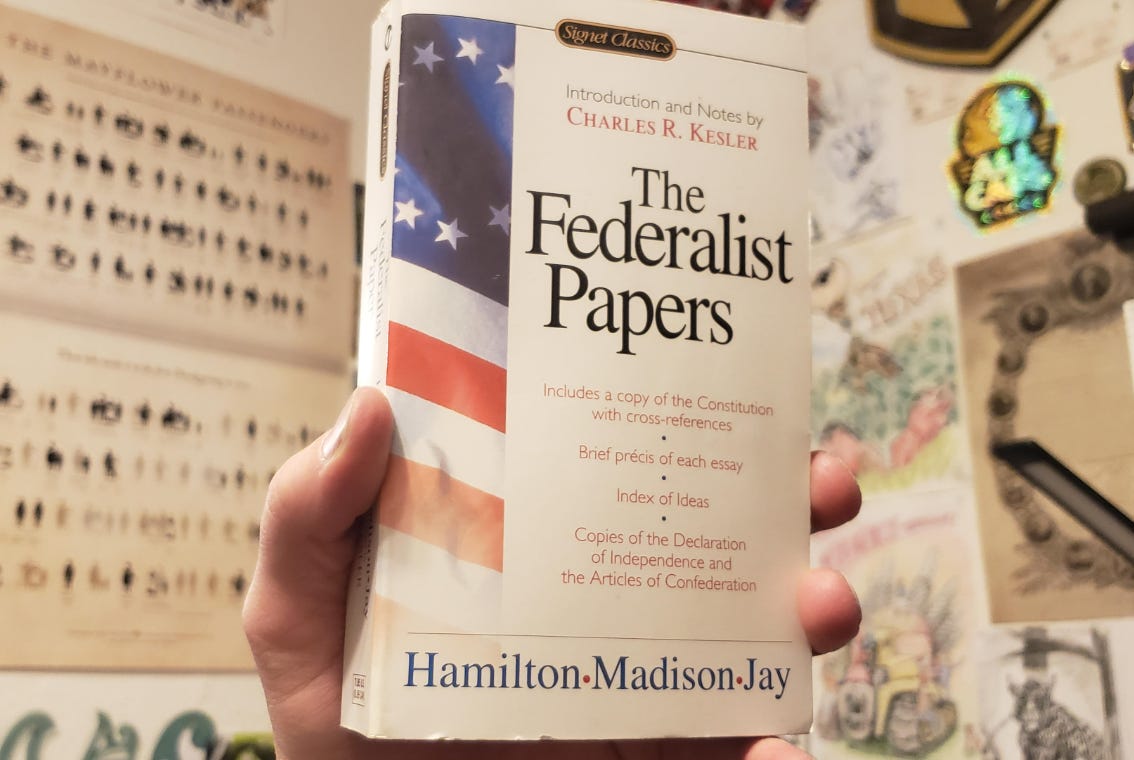
“Federalist Friday” is a six-part series wherein I share what I’m learning as I read the Federalist Papers in their entirety. Per the recommendation of my resident Ph.D., I’m using the Kessler edition, but I can’t seem to find a link to it on the ‘Zon. So I guess just follow along with whichever edition you prefer.
THE FEDERALIST PAPERS is a series of arguments put forth in the 1780s by Alexander Hamilton, James Madison, and John Jay, under the pen name “Publius,” to muster public support for the creation of a central government to the United States. Totaling eighty-five in all, these papers endure today as a record of the rigorous debate held at the time, and the thoroughness of the Founding Fathers in stress-testing the parameters of the government before committing it to paper.
A series of counter-arguments called THE ANTI-FEDERALIST PAPERS also exists, numbering some two hundred in all, but these have been pared down and compiled into a collection of eighty-five by Herbert Storing, meant to mirror the Federalist Papers. Once I finish this project, it’s my intent to read the AFPs as well. One thing at a time.
Federalist #1: The Big Question
As Hamilton lays out the case for a Federal government to unite the States, he reflects on the unique moment in history where they stand, and asks a question: can we really govern ourselves? On purpose? Or do good things happen purely by accident, until they don’t? He then lists the obstacles to the establishment of just such a good government, not least of which is the opposition at each State’s level. By creating a federal government, men who have responsibilities in the State government will find their power and influence diminished. Nobody wanted to be subject to yet another strong, central authority, any more than they wanted to be subject to yet another monarch.
Hamilton briefly considers this fact and acknowledges the inherent risk in establishing this or any similar power structure. I’ve said this numerous times over the years, and it applies once again: an institution is only as moral as those who administer it, and if you give the State power over life and fortune, that power can be abused. Effective checks and balances are the best you can hope for. Even accounting for that, Hamilton stacks those risks against the more measurable hazards of “three or four confederacies of states” flying in close formation within a finite geographical space, which will indubitably lead to inimical confrontation and conflicting interests.
And so the aim of the Federalist Papers is to persuade men, with appeals to mind and spirit, to assent to the formation of a central government to the States.
For in politics, as in religion, it is equally absurd to aim at making proselytes by fire and sword. Heresies in either can rarely be cured by persecution.
(I love the implication that fire and sword can still cure heresy sometimes, but I digress.)
And so, Publius (Hamilton) declares that future essays will address each valid complaint against the ideas he advocates. We’ll see what’s to come of it.
Federalist #2: Kneecap an Ancap
If you’ve ever hung out with more than one libertarian, you know there’s nothing they hate more than libertarians, because they can never agree and just how little government should exist. No libertarian is more obnoxious than the “anarcho-capitalist,” or “ancap” for short—a subspecies of ultra-libertarian who is convinced that freedom, peace, and prosperity will magically coalesce out of the ether when the only governing force around us is Muh Free Markets.
John Jay must have dealt with Ye Olde Ancap back in the day, because he addressed the need for government almost before addressing anything else.
Nothing is more certain than the indispensable necessity of government; and it is equally undeniable that whenever and however it is instituted, the people must cede to it some of their natural rights, in order to vest it with requisite powers.
Like Hamilton, Jay (still writing as Publius) invokes the alternative scenario of multiple confederacies of States, and suggests that each of these will have different degrees of rights codified into law. We already see this happen with multiple States, so having multiple Confederated governments would just add more layers to the problem. It goes without saying that removing the laws altogether would actually multiply this problem exponentially, as each man would become a law unto himself, and there would be nothing to unite our conduct—and this would result in contention and conflict.
Like it or not, men must be governed. The real argument is over how much or how little, and why.
Jay also spends a few paragraphs waxing poetic about how the land and the people were made for each other, how the rivers and the mountains form almost God-ordered boundaries to divide up the land for them, and how they are united by ancestry and language and custom. Since we have always been one people, we should always be one people, and a central government is a component of that. Making such a spiritual and emotional appeal is shrewd and tactical, and it ought to be so, as we are not merely creatures of logic.
Federalist #3: Predicting International Beef
As a continuation of Federalist #2, Jay goes into the specifics and minutiae of international relations between a strong federalized government and foreign powers, as compared to a cluster of confederacies that could get mogged by an old world empire like Britain.
While there isn’t much to parse out and summarize beyond that (this paper is short and very focused) I find myself cynically rolling my eyes at Jay’s 1787 optimism, until I remember he was probably right back then, and we just live in a cursed timeline all these years later:
When once an efficient national government is established, the best men in the country will not only consent to serve, but also will generally be appointed to manage it; for, although town or country, or other contracted influence, may place men in State assemblies, or senates, or courts of justice, or executive departments, yet more general and extensive reputation for talents and other qualifications will be necessary to recommend men to offices under the national government—especially as it will have the widest field for choice, and never experience that want of proper persons which is not uncommon in some of the States.
Alas.
Federalist #4: Preventing International Beef
John Jay carries on the previous subject but takes a new angle: we shouldn’t “invite hostility or insult” by looking weak and thus being easy-pickings. A loose confederation of small clusters of States would be easier to attack than one united nation of States that would back each other up, giving foreign powers greater hesitancy in initiating aggression.
It is too true, however disgraceful it may be to human nature, that nations in general will make war whenever they have a prospect of getting anything by it;
(My emphasis). Raise the cost of acquisition and you limit the prospect of encroachment.
A nation with a strong commercial core will necessarily have a strong military element to compliment it, otherwise it invites challenge by those who do have a strong military element. Make no mistake, commerce factored heavily in the Revolution, and that interest carried into the considerations made as the government was being formed in the 1780s. Foreign powers in Europe would not love to see America thrive commercially and if we didn’t have a strong unified front to contend with them, they’d interfere, or try to take over us for the boon of our commerce.
Jay adeptly cites the UK as an example of this, especially when considering national (racial) differences among militias. The Scots wouldn’t want to obey the English, who wouldn’t want to obey the Irish, who wouldn’t want to obey the Welsh, but under the united banner of the British, they could find a common cause without losing the deeper meaning of who they were. In the 1780s, Americans shared these same ancestral ties and land-based concerns, and many of them had been Virginians, or Bay Staters, or New Yorkers, for a hundred years. They weren’t “going back.” They’d never been “back.” They were building something new here.
He closes by reiterating the sum of his argument: a unified nation is stronger, and a divided nation is easier to defeat, not least of all if we spend all our time fighting ourselves. Unite and look outward for hazards.
Federalist #5: But Wait, There’s More.
Jay hasn’t run out of things to say on the aforementioned subject. It “is copious and cannot easily be exhausted.” (That won’t stop him from trying.) Here are my preferred excerpts from Federalist no. 5:
[Quoting Queen Anne in 1706]
“An entire and perfect union will be the solid foundation of lasting peace: It will secure your religion, liberty, and property; remove the animosities amongst yourselves, and the jealousies and differences betwixt our two kingdoms.”
[Examining Britain’s tendency to fight itself along the previously mentioned ethnic lines]
“Notwithstanding their true interest with respect to the continental nations was really the same, yet by the arts and policy and practices of those nations, their mutual jealousies were perpetually kept inflamed, and for a long series of years they were far more inconvenient and troublesome than they were useful and assisting to each other.
“Should the people of America divide themselves into three or four nations, would not the same thing happen?”
Arguing for Federalization as a preventative measure:
“The most sanguine advocates for three or four confederacies cannot reasonably suppose that they would long remain exactly on an equal footing in point of strength, even if it was possible to form them so at first;”
And finally:
“Let candid men judge, then, whether the division or America into any given number of independent sovereignties would tend to secure us against the hostilities and improper interference of foreign nations.”
Federalist #6: Hamilton Predicts Die-versity
I’m harsh on Hamilton because he’s an extremely boring writer. That said, he’s got several good points in Federalist no. 6, points that I can appreciate after having lived in Europe, where they’re blood traitor-haters simply for the love of the game. Turns out that living in close proximity with someone for centuries with sharing everything in common (language, culture, denomination) is a recipe for tension. Who knew?
Hamilton doesn’t immediately get into blood differences—after all, the States largely had the same ancestry, language, and religion. That isn’t to say they all had the same interests. This is where we start to touch on the hazards of partisanship.
“To look for a continuation of harmony between a number of independent, unconnected sovereignties situated in the same neighborhood would be to disregard the uniform course of human events, and to set at defiance the accumulated experience of ages.”
Translation: fragmentation leads to conflict. You reach a point where you must necessarily gatekeep or enforce a border of distinction, but there are guidelines you can follow to determine where those effective lines are. The aforementioned components of language, culture, roots, and religion are the most sound place to start.
An underrated fourth factor is that of commerce, which shows up once again in the discussion. Hamilton says that “the spirit of commerce has a tendency to soften the manners of men,” as part of the larger formula for peace and prosperity. Commerce on its own is not binding enough, though. It works best as a supplement to the stronger ties of language, culture, religion, and roots.
Federalist #7: The Westward Canvas
Hamilton continues the same thread as in Federalist no.6, this time with an eye to the west and to the future. There were vast tracts of unsettled land to the west of the more metropolitan and coastal cities of the Union, and in due time those lands would have occupants, farms, and city-centers of their own. Without the binding ties of federalism, the oft-cited “three or four confederacies” of the States would soon find themselves pinned between the Plains and the Atlantic by entities that could just as easily be antagonistic as friendly.
Federalism would provide a mechanism to decide territorial disputes (and he cites a case between Connecticut and Pennsylvania to illustrate his point.) Just as in a court of law, a federal government could act as a neutral third party to arbitrate a dispute with the interests of both parties held in just regard. This could only be thwarted by an internal division in the States, wherein a biased party seized the judgment-seat and ruled unjustly for one side over the other (and boy have we seen THAT in our lifetimes.)
Hamilton’s closing line is probably the most powerful of these writings thus far. After a long-winded sentence describing conflicts between States and territories, he says:
Divide et impera must be the motto of every nation that either hates or fears us.
Divide et impera is Latin for “divide and command”
Federalist #8: Mog or Be Mogged?
Hamilton. Back for more. Same subject. He highlights another hazard of loosely confederated States, especially if they are neighbors of larger, more powerful States, citing the example of small European nations whose entire history is that of a tug-of-war between greater powers.
The history of war in that quarter of the globe is no longer a history of nations subdued and empires overturned, but of towns taken and retaken, of battles that decide nothing, of retreats more beneficial than victories, of much effort and little acquisition.
…
The populous States would, with little difficulty, overrun their less populous neighbors. Conquests would be as easy to be made as difficult to be retained. War, therefore, would be desultory and predatory.
And it would be endless. You know this. Yugoslavia collapsed in my lifetime and I’m only in my forties. They’re still beefing about it over there. Now imagine that with Cajuns and Appalachians.
Federalist #9: Bad Government vs Good People
I’ll admit I’m running out of steam here only because Hamilton is a boring and long-winded writer, even when he’s right. Federalist no.9 is about “The Union as a Safeguard Against Domestic Faction and Insurrection.”
This idea works only so long as a federal system prevents a State system from throttling the virtues of its citizens. Once the federal system starts doing that, and the State is neutered in its efforts to interfere, it becomes a problem. But in Hamilton’s day, there was no overly large Fed to contend with, and I’m sure Herbert Storing will have something to say about that when I get to the Anti-Federalist Papers.
If momentary rays of glory break forth from the gloom, while they dazzle us with a transient and fleeting brilliancy, they at the same time admonish us to lament that the vices of government should pervert the direction and tarnish the luster of those bright talents and exalted endowments, for which the favored soils, that produced them, have been so justly celebrated.
Federalist #10: Fire and Life Both Need Air
Fortunately James Madison finally tags into the fight, and the future president punches up Hamilton’s argument with some much-needed adrenaline. There’s a reason Federalist no.10 is oft-cited.
If the question is “How do you control the violence of faction?” then the answer can never be “Through sheer top-down control of everything.” Madison says it best here:
There are two methods of curing the mischiefs of faction: The one, by removing its causes; the other, by controlling its effects.
There are again two methods of removing the causes of faction: The one by destroying the liberty which is essential to its existence; the other, by giving to every citizen the same opinions, the same passions, and the same interests.
It could never be more truly said than of the first remedy, that it is worse than the disease. Liberty is to faction, what air is to fire, an aliment without which it instantly expires.
But it could not be a less folly to abolish liberty, which is essential to political life, because it nourishes faction, than it would be to wish the annihilation of air, which is essential to animal life because it imparts to fire its destructive agency.
And why is it dangerous to create a State power that can remove liberty from its citizens? I think we know the answer, kids!
It is in vain to say, that enlightened statesmen will be able to adjust these clashing interests, and render them all subservient to the public good. Enlightened statesmen will not always be at the helm:
I don’t care what color or animal is on your political flag, YOU KNOW HE’S RIGHT.
This is where it gets really tender and juicy, though: Madison explains why we have a federal system—and if you understand what he’s saying in Federalist no.10, you know why we also HAVE TO HAVE an Electoral College.
If a faction consists of less than a majority, relief is supplied by the republican principle, which enables the majority to defeat its sinister views by regular vote: It may clog the administration, it may convulse the society; but it will be unable to execute and mask its violence under the forms of the Constitution.
In the year of our Lord two thousand and twenty-six, this is imperative to understand in the context of what’s going on in Minnesota, California, and other States that have imported ridiculous numbers of illegal voters who are counted in federal elections. (Fulton County, Georgia just found over 315k illegal votes on its roster for the 2020 election, which was decided by 11k votes.) This is a perversion of the Constitutional system that flat-out didn’t exist in Madison’s day and MUST be remedied to preserve our Republic. I didn’t want to get into any Current Day-isms in this project but nothing was more glaring than when I read this Paper while all this is going on.
We must preserve the Republic as Constituted. It’s the best system for the preservation of our liberty. America’s enemies know this, and they play outside of the rules to subvert what we have. Divide et impera.
In the extent and proper structure of the union, therefore, we behold a republican remedy for the diseases most incident to republican government. And according to the degree of pleasure and pride, we feel in being republicans, ought to be our zeal in cherishing the spirit, and supporting the character of federalists.
Federalist #11: Boats & Bill$
If you’re still reading Hamilton at this point you have my respect. He’s so boring and verbose when he doesn’t have to be, and the purple prose is tactically deployed to conceal his point half the time. That said, he’s actually got something relevant to say in No.11, to the point that I wish he’d get to the point a little more clearly.
He’ll expound on this in No.12, but the general thrust of it is that commerce is critical to a thriving nation, and America especially needs commerce on the waters between herself and the powers of the Old World. This was made abundantly clear in the early days of the Revolution, when the Brits blockaded America, and the colonies replied by legalizing piracy of British vessels.
Hamilton doesn’t just make the case for commerce as the nation’s main fortification against foreign powers, but for a naval presence as the main fortification for that commerce.
Federalist #12: Economic Zones, yes…
Dang. Hamilton. Again. BUT. This one’s good.
While the Founding Fathers weren’t hellbent on creating an economic zone (they wanted a Nation, and they got it), a strong economy would nonetheless be instrumental to their future security, and Hamilton explains why. You can have land anywhere, you can even have resources on that land, you can even fill those resource-laden lands with wealthy people, but unless commerce is happening on those lands, you’ll stagnate.
To the degree that taxes should happen at all, anywhere, having them happen alongside commerce is the only way to keep from draining a nation of its wealth—provided you don’t apply them too heavily and crush the commerce itself. Hamilton lists examples of European nations with plenty of resources and rich people, but which have stagnant economies, and thus don’t thrive. The governments then levy taxes against immobile wealth in order to slake its thirst for revenue, which just makes the problem worse. Idle wealth doesn’t move. Taxes on mobile commerce are the superior alternative.
Not that I’m a fan of taxes to any degree, but Hamilton is right that “A nation cannot long exist without revenue.” And so he lays out the case for a proper mechanism of encouraging commerce, enabling it, and protecting it, as well as decrying any form of abusive targeting and collection—the details of which sound SHOCKINGLY like the kind of stuff the IRS gets up to every year.
But taxes are not the only way that we have strayed far from the light of the Founding.
As far as how all this relates to federalism, Hamilton’s overall argument is that this mechanism is easier to achieve, maintain, and protect, if it’s larger than the 3-or-4 confederacy model he’s keen to mention.
Federalist #13: Spreading the Cost
Hamilton actually keeps his word count in check! He must have had a date that night. Fed. 13 only runs for two and a half pages, and the subject is whether it’s better to have a central government funded and operated by thirteen States or multiple central governments funded by four or five States each. While one may consider scale to be a factor, the cost of time and talent relative to the efficacy of such a body is not a favorable one.
“…the thirteen States will be able to support a national government better than one half, or one third, or any number less than the whole.”
On top of that, coordinating the interests of three or four confederacies would be even less efficient, as they would then have to refer to their component States for concurring votes on whatever subject was at hand.
Federalist #14: Madison at Last!
We conclude this first leg of the Federalist Papers with blessed relief in the comforting arms of our fourth president, Mister Madison. He makes the case for a central federal government in the name of the American Republic, because we are a Republic, and not a democracy (because democracy is stupid and ineffective).
“…in a democracy, the people meet and exercise the government in person; in a republic they assemble and administer it by their representatives and agents.
“A democracy consequently must be confined to a small spot. A republic may be extended over a large region.”
And as big as that region was, back in the age of horse-and-buggy transportation, it was only going to get bigger. Steam locomotives wouldn’t arrive in England for another 25+ years from the time of Madison writing this, and it would be yet another 20-25 years before they came to America.
The counter-argument, then, is that it must take a long time for representatives from the farthest States (like Georgia) to reach the seat of power (then Philadelphia, later Washington) for assembly, which wasn’t constantly in session. Madison points out that not only had Congress been in continuous assembly for over a decade during the Revolution, but transportation between the center and the extremities was manageable, and would only become more so as the States thrived, built roads, and got better at crossing great distances.
Furthermore, the advantages of belonging to a centralized Confederacy greatly outweighed the hazards of being a distant State on one’s own, butted up against a foreign power like Spain in the south, or France and Britain to the north and east.
“It may be inconvenient for Georgia or the states forming our Western or North-Eastern borders, to send their representatives to the seat of government, but they would find it more so to struggle alone against an invading enemy, or even to support alone the whole expense of those precautions, which may be dictated by the neighborhood of continual danger.”
He makes sense, and he often has to keep making sense to people who refuse to hear sense, because we as Americans are nothing if we are not stubbornly committed to our own viewpoints, regardless of the practicality of another way.
“Hearken not to the voice which petulantly tells you that the form of government recommended for your adoption is a novelty in the political world; that it has never yet had a place in the theories of the wildest projectors; that it rashly attempts what it is impossible to accomplish.
“No my countrymen, shut your ears against this unhallowed language. Shut your hearts against the poison which it conveys; the kindred blood which flows in the veins of American citizens, the mingled blood which they have shed in defense of their sacred rights, consecrate their union, and excite horror at the idea of their becoming aliens, rivals, enemies.
“And if novelties are to be shunned, believe me the most alarming of all novelties, the most wild of all projects, the most rash of all attempts, is that of rending us in pieces, in order to preserve our liberties and promote our happiness.”
Damn, that is sexy.
Closing Remarks
Okay, well, that’s Fed 1-14 for you! Holy crap I learned a lot about the arguments they were having, and that’s before even jumping in on the Anti-Federalist arguments. It’s a bit grueling to try keeping pace with this but I’ve enjoyed reading it on the treadmill a few times a week. I’d post these every Friday but I feel like I’m hammering you with enough weekly content that something monthly is a respite by comparison.
Let me know what your takeaways are! Mine are mainly that Madison was a brilliant writer and debater, and Hamilton sucked! Even when he was right!
Drive safe, see you out there. BUY MY NOVELS.