

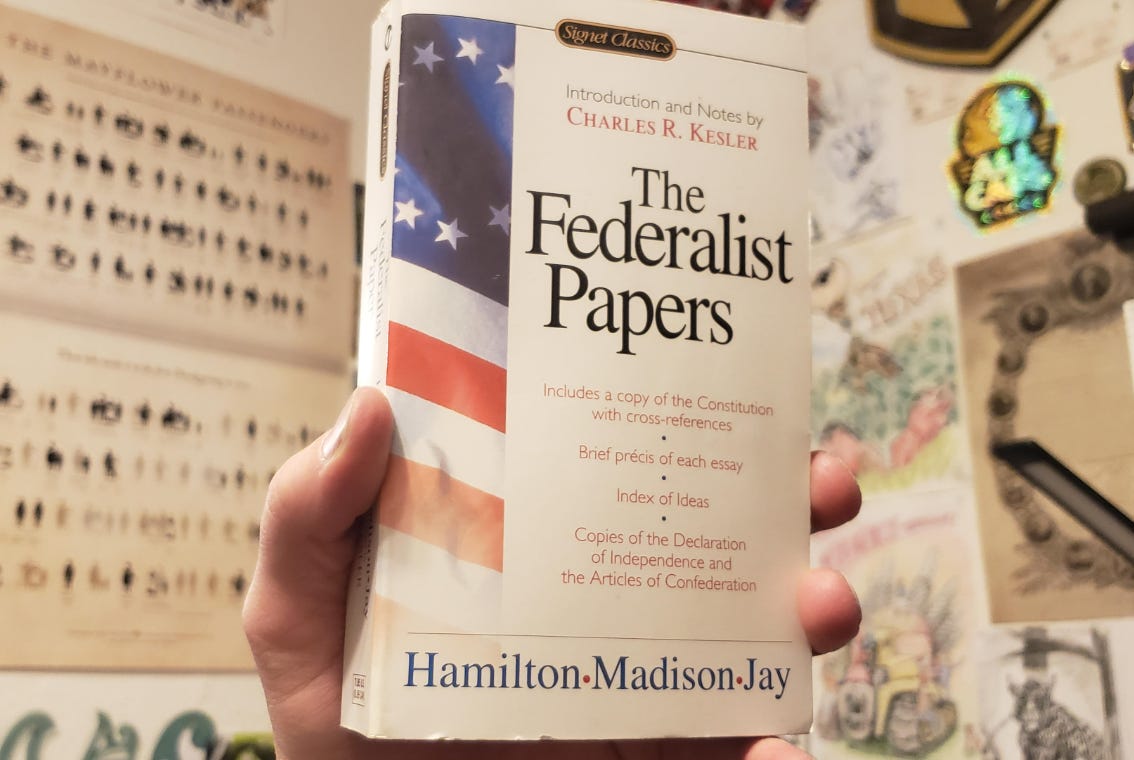
“Federalist Friday” is a six-part series wherein I share what I’m learning as I read the Federalist Papers in their entirety. Per the recommendation of my resident Ph.D., I’m using the Kesler edition, but I can’t seem to find a link to it on the ‘Zon. So I guess just follow along with whichever edition you prefer.
You know…I’m glad I’m making myself read the Papers. It gives me the ammunition I need so I can dunk on my two worst enemies: myself, and the people who disagree with me.
Graham v Graham
Why this framing? Because I could have known all of this stuff a long time ago if I had just sat down and read this book, but I didn’t, and none of my excuses for that are all that compelling. Most of them boil down to laziness. Now that I’ve got my initial grasp on the arguments of Publius, I can smugly look down upon my intellectual opponents (numerous) and say “Ha! You fool. This was covered by Hamilton/Madison/Jay in Federalist [Number]!” And there can be no greater fool than I, for I was once among them.
Graham v The World
As I creep closer to the end of this project, my contempt for the Reddit class of Internet Arguers only rises, especially because the debate style of Publius is the standard by which all policy questions ought to be measured. Think of any proposed law as the stroke of a razor-sharp scalpel, and the impacted subjects of said law are a perfectly healthy human body with a tumor in one specific place.
The law has to be executed in order to remove the tumor. But you can’t cut beyond the tumor or you’ll destroy healthy tissue, maybe even cause a fatal bleed-out. Every legal question is the process by which you determine exactly where to cut to preserve life, not harm it. The Constitution, the Bill of Rights, and our entire federal Electoral process is the result of intense debate and discussion by minds that were more thorough, more patient, and more wise than the staggering majority of their modern naysayers. They made what they made for a reason, and yes, they did consider Your Argument. (I hope they laughed at it.)
Said naysayers target the large number of voters who 1) actually show up to the polls regularly and 2) don’t actually understand the system in which they live. Most of modern politics is just dishonest people trying to whip voters into a frenzy so they’ll support whatever self-serving (and destructive) policy is on their agendas. “The Electoral College is unfair, it should be the popular vote!” or “Why does Wyoming get the same number of Senators as California?” or “It’s not fair that Texas has one Congressman per 800,000 residents while Vermont gets one per 600,000!”
The inherent implication is that the system is unfair and should be scrapped.
Nobody who votes like that has actually read and understood the laws that explain how and why we use the system that we have. They should not have the right to vote. I’m rapidly accelerating toward a belief that one ought to pass a test demonstrating that they have read and comprehended the Constitution, the Bill of Rights, and the Federalist Papers (since they won out) before being allowed to vote.
I’m just observant enough to believe some cabal of criminals would then subvert and isolate the test to their own ends, much as they have the narrative around the system in which we live. So the best defense is to continue learning the origins of the system, and work accordingly.
Madison Has Your Answers
Federalist 55 has some of the best text of the entire series because, unsurprisingly, it wasn’t written by Hamilton (Aaron Burr did nothing wrong). Madison uses 55 and 56 to lay out the exact mechanism by which the number of Congressmen is determined for each state, with an eye to the future of how populations will grow (and the number of Reps will grow accordingly.) It’s more complex than just fitting a fixed percentage and saying each state should have X amount per Y residents.
“It’s a scalpel, that’s a tumor, who cares if it’s in the lung or the brain stem? We should cut them the same.” Are you starting to understand the problem? Go read Federalist 55, I’m not going to summarize it all here, it’s a thorough argument, and he knew that it needed to be made:
In all very numerous assemblies, of whatever characters composed, passion never fails to wrest the scepter from reason. Had every Athenian citizen been a Socrates, every Athenian assembly would still have been a mob.
For a moment as Federalist 55 came to a close, I started to worry that Madison was veering off into realms of naivete with regard to how easily Congress could be subverted by foreign influence (and foreign gold). Surely someone as wise as Madison could have foreseen someone as corrupt as Eric Swalwell, right? Yet he hits us with:
The improbability of such a mercenary and perfidious combination of the several members of government, standing on as different foundations as republican principles will well admit, and at the same time accountable to the society over which they are placed, ought alone to quiet this apprehension.
To which I say “Oh, buddy…” and I look at the current state of things. That said…my cynicism rightly has its limits, and the future fourth President had a decidedly more charitable view of humanity as well.
As there is a degree of depravity in mankind which requires a certain degree of circumspection and distrust, so there are other qualities in human nature which justify a certain portion of esteem and confidence.
Republican government presupposes the existence of these qualities in a higher degree than any other form. Were the pictures which have been drawn by the political jealousy of some among us faithful likenesses of the human character, the inference would be, that there is not sufficient virtue among men for self-government; and that nothing less than the chains of despotism can restrain them from destroying and devouring one another.
You cannot make a perfect system with an imperfect people. You can, however, put checks and balances in place to make it really hard for malicious people to subject the earnest citizen to their ill will. The key is that those earnest citizens need to be involved citizens, and enforce their righteous will when they have the just power to do so. Read and vote, kids.
Lightning Round
56-58 were also Madison. He further addresses concerns about the shortcomings of the House of Representatives as a legal body, and what safeguards exist to keep it from devolving into corruption. Note that the primary force against their corruption is frequent voting intervals. Once again, citizens need to pay attention to their local elections and vote accordingly. He also addresses the initial size of the House and how it will grow as the country grows. (Though later Congress would be capped, which flies in the face of this concept. If we can’t have more Reps, we should have fewer residents, and we can start by deporting the ones who don’t have the legal right to be here…)
59-63 were Hamilton. He contrasts the Constitutional method of setting the time and place for elections with the previous form under the Articles, which was subject to manipulation and corruption. Much of these Papers are also concerned with the election of Senators, which was not a direct process back then as it is now, and could be the subject of another article.
62 and 63 were Madison again. Madison contrasts the Senate with the House; a bicameral legislature is necessary so that each State has two forms of representation in Congress: first by population, and second by statehood. This is designed to keep small pockets of the country from mogging each other, as the kids say. He specifically cites the need for a Senate based on historical precedent, because older and wiser men provide a steadying hand for the nation. The Latin word “senatus” directly translates to mean “a body of older men.” A brain-trust, if you will. Boy have we deviated from that one.
Conclusion
If you want to know how we got the Congress that we have, and what it was designed to do (or not do), this leg of the Papers is where you will find the thoroughly-detailed arguments for that. Read it and tell me what you think.
Drive safe, see you out there. BUY MY NOVELS.