

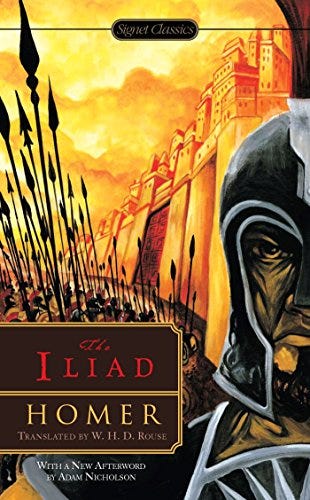
This is another ongoing series as I do a slow-read of THE ILIAD by Homer, translated by Rouse. Previous installments: book 1 | 2 | 3 | 4 | 5 | 6 | 7 | 8 | 9 & 10 | 11 & 12 | 13 & 14 | 15 & 16 | 17 & 18 | 19 & 20
Condensation
Yes, normally this would be two posts, but to be perfectly honest I am ready to put a wrap on this and get going on another book. It’s been a joy to read these stories and test-drive the summaries on my kids before giving you, dear reader, the more stylized version complete with puns and metaphors that would go over juvenile heads. Thus, I’m putting the last four books in one post, in what may in fact be more than a five-minute read. I’ll endeavor to be brief.
Book 21
Armed and armored, Achilles enters a flow-state of absolute and divine arse-whipping. Apollo won’t let him kill Hector so he decides to kill literally everyone else on Troy’s side. His most harrowing kill is Lycaon, a son of Priam by one of his multiple wives or side pieces; Achilles had encountered him earlier in the war, beat the crap out of him and sold him into slavery, only for Lycaon to eventually be returned to Priam by a neighboring monarch.
Lycaon was home in Troy for a whopping twelve days before Achilles comes across him here. Other than being Trojan, Lycaon pretty much dindu nuffin wrong. He even (rather pitifully) begs Achilles for his life, but Achilles won’t hear a word of it, because Troy (by way of Hector) did nothing of the sort for Patrcolus, knowing full well who he was. So he kills as indiscriminately as Hector did, and slays Lycaon on the spot.
The arse-whipping continues but the morale never improves. Achilles only stops when he crosses the aforementioned Xanthos, a.k.a. Scamandros, a Trojan river deity, who swallows him up and nearly drowns him. He has to be rescued by Hephaestus and Hera, and he gets right back up to flog that a$$. King Priam orders Troy to retreat back inside the walls, and most of them make it back inside; those who don’t are hurled into the (Brad) Pit(t) of Hell by Achilles.
Book 22
Hector finally faces the music and steps outside to duke it out with Achilles. He knows he is an entire hardware aisle’s worth of screwed. His previous bravado and braggadocio are all gone, because this is it. Zeus himself will not intervene here. This is all fated now. Achilles’ mother is a daughter of Nereus, an entity who is not strictly subordinate to Poseidon but rather adjacent to him, by some measurement; what we learn here as well is that Achilles’ father Peleus was a grandson of Zeus. So was Priam of Troy, along with the whole Trojan royal family (and Helen, for that matter), but since Achilles is at the reunion, Zeus leaves it to them to solve among themselves.
There’s plenty of action here. Some chariot-racing and chasing and trickery. Some intervention by the gods. (Athena helps Achilles spring a trap on Hector to force him to fight.) The first prince of Troy pleads for a dignified burial and for his body to be returned to his father, but Achilles is not having it. And that is especially hilarious after the hellish fight that Troy put up for Patroclus’ corpse, attempting to wrest it away from Menelaus and the other Greeks so they could defile and desecrate it as a war trophy. Achilles may have overreached with Lycaon but Hector has this coming.
Spoiler alert: Achilles wins. He kills Hector with a spear to the throat, takes his old armor back, and then drags his body back to the Greek camp by his ankles, tied to the back of Achilles’ chariot. From their high vantage points inside the walls, the Trojan royals watch this whole thing play out.
Let me remind you that Paris and Helen absolutely suck and they did this.
Book 23
Troy and Greece both hold funeral traditions involving twelve days of games, and we get accounts of those games here. The Greek camp is holding games for Patroclus, some of which include Achilles taking victory laps around Patroclus’ funeral mound with Hector’s dead body tied to the back of his car. There’s an outlet of rage and frustration here that, on the surface, seems to just be an expression of base-level emotions, but the formalization of it all marks Achilles’ return to order and civilization—something to bring him back from the flow-state of battle.
The civilizing effect of the funeral process puts a change on Achilles that he wouldn’t have endured before, just in time for…
Book 24
One of the few mentions of Hermes pops up here: he helps Priam to sneak into the Greek camp so he can personally confront Achilles in the middle of the night and ask for Hector’s body back. He begs on his knees for his son’s corpse. His grief moves Achilles, and he grants the king’s wish. Despite the abuse the body has taken, it hasn’t decayed or been eaten by worms—a fate the men are well familiar with after a decade of brutal war, and one that Achilles specifically asked the gods to stay from Patroclus.
Seeing how the gods favored Hector’s and Patroclus’ bodies alike, Achilles sends Hector back with Priam, and they share a parting meal. The Trojans mourn their fallen hero, and so ends The Iliad.
Closing Thoughts
You might be surprised to know that the Trojan Horse—the most infamous visual element of the Siege of Troy, and thus The Iliad—does not appear in The Iliad. It is, itself, an incomplete story. It starts after Helen has been in Troy for almost a decade and ends before Greece has gotten inside the walls. So what’s the point of the story?
I’m no expert on Homer or this era of Greek history. I do own a copy of The Landmark Herodotus and I’m going to read it over the next several months, along with The Odyssey, because what could be more Graham than biting off too damn much? I’m good at like, four things and that’s one of them.
That said, I would assume that the linear analysis of this story, and the need to bracket the war with its cause (Helen’s flight) and conclusion (Troy’s fall) is the machination of posthomeric editorialization. It’s been 3200 years since this war happened and 2500 years since a blind man converted it to a poem to be performed in two dozen parts, aloud, to a meter. I’m making some guesses here. What was the value or purpose of this tale then, and what lessons still apply to us today?
Rouse offers up some observations in his afterword that I agree with, that it’s a story of barbarism (Greece) versus true civilization (Troy) but the conflict manifests between two imperfect, mortal organizations, who each borrow from the other’s playbook. Greece has aspirations of wealth, glory, and empire—the things people think of when they look at Troy’s riches and greatness. Troy has pride and isn’t ashamed to defend its trappings with barbarism of their own. Both sides pray and sacrifice to the same roster of gods, though these themselves play favorites.
If refinement and civilization are the mortal attempt at godliness, than barbarism is a sprint in the other direction, and for my money there is a warning here: you can’t be both. Especially not when both sides profess the same faith and structures of worship.
But that’s just one of scores of lessons I would take away from this text. I see why there are entire academic tracts dedicated to it, and that some professors spend decades teaching it to class after class of students. I don’t want to give you all my thoughts or takes.
I want you to read The Iliad if you haven’t, and decide for yourself what your own thoughts are. Tell me. Let’s bounce them off each other in the comments.

Visit Nauvoo Supply to order HEARTLANDERS, the most American novel I’ve ever written. It’s like if National Treasure happened during Fallout with G.I. Joes.
My Amazon page has my other books, including FOSSIL FORCE for young boys and Engines of Liberty for all ages.
I post several times per week on YouTube.
Subscribe here for more book reviews and for articles on what I continue to learn as I read.