

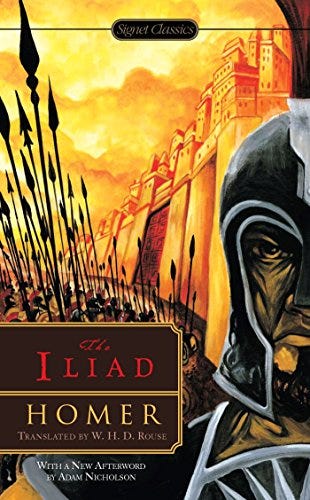
This is another ongoing series as I do a slow-read of THE ILIAD by Homer, translated by Rouse. Previous installments: book 1 | 2 | 3 | 4| 5 | 6 | 7 | 8 | 9 & 10 | 11 & 12 | 13 & 14 |
Book 15: The gods play with their food
Zeus wakes up after Hera’s masterminded effort to put him to sleep by having vigorous marital relations with him, because even if he can conjure up the lightning, he’s still a lightweight in the sack. (He makes up for low T with high volume and lack of preference.)
They have a bit of a spat over this, but it doesn’t get so bad that the neighboring gods in the divine trailer park have to call in a domestic disturbance. Zeus doesn’t like that he was tricked and he also doesn’t like seeing Poseidon down there helping the Greeks against his precious Trojans. Hera swears that she didn’t encourage Poseidon to get involved (though she knew what he was up to.) Zeus believes her, and then lays out what’s going to happen from here:
He knows Hera wants her Greeks to take Troy. He’s going to hear his Trojans’ prayers, but he’s also going to accept his wife’s wishes. On top of that, he’s amenable to Achilles, who is at odds with the king of Greece, so the outcome is complicated but he knows how to make it all work.
The Trojans will appear to win for a while. Achilles, who currently refuses to fight, will join the fray when his best friend Patroclus is killed by Hector. Achilles will kill Hector, one thing leads to another, and ultimately the Greeks will sack Troy.
My favorite part of book 15 was a discussion between Zeus and Hera about the fate of Sarpedon, a demigod who was one of Zeus’ many bastards. He was fated to die against Patroclus. Zeus debated whether to spare him, but Hera said it was a bad idea since the gods had several bastards on both sides of the fight, and if he played favorites with his, they would all want to spare theirs. Zeus was, in this way at least, fair. He lamented it because Sarpedon was going to die far away from his native soil, but he would make it up to him by having his body spirited home with full honors.
Meanwhile up in Olympus, Zeus’ mandate that the gods quit getting involved is still in effect. Ares learns that one of his sons was killed in battle, but Hera tells him he can’t do anything about it and that nobody can get involved without the permission of Zeus. On that note, she sends Iris and Apollo to go check in with the Thunder Daddy.
Despite Hector getting smashed with a giant rock by Ajax (seriously they all love doing this to each other), he’s still alive, though he needs his hit points revitalized and a healing potion would not go amiss. This is why Apollo was sent from above. He casts Divine Regeneration and fortifies Hector for Round Six or whatever we’re up to, so that he can continue frustrating the Greeks. Zeus and Poseidon then proceed to dump out their toy boxes on the beach and smash all their best action figures together, leaving pieces all over the place along with shattered hopes and dreams.
By the time the dust settles, Hector is once again on top and he has the Greeks backed up to their ships. Patroclus, who has been on the periphery of all this, decides to pay a visit to Achilles with an idea.
Book 16: Hector squishes an ant
“Graham, what are you talking about?”
Okay so the soldiers under Achilles’ command are called ‘Myrmidons’ and I’ve heard that name my whole life and never actually knew what it meant. I just knew they were one of a dozen types of Greeks and they were really good soldiers. It turns out the etymology of the word goes back to the Greek name for ants. That’s according to Britannica, so who knows, but the reasoning is sound; they’re effective, they fight with sound tactics and strong coordination, and they complete tasks as ordered. Ergo, ants. Myrmidons.
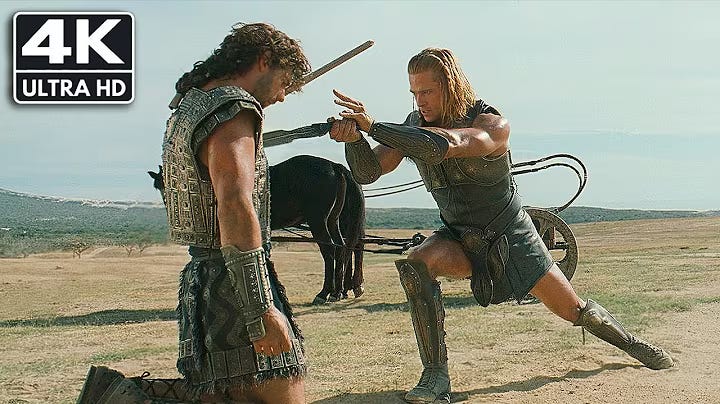
Patroclus, who is the oldest and closest friend of Achilles, takes the idea planted in his head a few books ago and tells Achilles that he wants to lead the Myrmidons into battle against Hector. Once again I compare this to the scene from Troy (2004) and I ask myself how Wolfgang Peterson misinterpreted it so egregiously. In the movie, Patroclus stole the armor, led the Myrmidons without them knowing, fought Hector, and died. Both the Myrmidons and Hector were shocked when they realized it was Patroclus, whereas in the actual account, Achilles supported the idea, willingly gave Patroclus the armor, sent him against Zeus-backed Hector, and expected him to win. Hector knocked his helmet off, realized he wasn’t Achilles, THEN killed him and gloated super hard that the kid thought he could take on Troy’s greatest warrior.
Hector wasn’t apologetic about the mistaken identity. He stunted on that hoe.
Here’s the thing though: Hector had help. Apollo, in disguise, fought alongside Hector and even issued warnings to Patroclus multiple times to withdraw. Patroclus didn’t, so Apollo struck him in the back like a b**** and that’s what dislodged his helmet. Patroclus, who was not a demigod like Achilles, 1v3’d Hector and only went down because the gods cheated. That’s how good the Myrmidons were.
Pactroclus’ death immediately starts a fight-within-a-fight as the Greeks try to recover his body, and the Trojans instead strip away his (Achilles’) armor. Hector then puts the armor on and peacocks around on the battlefield, as Ajax and Menelaus retreat with Patroclus’ corpse.
WOLFGANG PETERSON HAD HECTOR PLEAD IGNORANCE TO ACHILLES OVER THE IDENTITY OF PATROCLUS. LOOK AT THIS S***.
(Blood warning.)
Anyways, Hector just royally screwed the pooch and sealed his death warrant, because he did the one thing that would get Achilles off his boat and back into the fight.
Coming soon.

Visit Nauvoo Supply to order HEARTLANDERS, the most American novel I’ve ever written. It’s like if National Treasure happened during Fallout with G.I. Joes.
My Amazon page has my other books, including FOSSIL FORCE for young boys and Engines of Liberty for all ages.
I post several times per week on YouTube.
Subscribe here for more book reviews and for articles on what I continue to learn as I read.