

Like the Five-Minute Iliad, this series will cover Homer’s other famous poem, but in fewer installments. Part 1 | 2 | 3 | 4 |
I am using the Butler translation. Subscribe to follow along. For another excellent story about a man trying to get home to his wife amidst a divine conflict, read HEARTLANDERS.
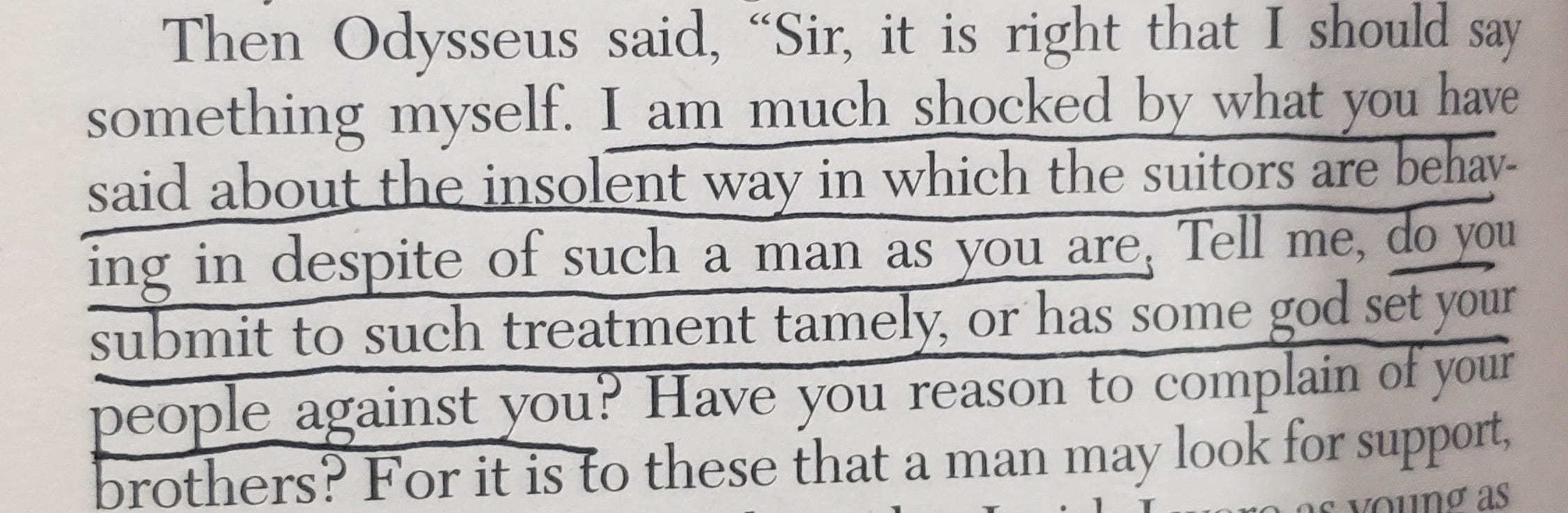
I want to emphasize something from book 16 that I didn’t touch on last week, because it’s doubly relevant in this week’s summaries:
All summer long, as people geared up to see Nolan’s Odyssey, the political takes keyed in from both sides of the aisle. The Left insisted that the story was about the importance of being hospitable to strangers (a misreading) and the Right was mad about all of the stunt-casting, what with black Helen, trans “Achilles” (they were wrong), and other modernisms that didn’t make a ton of sense. As is pretty much always the case, if you do your own reading of the actual source material and make up your own mind, you’ll realize that both takes are morally bankrupt and also pretty stupid. Furthermore, there’s actual hay to be made about what’s going on.
Take the above excerpt, for instance: Odysseus is back on Ithaca, talking to Telemachus his son, and catching up on the goings-on in his house. When he hears about the suitors camping out there, trashing the place, disrespecting his wife, threatening his son, and mowing through his stores of food and wine, he asks his son why he’s putting up with it. Either Telemachus tolerates the abuse willingly, or he’s unable to resist it because the gods favor his enemies. (This idea is intrinsically interwoven in both Odyssey and Iliad.)
If the Right at large (and especially the detestable Podcast Class) had any cultural literacy—to say nothing of integrity—they could certainly ask why this idea didn’t gain further exploration in the film. But that doesn’t garner clicks from morons, nor does it redeem promotional offers on special sponsored items, promo code SAVEAMERICAVPN, but I digress.
You can’t separate the gods as motivating forces from these stories. You just can’t. And the reasons why are still relevant 2500 years later.
Book 17
Telemachus returns from the swine herd to his father’s palace, where Penelope chides him for having left, but he stands his ground and projects some of the aura that you might expect of leadership and royalty. He tells her about his journey to Pylos and Sparta (I think I accidentally said “Pyros” last week) but he doesn’t tell her that Odysseus is home—he and Dad are keeping that on the DL. Even so, his new friend Theoclymenus, interpreter of bird sign, offers a prophecy that said Odysseus is already home.
As this happens, Odysseus and Eumaeus are en route to town. They cross paths with a goatherd, Melanthius, who’s a major tool; he insults the beggar (Odysseus) and kicks him, prompting Odysseus to seriously consider beating the man to an absolute pulp, but he remembers his larger objective and keeps his identity a secret. There’s a recurring idea that if he stunts on too many hoes before the time is right, people will guess who he is, so he needs to take the abuse. Melanthius also threatens to sell Eumaeus into slavery to someone else, because you could just do that back then.
Odysseus can take humiliation, but what he can’t take is hunger, so he goes to his own house where the suitors are taking up all the extra space, and he starts begging for food among them as a way to judge their character. The good ones will help him and the bad ones will be jerks about it. (This is where the “misreading” comes in; they definitely understand that they should be hospitable to strangers, only because they might be gods in disguise, but the mechanism does work as far as sorting the bastards from the ones who are less so.)
Antinous, to the surprise of no one, is the worst of the suitors, and the greediest with “his” bread—but Odysseus calls him out by telling him it’s not actually his food that he’s eating, and that’s the irony of it all. Antinous is lording over someone else’s property. Do you see what I mean? The Right could make a capital issue out of this message if they had any integrity when it comes to discussing the arts.
As such, Antinous actually throws a stool at Odysseus. It bounces off of him and doesn’t hurt, but he pretends it does, because again he’s trying to hide his identity. The aura of Odysseus precedes him.
Final note for book 17: while most people don’t recognize Odysseus, his old dog Argus does, and wags his tail happily before dying (the dog is at least twenty years old, damn). Penelope requests a meeting with this new beggar/stranger in the house, and Odysseus gets word to her that they should wait until night, because they should meet in secret.
Book 18
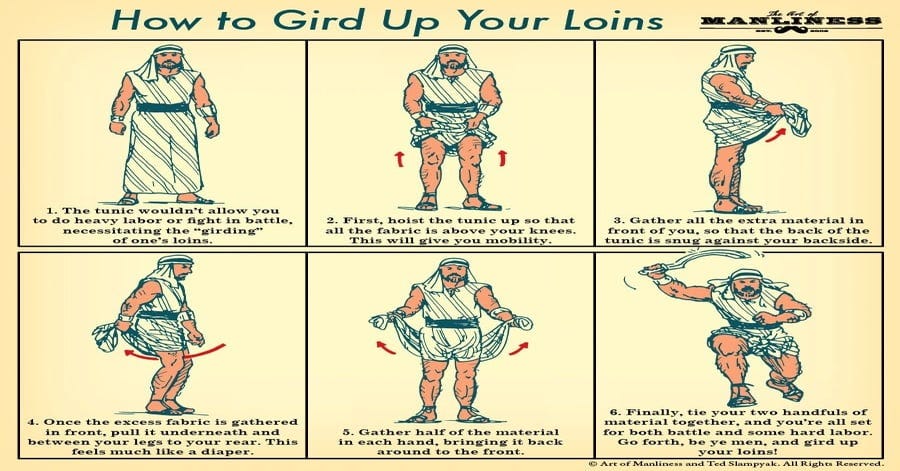
The suitors debate how to handle the arrival of this assertive, if mysterious, new beggar, and they resolve upon a solution 2500 years in the making: Grecian Proto-Bumfights. Let’s have this old man duke it out with a local fat loser called Irus, who we assume is buff just because he’s huge, but he’s actually just corpulent and arrogant, and he’s about to Find Out. The winner of this scrap will get a full feast in Odysseus’ house, with meat and bread and wine. Odysseus plays coy, like “Oh nooooo you’re so yoooooung and I’m so oooooold you’re going to beat my aaaaaaaass…” but then he girds his loins and reveals the indomitable nature of his sleeper build, and the suitors are like “Daaaaaaaaaaaamn Grandpa’s on that Swole Patrol…”
Irus thinks he’s still got this, until he throws a swing that barely does anything, and Odysseus claps back with a one-hitter-quitter that has him spitting blood in seconds. Dinner is served, b****. Don’t mess with old guys who’ve seen it all.
On a prompting from Athena, Penelope goes downstairs to hang out with the suitors and Telemachus. There’s some conversation there, the basic takeaway of which is that they are terrible people and shouldn’t act the way they have been, but they’re drunk whores and justice may be right around the corner.
Book 19
This book was one of the best in the entire cycle and if I shared every bit I enjoyed, I’d double the length of this article. I’ll try to be brief.
Penelope finally has her conversation with Odysseus—he tells her his name is Aethon, brother of Idomeneus from Crete, so he keeps his origin story the same as when he told Eumaeus. He tells her a story about encountering Odysseus and gives her details that prove it was him—the entire conversation is essentially him telling her that Odysseus is alive and back without revealing his identity straight up. At one point Penelope even has a servant woman wash Odysseus’ feet and she notices a distinguished scar from an old boar attack that everyone would recognize, but Odysseus threatens her not to reveal who he is.
The exchanges between husband and wife were excellent and very moving in this chapter. Odysseus makes plans to kill all those who offended his wife and his house in the years he was gone. This is where I cooked up the takeaway in the title: Odysseus was punished by Poseidon for what he did to Polyphemus, but he was eventually allowed to return home because the suitors will be punished by Athena (through Odysseus) for what they’ve done to Penelope and Telemachus.
Several lines in this passage focus on the maids who were raised by Penelope but then went on to whore around with the suitors and engage in their disrespect of Odysseus’ estate. Telemachus participated too when he was younger, but as he grew up and took on his father’s image, he also began to inherit his wisdom (through no small help from Athena) and embraced the legacy that was left to him.
You’ll see why I find this such a powerful series of events in the Odyssey.
Book 20
Odysseus sleeps in his own house but really he’s just lying there awake, pondering on how to kill the suitors. He has Telemachus empty out the armory and hide the weapons elsewhere in the house so that Odysseus can trap the suitors inside and kill them with impunity.
There are a lot of lines in book 20 about respecting one’s traditions and upbringing; forget the importance of hospitality to strangers, the real thrust of this book is the importance of reverence for your ancestry and your inheritance.
The herdsmen arrive with livestock for a feast, there’s some more quibbling between the suitors and the house, and Theoclymenus offers up another vision/omen that things are about to get bloody up in the heezy.
Up next: Penelope brings the men a bow and some axes, but what ever for?

Visit Nauvoo Supply to order HEARTLANDERS, the most American novel I’ve ever written. It’s like if National Treasure happened during Fallout with G.I. Joes.

My Amazon page has my other books, including FOSSIL FORCE for young boys.
Find my video reviews on YouTube.
I finish around a hundred books a year, most of which are audio because of my job.
Subscribe for more reviews and articles on what I’m reading.