

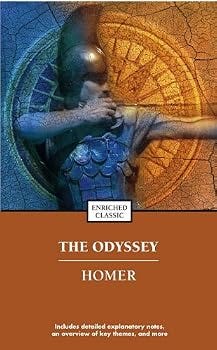
Like the Five-Minute Iliad, this series will cover Homer’s other famous poem, but in fewer installments.
I am using the Butler translation. Subscribe to follow along.
Introduction
Sometime late last year I decided to read The Odyssey, and with it, The Iliad, since they go hand-in-hand. None of my fellow booklovers have ever expressed a strong preference for The Aeneid but I added it to the list anyway since it rounds out the cycle. I’ll cover that one after this.
You probably know the skinny on The Odyssey; Odysseus, king of Ithaca, spent ten years at war on behalf of Agamemnon’s Greece, and his ingenuity was instrumental in the sacking of Troy. Somewhere on the way home he got lost, and it was another ten years before he returned to Ithaca, making his absence twenty years in all. During that time his young son, Telemachus, grew into a man, and his wife Penelope had to fend off a horde of would-be suitors who wanted the Ithacan throne.
It’s a story of yearning, of endurance, of hope, and of trial. If Iliad was a story of bad men fighting a pointless war while the gods watched in amusement, pitching in here and there as they saw fit, Odyssey is a story of a good man in a bad world who cannot be kept from home—despite what the gods have to say about it.
Book 1
The Olympian gods are chilling up on their mountain, recounting the story of Odysseus now that several years have gone by after the Trojan War. The Greek kings have returned home, save for a few who died en route, but unique among them is Odysseus, who has been trapped on an island by the goddess Calypso, because she’s totally down bad for him. (Homer has a tendency to randomly play up the greatness of whichever figure is his subject in the moment, and while he had praise for Odysseus’ virtues in Iliad, he’s elevated over pretty much everyone in Odyssey.)
In fact he’s so cool that Calypso is trying REALLY hard to get him to forsake Ithaca and spend all eternity on her special island, just constantly having sex with her, and he’s like nah, I got Anne Hathaway at home, I’m good. Yet he can’t get home because despite most of the gods being in his corner, Poseidon is pissed at him for reasons yet unknown. Thus, Odysseus can’t get back to Ithaca by sailing.
Athena, who’s always had a soft spot for Odysseus, convenes with Zeus and they agree to do what they can on Odysseus’ behalf. With permission, she bounces out of Olympus, disguises herself as “Mentes” (a wizened advisor) and checks in on Telemachus at Ithaca. Things are bad there: a host of suitors from neighboring kingdoms have crashed the place and are eating all of the livestock, drinking all of the wine, and constantly pestering Penelope to marry one of them.
With Mentes/Athena’s encouragement, Telemachus decides it’s time to do something about these guys, and since he can’t drive them out (he’s not technically the man of the house, not while Odysseus could potentially be alive) he has to find another way to get them gone. They’re all too hungry for his dad’s wealth and too horny for his mom, he can’t keep living like this. A plan starts brewing in his head.
Book 2
Telemachus confronts the suitors living in his father’s house, and they air out their grievances one to another. Telemachus is pissed that they’re consuming his estate’s material wealth (and rudely so), while the suitors claim Penelope is leading them on by not picking one of them. (Custom, tradition, and law all required that Ithaca have a king, and without confirmation of Odysseus’ death, the place was in a holding pattern.)
The suitors are legion, but the main bad guy among them is Antinous, who excels at coming off like an absolute tool. Reading a single page of his dialogue, I was immediately certain that Robert Pattinson was perfect to portray him in the new movie (while simultaneously convinced that Tom Holland was miscast as Telemachus, but I haven’t seen it yet.) Antinous tells Telemachus to his face that Penelope is just being a tease, and has been for several years, but he’s committed to this for the long haul and he is totally gonna hook up with Telemachus’ mom.
Telemachus would be well within his rights to kill one (or several) of these guys, but there’s that whole “what a man can do, and what a man can’t do” aspect to it. The suitors simply outnumber him and he can’t muster sufficient force to manually repel them. Thus, he has to sneak out with a crew and take an expedition to find his father, and includes Athena, still disguised as Mentes/Mentor. (Both were actual people that Telemachus knew, but for the bulk of the voyage here on out, she pretends to be Mentor. This role is the origin of the word as we use it today.)
Book 3
First stop: Pylos! Telemachus visits Nestor, who was an advisor in spiritual matters (and other things) to Agamemnon, who is currently dead. Nestor is a great man, honest and forthright, and believes in the full pantheon of gods. He entertains Telemachus, tells him that the gods won’t reveal to him whether Odysseus is dead or alive, and then sits down to recount his own exploits in the Trojan War.
As Nestor tells Telemachus who made it back and who didn’t, he mentions Orestes, son of Agamemnon, who avenged his late father by killing his murderer, Aegisthus. Telemachus is rather blunt in saying that he thinks his father is most likely dead, that even the gods couldn’t save him, and that he’ll never return.
My personal takeaway is that Homer (or Butler, if you will) told the story in this way deliberately; it’s not a mistake that Orestes avenging his father was the last tale told before Telemachus started talking. He may not avenge Odysseus outright, but the fates are not yet done with him. There’s some rhyming there.
Other than this, Nestor isn’t all that helpful in the end, and suggests that Telemachus sail over to Sparta and pay a visit to Menelaus. Nestor’s son Pisistratus will roll with him.
Book 4
Of all the injustice to proceed from the Iliad, the fact that Helen—of all people—made it back to Sparta with Menelaus seems the most egregious to this reader. But she’s there, reunited with the husband she abandoned for Aphrodite’s Trojan fop Paris. There is, somehow, affection between them, but Menelaus’ language toward her is laced with undertones of “you dumb b****” and her responses have a hint of “ha ha, yes.” Or maybe I’m just projecting. Anyways.
Telemachus pulls up in the middle of a wedding feast. Menelaus’ daughter is marrying Achilles’ son, so that house is gonna have some LINEAGE. Helen figures out who Telemachus is because of his resemblance to Odysseus, so he joins the feast. Menelaus pampers Telemachus—his house is super loaded—and they get to talking about the return from Troy. Menelaus himself struggled for eight years to get home, during which time Agamemnon was betrayed and murdered, explaining why Menelaus inherited so much wealth. Double-edged sword, that.
They discuss the specifics of how the war ended, and here’s where Helen weighs in: she tells Telemachus that Odysseus disguised himself as a beggar and entered Troy, found her, and told her he and the boys were gonna sneak in. She agreed to help because secretly she was ready to go home, and she felt bad for being a dirty, dirty whore who cheats on her husband. Hot chicks really can just get away with it, can’t they. Anyways. Odysseus went back to the beach, got everyone ready in the wooden horse, and camped out along with them until they were inside. Funnily enough, before bringing it in, the Trojans tested it by sending out that two-faced dog Helen.
She walked around it and called out the names of men inside, even going so far as to mimic the voices of their wives, because she knew all of them, to try to get them to break. Odysseus had to put hands on one dude because he was thirsty and almost answered the call. But the ruse worked in the end, and the Trojans took the horse inside the city walls. Troy is sacked, Helen is recovered, and the Greeks get ready to go home.
The problem is that a lot of them displeased the gods with their conduct during the war and the sacking. Thus, when Odysseus and the others finally got underway, he and the men under his command had to contend with that displeasure, and the delays started to stack up. Menelaus recounts his own problems, and if his were that bad, Odysseus must have struggled similarly. Here we find out that Ajax died too, mostly of hubris, and there’s the aforementioned death of Agamemnon. Before Menelaus came home, he found out that Odysseus was being held on Calypso’s island and couldn’t go home. Menelaus was only spared because he was Zeus’ son-in-law, meaning that at long last, there was finally some upside to marrying Helen.
Telemachus thanks him, leaves his horses in Sparta (they’re not great on the ship), and resumes his journey. Back in Ithaca, both Penelope and the suitors—led by Antinous—discover Telemachus is gone. Penelope laments the potential death of Odysseus’ bloodline, while Antinous leads the suitors on a trip to chase down Telemachus before he can spoil their designs on his throne.
Conclusion
I saw a dumb meme somewhere online that started out half-true and then went full-tard, so much so that it must have been bait. (I did not partake.) The gist of it was that “hurr durr the Trojan Horse isn’t in the Iliad” (true) “it was invented 700 years later by Virgil in the Aeneid” (false). I put a lot of details in my summary of book 4 because it was so intriguing and it directly described the end of the war, which we didn’t see in Iliad. Helen’s account of the horse was cool, and disproves whatever BS that meme was trying to peddle.
After finishing Iliad—and recapping each chapter to my kids, who got really into it—my son said “Wow, are they going to make another one?” which made me laugh. The idea that something like a novel could be published 2,700 years ago just doesn’t click with him and I think that’s cool. He figures it came out this year or something.
But Odyssey essentially functions as a sequel, and the fourth book really connects it to Iliad’s closing events. One thing that helped me understand the context of the events at Ithaca—the awaiting suitors, and such—was Dave Butler’s video from a few weeks ago, explaining why Penelope couldn’t replace Odysseus on the throne and why the suitors were pressing her to pick one of them.
I highly recommend Dave’s channel, he puts out around one video per week and he’s one of the smartest men I know. He breaks all that down and makes it easy to understand. (Man, this video really went gangbusters too, it got like 10x the views of anything else he’s done.)
I’ll read the next four books this week. I liked the slow read of the Iliad and I’m still taking detailed notes on Odyssey, but I’m anxious not to take as long on this project. Stay tuned.

Visit Nauvoo Supply to order HEARTLANDERS, the most American novel I’ve ever written. It’s like if National Treasure happened during Fallout with G.I. Joes.

My Amazon page has my other books, including FOSSIL FORCE for young boys.
Find my video reviews on YouTube.
I finish around a hundred books a year, most of which are audio because of my job.
Subscribe for more reviews and articles on what I’m reading.