

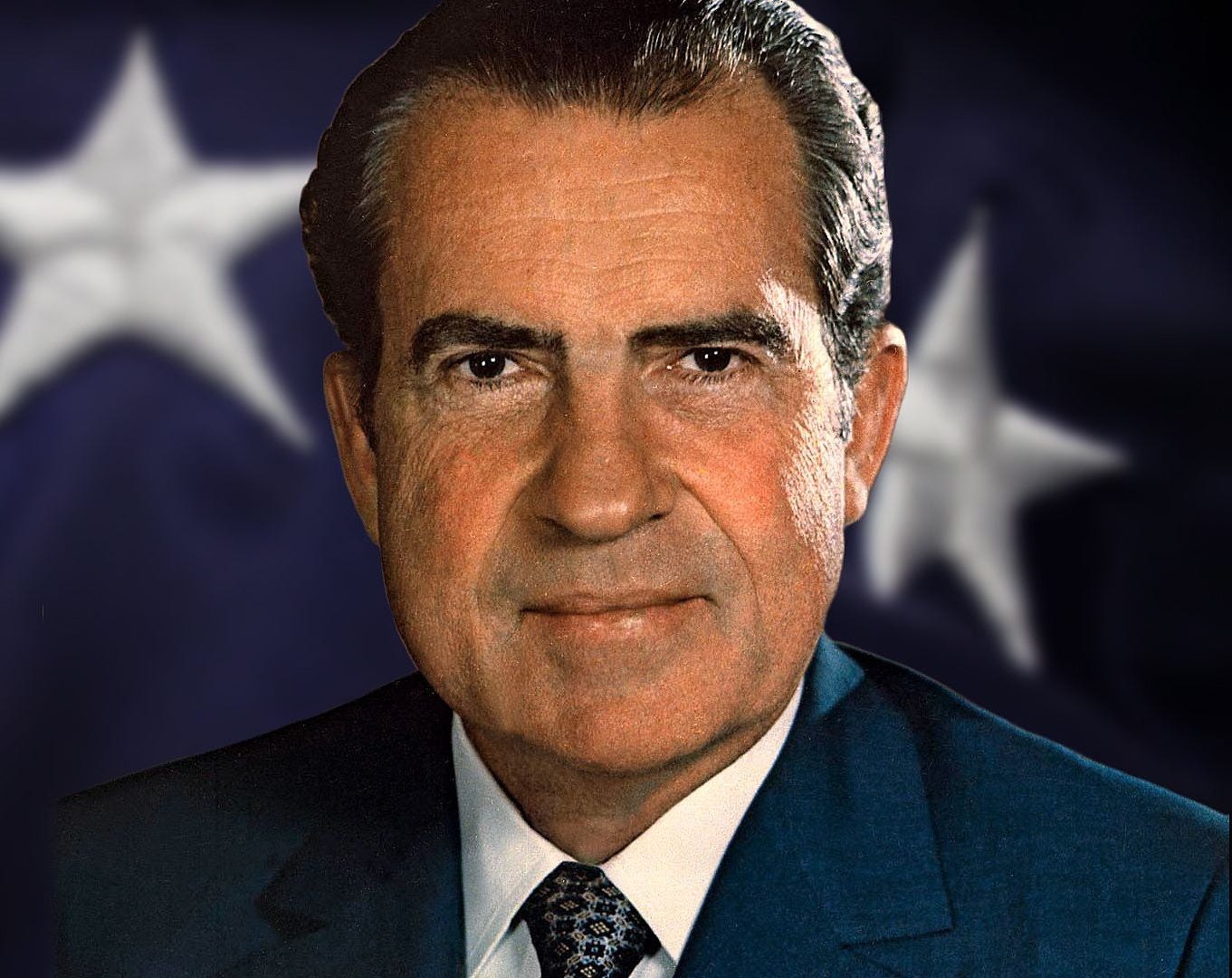
“Electoral Brawlage” examines the first election and inaugural address of each U.S. president from Washington to Trump. This project will conclude in December 2026.
If you like shootouts, car chases, dogfights, and American history, read Heartlanders!
Subscribe to get these articles via email. Become a paid subscriber to help me buy more books.
To call 1968 a chaotic year would be a tremendous understatement. The election was marked by violence, protests, assassinations, and a general sense of unease about the future, even with America’s bicentennial right around the corner.
On the Democrat side, Lyndon B. Johnson chose not to run for a second term. Even though he finished out JFK’s first, he did so with little enough time in office that he qualified for a second full term under the 22nd Amendment. (If he had served more than two years of the term to which JFK had been elected, he wouldn’t have qualified, but it was moot either way—he wasn’t running.)
The popular Democrat that year was Robert F. Kennedy, John’s brother, who was winning the primary contest quite handily. Unfortunately he was assassinated by a Palestinian right after winning the California primary; the murderer, Sirhan Sirhan, was demonstrating his moderate Middle Eastern method of disagreement over RFK’s support of Israel during the Six-Day War. It’s a cultural thing, we wouldn’t understand, we should probably import more of those people here until we do. It’ll be fine. (Sirhan’s death sentence was commuted, I don’t know why we put up with this.)
Anyway, with RFK assassinated, the nomination went to Hubert Humphrey, the incumbent vice president under Johnson. (This, despite RFK’s main challenger being Senator Eugene McCarthy of Minnesota for most of the primary.) Humphrey picked Edmund Muskie, a Senator from Maine as his running mate.
On the Republican side, Richard M. Nixon was back for another go. He’d been in Congress, the Senate, and V.P. under Eisenhower, then lost to JFK in 1960. He ran unsuccessfully for governor of California in 1962 and after that loss, most people thought he was done with politics. Like a west-coast revenant, he came back for another round in ‘68, choosing Spiro Agnew—governor of Maryland—as his V.P.
There was a third party, the American Independents, that comprised a sort of “final hurrah” from the rebellious South on the national stage: their ticket was led by George Wallace (former Alabama governor) and Curtis LeMay (USAF General out of California.) Their platform focused heavily on returning self-government to the states, limiting the power of the Fed, and empowering law enforcement in a time when crime was surging everywhere. Much of this was related to race-mixing issues and was downstream of federal policies like forced busing in schools.
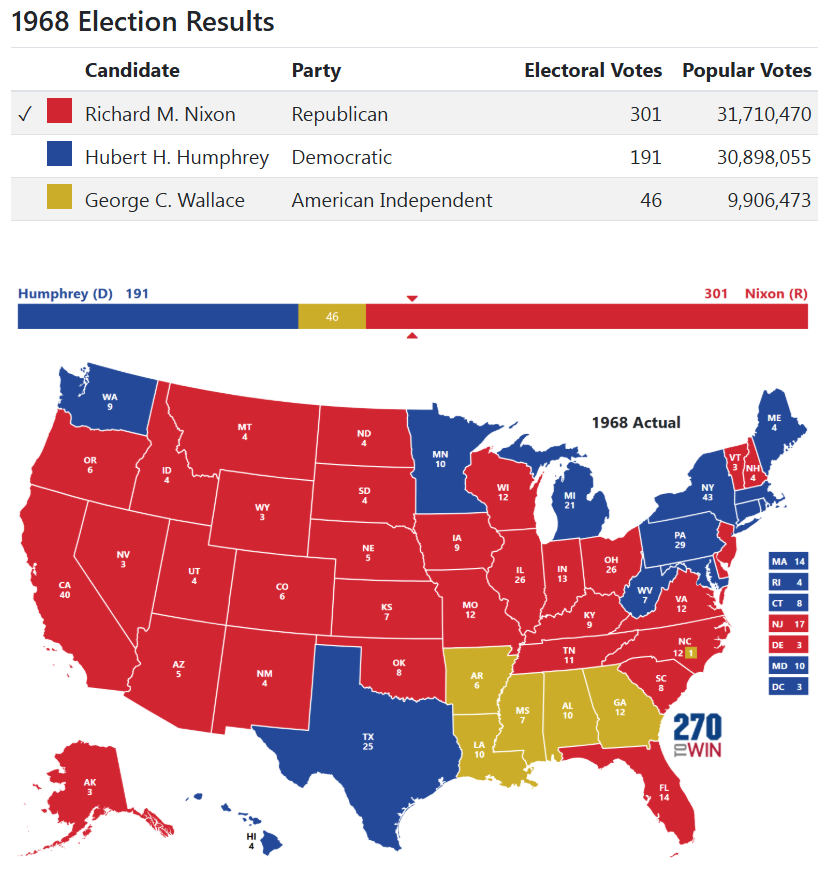
Nixon won a strong Electoral count at over 300; Humphrey somehow took Texas and half the Rust Belt, and his home state of MN (along with Muskie’s, ME.) Nixon delivered CA, Agnew did not deliver MD. Nationwide, Nixon’s popular vote margin (irrelevant) was around half a million.
While Wallace racked up an impressive 46 EVs (and was the last third-party candidate to do so) he didn’t really put a dent in Nixon’s momentum, and even if he hadn’t been in the race, he wouldn’t have given Humphrey the Electoral win. It’s hard to say what the popular breakdown would have looked like without him, but that’s okay because it doesn’t matter. It never matters. If it matters to you, cry harder.
While my rule on third-party candidates is usually “they deliver power to the worst candidate,” Wallace’s run was a unique exception driven by regional differences in national interests. If you overlay the yellow states with The Map (you know The Map), you can guess what those unique differences were. I digress.
Nixon’s Speech
The issues of the day were race relations, the Civil Rights Act (which passed four years prior), the Vietnam War, rising crime, and the high-profile assassinations of Robert Kennedy and Martin Luther King, Jr. The space program was also in full swing and the Apollo missions were set to put a man on the moon in just six months.
Read the speech here.
Nixon’s focuses were twofold: progress and peace. Not “progress” in the sense of excessive government and social liberation, but cultural and civilizational progress, paired with the improvement of technology and the quality of life for the world. He wanted peace with other nations, not just victory over them. This ideal would be tested during his tenure.
This means black and white together, as one nation, not two. The laws have caught up with our conscience. What remains is to give life to what is in the law: to insure at last that as all are born equal in dignity before God, all are born equal in dignity before man.
He wanted “equal dignity” between the races, a noble goal that struggles in the details and the execution to this day, for reasons beyond the scope of this article. Matching rhetoric with reason would be the only path to success, and people needed to lower the temperature when it came to their political passions. (This is still true.)
The greatest honor history can bestow is the title of peacemaker. This honor now beckons America--the chance to help lead the world at last out of the valley of turmoil and onto that high ground of peace that man has dreamed of since the dawn of civilization.
If we succeed, generations to come will say of us now living that we mastered our moment, that we helped make the world safe for mankind.
This is our summons to greatness.
I believe the American people are ready to answer this call.
Government has a role to play in these things, but Nixon also acknowledged the limits of what government could accomplish on its own. Much of this work would fall upon ordinary citizens to achieve. Americans couldn’t simply vote a leader into power who would fix all their problems; in the majority of cases, they need to vote a leader who will stay out of their way and then do great things themselves.
I do not offer a life of uninspiring ease. I do not call for a life of grim sacrifice. I ask you to join in a high adventure--one as rich as humanity itself, and exciting as the times we live in…
Our destiny offers not the cup of despair, but the chalice of opportunity. So let us seize it not in fear, but in gladness-and "riders on the earth together," let us go forward, firm in our faith, steadfast in our purpose, cautious of the dangers, but sustained by our confidence in the will of God and the promise of man.
You can watch a full video of it here:
Visit Nauvoo Supply to order HEARTLANDERS, the most American novel I’ve ever written. It’s like if National Treasure happened during Fallout with G.I. Joes.
It’s short, it’s fast, it’s full of smarts and action, and you’ll love the characters.
If RFK Sr. hadn't been shot, I'm sure he would have been elected. This would have left Nixon a two time loser, and no one outside of Washington, D.C. would ever have known what Watergate meant.