

“Electoral Brawlage” examines the first election and inaugural address of each U.S. president from Washington to Trump. This project will conclude in December 2026.
If you like shootouts, car chases, dogfights, and American history, read Heartlanders!
Subscribe to get these articles via email. Become a paid subscriber to help me buy more books.
Oh boy. This one’s a doozy.
I will once again refer you to the 1876 election of Rutherford B. Hayes as a model for electoral insanity, with an ending that a Hollywood screenwriter couldn’t come up with: the margin was so razor-thin that the election had to be decided by a Congressional committee of 15 members, divided almost evenly along party lines, and that came to a conclusion along those exactly lines 8-7. And this decision came down two days before the inauguration on March 4th, 1877.
This makes the 2000 election one of the top three craziest elections in our nation’s history, and the first of two in my lifetime. It didn’t go to Congress, but it did go to SCOTUS, who made a determination based on existing law, confirming Bush as the winner in Florida. But boy was it close.
So what the hell happened? Let’s start at the beginning.
The Primary
On the Democrat side, the obvious move was to pass the torch to Vice President Gore, who enjoyed Clinton’s slightly diminished popularity (due to public blowback from the Lewinsky Scandal, and a slowing economy). The dot-com bubble had burst, gas was rising, and the Fed was raising interest rates, but the modest recession wouldn’t officially start until March of 2001, so this election could really just be a popularity contest between Team Blue Donkey and Team Red Elephant.
Gore faced a modest challenge from New Jersey Democrat Bill Bradley, but easily coasted to the nomination and selected Senator Joe Lieberman (New York) as his V.P. pick. This made Lieberman the first Jewish person to ever land on a national presidential ticket for a major party.
The GOP had a more open primary to see who would challenge the Clinton machine. Many threw their hats in, including Utah’s perma-senator Orrin Hatch and America’s creepy grandpa John McCain (Joe Biden was America’s creepy uncle), but only McCain poised a serious challenge to the eventual winner, Texas governor George W. Bush. Voters preferred governors over senators, Texas over Arizona, and a Bush as a throwback to the Reagan Era. McCain would spend the next eight years being butthurt over this loss.
The parties held their conventions the summer I turned 16; I grew up in a Limbaugh household so Mom always had the news on, and one day I saw Bush in an interview or something and I briefly wondered if 41 was running for a second term, but Mom told me no, it was his son. Sometime around then, Bush picked Dick Cheney as his vice president, but I knew nothing about him. A few weeks later Mom was watching the highlights of the Lieberman-Cheney debate, and all I remember was Lieberman coming off as timid and Cheney looking aggressive. That assessment still holds.
The General
I have a much clearer memory of SNL’s versions of the presidential debates than I do the actual debates—which is fine when you’re too young to vote, but bad when you’re old enough and actually do vote. It would shock you how many people vote based on pop culture influence. I will say that SNL captured the essence of one candidate who was wildly inarticulate and another who was trying clearly to hide how socially awkward (and dumb) he was. America has had better offerings in past years, make no mistake.
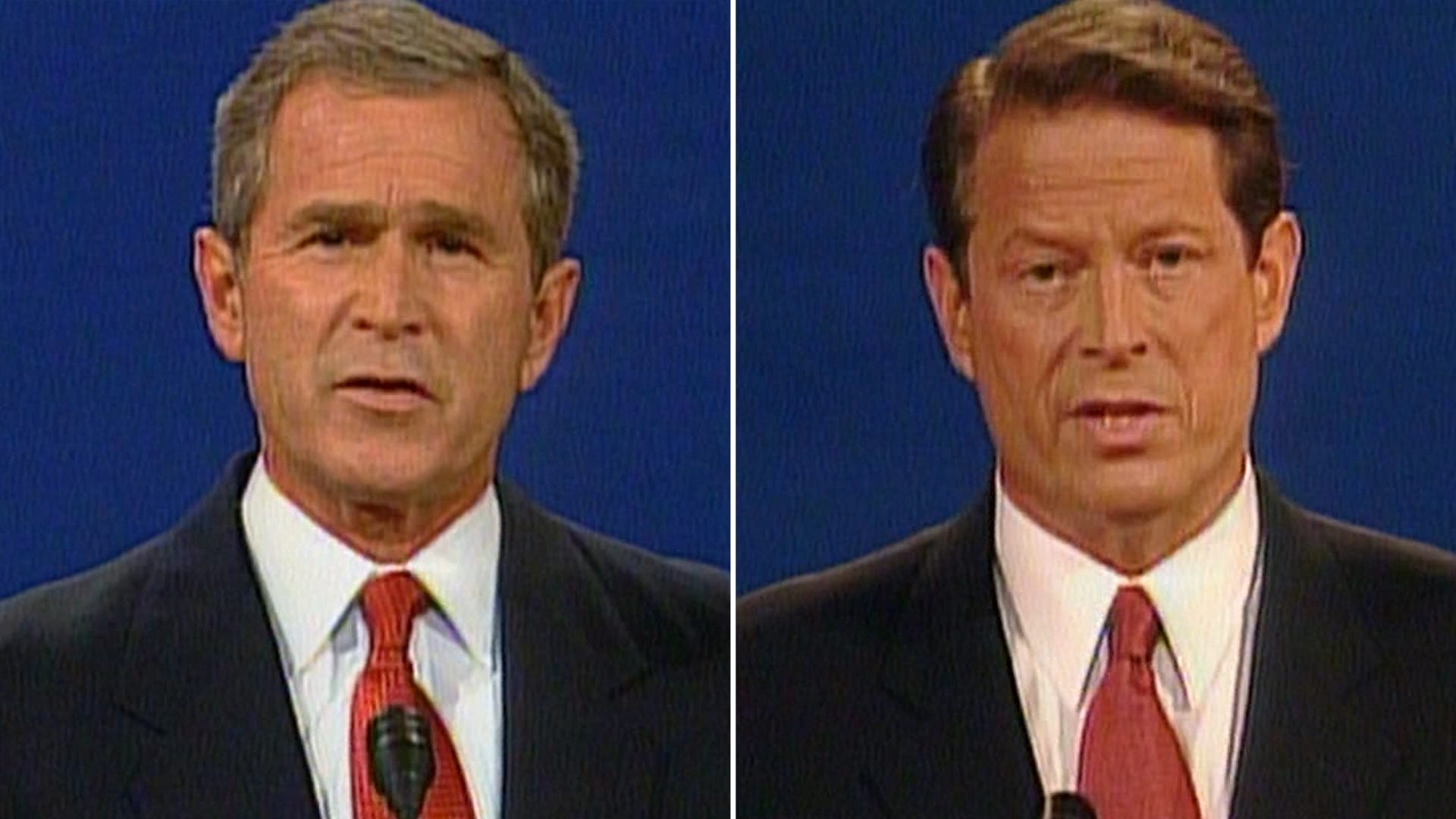
It was precisely that lack of inspiration from either candidate that I think ultimately resulted in the post-election breakdown that November. Both men won the states they were expected to, and then the toss-ups came in. That was where the problem began.
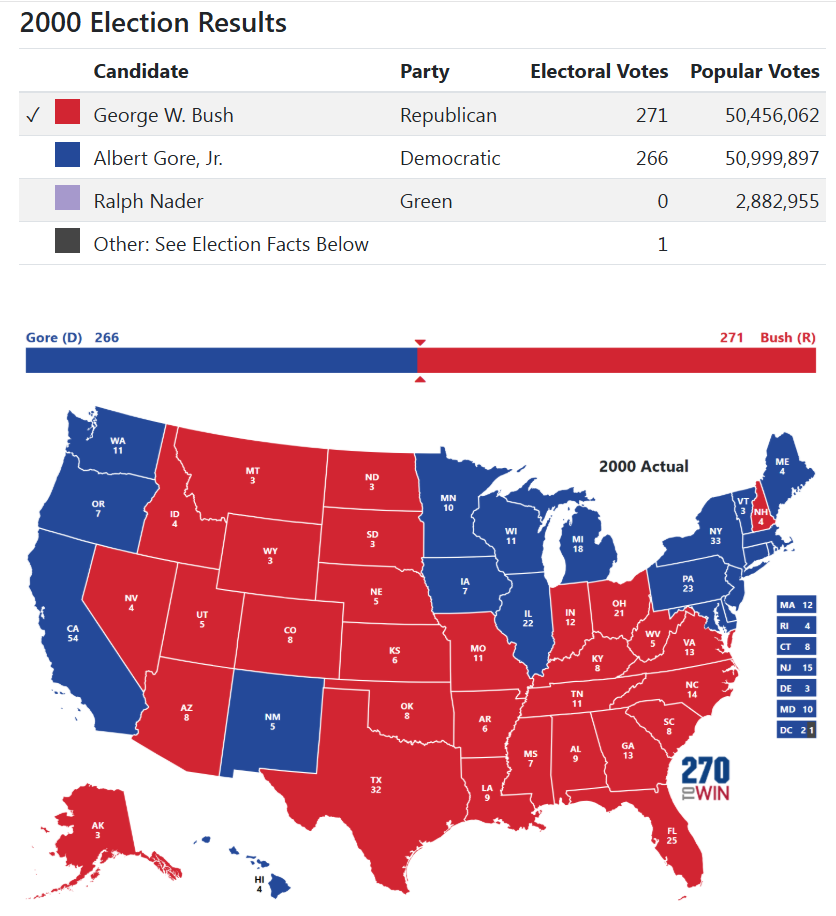
Ralph Nader, a guy who hates fun and really hates car culture, shot his shot in a very Ross Perot-esque way, much to the chagrin of established Democrats in solid blue states. Nader mostly siphoned support off of Gore, thus bolstering Bush, and I distinctly remember my Dad saying at the dinner table one night “They all thought it was hilarious when Perot did it.” Nader, however, did not garner as many votes as Perot did (almost 30 million in two elections.) I think he mostly amounted to a thorn in everyone’s side…unless he managed to take roughly 540 votes from Gore in Florida. (Unclear.)
The WTF and the SCOTUS
And that right there was the problem. Remember that you need 270 Electoral Votes to win the contest, because the popular vote isn’t a real count, and if you care about it, ha ha, you’re a loser. Especially since we still allow states to certify their votes while counting noncitizen ballots. Until that happens, you have no right to be heard on this subject. Anyways.
Florida was the final state without a certified tally. In fact it pretty much all came down to West Palm Beach County, which had problems with its voting machines and wasn’t sure if ballots had been marked properly for one candidate or another. (This is where Americans learned what the hell a ‘chad’ was, and that it could be both pregnant or dimpled.)
Without Florida, Gore had 266 EVs, and Bush had 246. Whoever took that state would win—in fact, whoever took that county would win. Bush initially led there by 1700 votes, until a machine did a recount and cut his lead to just over 300. Gore, then demanded recounts in multiple counties to get a precise number, stalling the certification process.
This didn’t just carry through the night; I remember hearing other students talking about it at school the next day, chatting between classes as the more attentive of us tried to figure out who the next president was going to be. The debacle stretched through the end of the week, then the end of the month, at which point the Bush campaign sued the Gore campaign because the recounting prevented the certification of the election (and in every count, Bush led.) Given the importance of the issue, SCOTUS fast-tracked a decision, and determined that since there wasn’t a uniform standard for manual recounts, the machine tally would stand under the Equal Protection Clause in the Constitution. Bush’s final lead was just over 500 votes in Florida. The decision came down on December 12, 2000.
It was my junior year of high school. I had just gotten my driver’s license three weeks before. My U.S. History teacher wheeled a TV into the room and played a recording of Gore’s concession speech, expressing his disappointment in the Court’s decision, but his respect for the process. She then told us to make up our own minds about how we felt concerning Mister Gore, and that this was a memorable moment in our electoral history.
Bush’s Speech
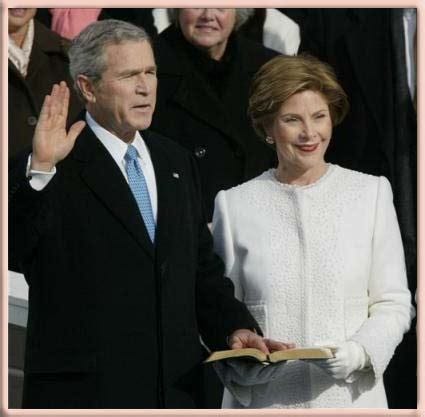
Since the recession wasn’t officially underway and we weren’t in the middle of any serious foreign entanglements (the Kosovo incident was in the rearview), Bush got to focus mostly on social and civil issues in his speech, painting a picture of a bright future, etc etc, the kind of stuff you’d expect. Let’s have shared ideals, let’s raise the dignity of each person, let’s serve in our communities, etc etc. It’s the kind of bland boilerplate that we should be lucky enough to have as executive priorities, but we gotta keep doing stupid fiscal and foreign policy crap. The needs of that time were almost Leave It To Beaver levels of chill, to the point that it annoys me to think about it. Go read it yourself, it’s the last pre-9/11 inaugural in American history.
I realize that I began Electoral Brawlage as a series focused on inaugural addresses but lately the circumstances around the elections have held more interest for me, and the speeches have become safe and sterile. Let’s roll with this.
The Re-Election
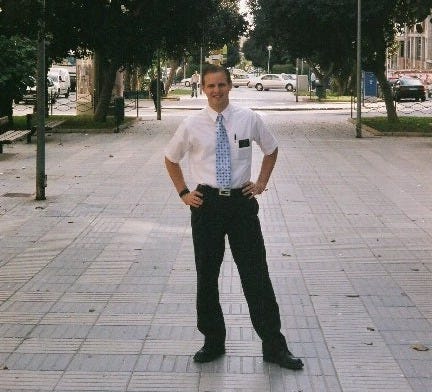
In 2004 I was a missionary in Spain. It was the first election where I was old enough to vote (though I can’t remember now if I was registered in Nevada; probably, because I did get to vote in the 2002 midterms.) I would have voted for Bush over Kerry, but I wasn’t able to get my absentee ballot printed out in time. We only used the Internet once a week, and not every locutorio or cyber cafe had a printer. As a result, my vote wasn’t counted, but you can see here that it didn’t matter.
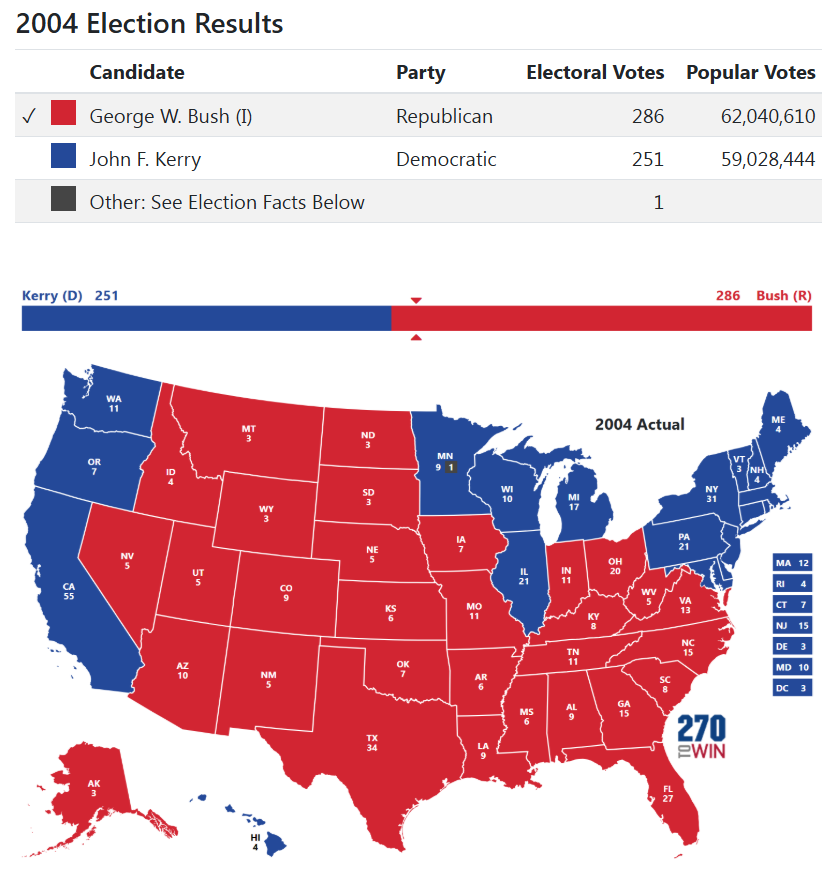
Bush added 15 EVs and 12 million more votes, garnering him 3 million more than Kerry; he lost New Mexico and New Hampshire this time but took Iowa, and the 2000 Census had also taken effect, adding EVs to red states which bolstered his totals. Turnout was huge, even beating the 1984 election.
That said, I didn’t exactly walk around celebrating in the streets. For one, I was in a foreign country. For two, Spain wasn’t a fan of Bush or the Iraq War, and for three (most of all), I was there as a missionary, not as an American. My purpose was different and separate from the political. Spain had originally been part of the U.S.-led coalition into Iraq in the spring of 2003, when Populist Party leader Aznar was president, but he and his party got drummed out of power in the spring of 2004, replaced by Zapatero and his Socialist Labor Party cronies. That was a big dub for the Spanish Left, and they led themselves to think it was an omen for Bush in the fall. The timing of his re-election, then, was kind of funny.
As missionaries we have to obey the laws of the countries where we serve, and in Spain we had to follow strict residency rules. We were there on something akin to a student visa, just with special carve-outs as religious preachers. Since I arrived in-country in November 2003, my annual renewal was November 2004, and just so happened to come on the day after the election.
Spain followed American news and politics even closer than their own, because their country doesn’t enjoy our level of international impact. People tried to bend my ear regularly with their opinion on why I should vote for Kerry and that he should be the next president, and I just kind of had to bear it and not say anything. Wasn’t my purpose. This is where my position on international politics comes from; I’ll follow news and events in other countries, and might even be a fan of some foreign figures, but I won’t bother telling people who to vote for unless it’s in an extreme, dire, end-of-your-nation scenario, like the UK with Labour//Tories/Reform/Restore.
I’ve been on the receiving end of that focus. It’s annoying. Fix your own impotent country, I’m not voting based on what foreigners tell me. If I did that there’d be even more foreigners here. Go home.
Anyway, there I was in early November, sitting in the waiting room of a government office in Alicante, Spain, about to meet with a grumpy tobacco-addicted public employee who would stamp my paperwork, giving me another twelve months of permission to stay in the country, and my fellow waiting room-dwellers were all some form of sand-and-turban enthusiasts. More than one of them looked at me with loaded smile and said “Hey, you’re American? Bush won yesterday.” And I’d have to act indifferent, like I hadn’t heard. I was also trying not to laugh.
The greatest trial was being in the office with the overweight, nearsighted employee who was counting the seconds to his next smoke break (the only European country that smokes more than Spain is Russia). As he perused our paperwork, not looking up, he very grumpily asked if I’d heard that Bush won the election. I told him I didn’t watch the news (true), and he corrected himself saying “I’m telling you, Bush won yesterday.” I said I hadn’t known the election was yesterday. (Also true.) He wasn’t talkative after that, he stamped my paperwork, and I left the office, clear to keep spreading the Good Word to the people of Spain.
That was the entirety of my experience with the 2004 election; a few random people even stopped me in the street in the run-up to the contest, telling me Kerry had to win, and I got really good about asking if they’d read the Book of Mormon yet, and that usually made them lose interest in talking to me.
So there I was, 20 years old, bilingual in a foreign country, old enough to vote but without having cast my ballot, though I would have, and for the winner. It would be a long time before that happened again.
More about that next week.
Visit Nauvoo Supply to order HEARTLANDERS, the most American novel I’ve ever written. It’s like if National Treasure happened during Fallout with G.I. Joes.
It’s short, it’s fast, it’s full of smarts and action, and you’ll love the characters.