

“Electoral Brawlage” examines the first inaugural address of each president in U.S. history, with some commentary and analysis. Check back on Mondays for more.
Subscribe to get these articles in your inbox. Become a paid subscriber to give me money, because I like money and I use it to buy books.
Some background…
I turned 16 in the year 2000. Until then I basically only remembered a few presidential elections, and both had been won by Bill Clinton. I remember the brief Bush 41 presidency but I was only 4 when he took office. My parents, staunch conservatives, were disappointed (to say the least) that Bush didn’t get a second term, and again when Bob Dole lost in ‘96. So when the 2000 election came around, with all the shenanigans related thereto, it was a big deal.
Conservatives wanted the Reagan Era to come back, and liberals wanted continuity with the boom of the 90’s under Clinton. Let’s be real though, it wasn’t completely about policy arguments: Americans approach political parties the way they approach sports fandom. At the end of the day, lots of people wanted Their Team to beat the Other Team.
For those who were too young to remember it, the result of the 2000 election was rather insane, and turned the news cycle into an [expletive deleted] circus for about a month and a half. The Supreme Court had to get involved and in the end, George W. Bush was declared the winner of West Palm Beach County, Florida—ultimately meaning he was the next president.
Ever since then, the 2000 election has been invoked as the prime example of either corruption or close calls in presidential politics. “The worst in our history.” (At least until 2020, but we’ll get there in a few months.) The losers still cry about it to this day as a stolen election.
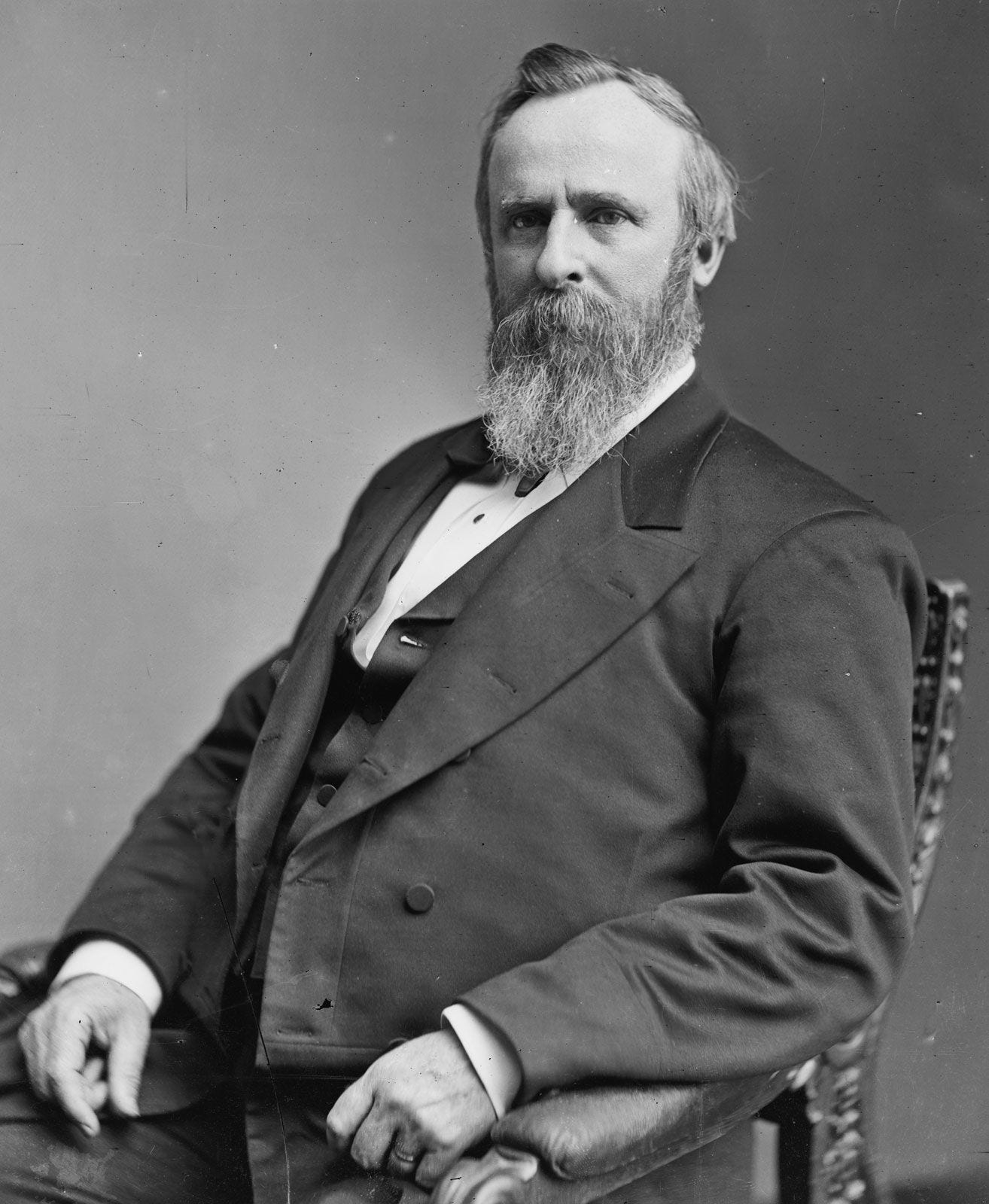
I probably said something to this effect about the 1824 and 1828 elections between J.Q. Adams and Andrew Jackson, but it is once again true in the case of the 1876 election: if you think 2000 was the first time this has happened, you are unaware of your nation’s history. Rutherford B. Hayes would like a word with you.
The Centennial Election
The Grant Administration was, unfortunately, a saga of missteps and corruption (though it had its great moments too.) Grant himself was a great man who had a bad habit of trusting the wrong people in his cabinet. Story for another time. The takeaway is that if the Republicans were going to hold on to the White House beyond ‘76, they’d need a clean break from Grant, and couldn’t run with his first VP Schuyler Colfax, who only served one term due to a scandal. Grant’s second VP, Henry Wilson, had died in office. Things looked grim.
Enter Hayes, an Ohio man through-and-through, who had served in Congress and also as the state’s governor for multiple terms. He picked a New Yorker, William Wheeler, as his running mate. The ticket was popular and well-balanced, provided you were a Northerner, but Hayes was sympathetic to the South. Overall, the ticket had good prospects.
Opposite Hayes was Samuel Tilden, a New York lawyer and an acolyte of Martin Van Buren. He picked Thomas Hendricks from Indiana, a popular former governor who gave the ticket some Midwestern balance. The election was sorely contested and, with a decade of Reconstruction behind them, the South was ready to participate at a level that they hadn’t enjoyed since the end of the War.
Turnout was near to 82% of the country’s eligible voter population. Tilden won the popular vote outright—and you’ve never heard me say this before, but that doesn’t count for either diddly nor for squat, thanks to God and our Founders—with a whopping 51%. Now let’s take a look at the Electoral Vote total.
Here’s where it gets tricky.
Tilden racked up a convincing 184 votes. Hayes only got 165. At the time, 369 votes were up for grabs, so 185 was the magic number. You’re doing the math and asking “But Graham, where are the other 20 votes?”
They were hiding. They were sneaky little votes. They camped out in the dark corners of Florida, Louisiana, South Carolina, and, inexplicably, one little turd from Oregon. In some cases, dual returns were reported. Allegations of fraud hit the newswires, with rumors of ballot box intimidation and more. Nobody could certify the election and the count dragged on for months, through the New Year and into March.
Congress then put together a panel of 8 Republicans and 7 Democrats to figure out what the hell had happened and who the next president should have been. To the shock of absolutely no one, this panel’s decision came down to a vote, and that vote was decided along party lines. Those 8 Republicans voted to hand the 20 missing EVs to Hayes, bringing the final tally to 185-184, GOP.
They decided this two days before inauguration.
Result
Yeah, 2000 was a circus and 2020 was pretty nuts, but woo damn, this had people fired up. Congress knew the only way they were going to get the South to go along with this was to compromise, and compromise they did. The Compromise of 1877 stated that those Southern electors would vote in Hayes’ favor, and to calm everyone’s tempers, the Fed would (at long last) withdraw all its troops from the South, which had occupied the former Confederacy since the end of the War. Rutherford B. Hayes’ election ended the Reconstruction Period, though it wouldn’t end conflict between the North and the South. Not by a mile.
His Address
With all that history, I almost don’t give a damn what he said in his inaugural address. The Democrats sure didn’t, and they referred to Hayes as His Fraudulency throughout the rest of his time in office. (You would too, no matter your party today.) Still, he had a set of objectives and he laid them out once he took office:
Permanent pacification of the country. Securing full constitutional rights for the South, peaceful local government (including for blacks), and urging an end of racial segregation.
Universal suffrage based on education. The exact phrase is “universal suffrage resting on universal education” which called for the creation of a public school system at each state’s level, supported by national aid if needed. (This sounds good on paper, but 150 years later I question the results.)
Civil service reform. He wanted appointment in the government to be based on merit and not connections. Sorry Rusty, you’re gonna be waiting on this one for a while.
Return to specie payments. The country had been in a depression since the start of Grant’s second term in 1873 and paper currency had a lot to do with why. Hayes wanted a gold standard for currency. This is a good policy.
Acceptance of election results. Lol. Yeah I get why you’re saying this, bud—and hopefully you get why your opponents disagree. If Congress had put 8 Democrats on that committee instead of 7 you’d probably be singing a very different song.
There was more, but those five stood out. Go read the address. This was the result of the nation’s Centennial Election. The Bicentennial Election would be rather chaotic as well, and now that we’re in the 250th (which is a midterm year), you might be saying to yourself that things are uniquely crazy in our history.
They’re not. They’re just crazy. We’re America, baby! That’s where we excel.
My Amazon page has all my novels, including the critically-acclaimed FOSSIL FORCE for young boys, and the Engines of Liberty series for all ages.
I post several times per week on YouTube.
Subscribe here for more book reviews and for articles on what I continue to learn as I read.