

“Electoral Brawlage” examines the first inaugural address of each president in U.S. history, with some commentary and analysis. This is the twelfth installment. Check back on Mondays for more.
Subscribe to get these articles in your inbox. Become a paid subscriber to give me money, because I like money and I use it to buy books.
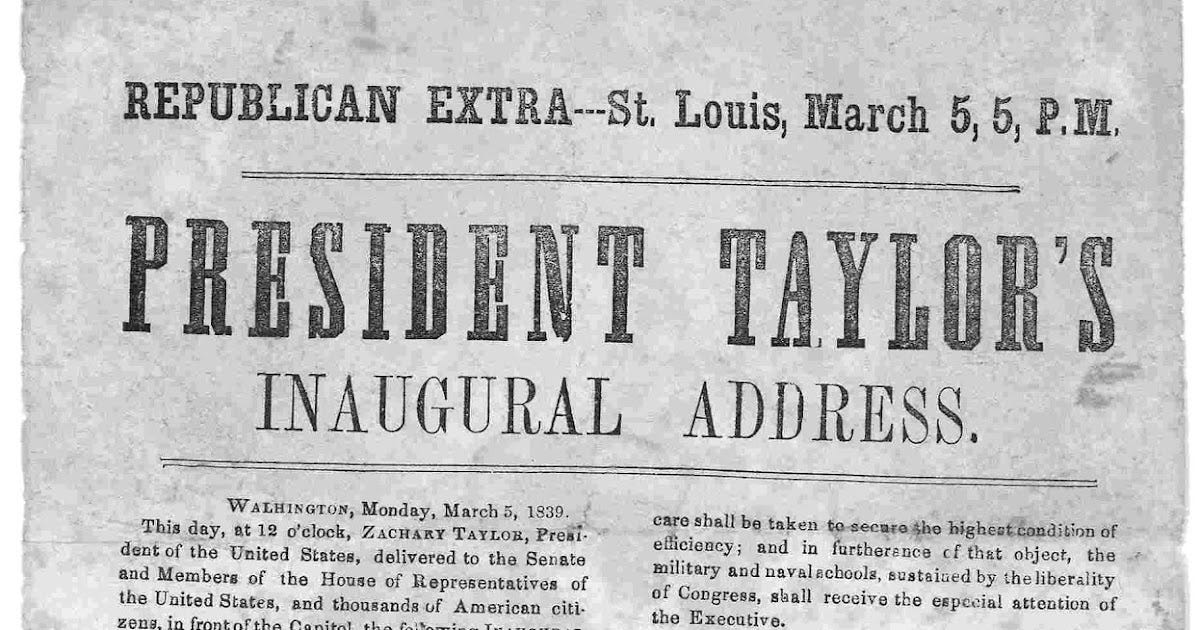
The 1848 election was a three-way fight between the Whigs, the Democrats, and the Free Soil Party, represented by Zachary Taylor, Lewis Cass, and Martin Van Buren respectively. Van Buren wouldn’t be the last former president to seek a non-consecutive second term; Teddy Roosevelt would do the same in 70 years, but we’ll get to him later.
Taylor had the inside track. The Mexican-American War had just ended, and he had served in that war, along with the War of 1812 and a few of the Indian Wars. He was a successful officer and very popular. He benefited from his affiliation with Polk, who wasn’t seeking a second term, but was also popular. People wanted continuity, so Taylor took up the torch.
Zachary Taylor won 47% of the popular vote (irrelevant) and 163 electoral votes (only thing that matters.) Cass won the same number of states as Taylor (15) but these had fewer EVs. As is usually the case with third-party candidates, the core vote among Democrats was split between Cass and Van Buren, which led to Taylor’s success in certain northern states.
As we’ve seen in the last few elections, slavery became a bigger issue for executive candidates to address. Taylor wisely didn’t make it a point in his platform either way. Cass supported a state’s right to decide, while Van Buren openly ran on anti-slavery principles.
Taylor had a rather succinct address to open his presidency. He started with the common staples: “Hey, I’m honored and humbled, this is a big job, I’ll do the best I can, thanks for trusting my campaign, and God help me…”
This paragraph stands out to me though:
“As American freemen we can not but sympathize in all efforts to extend the blessings of civil and political liberty, but at the same time we are warned by the admonitions of history and the voice of our own beloved Washington to abstain from entangling alliances with foreign nations. In all disputes between conflicting governments it is our interest not less than our duty to remain strictly neutral, while our geographical position, the genius of our institutions and our people, the advancing spirit of civilization, and, above all, the dictates of religion direct us to the cultivation of peaceful and friendly relations with all other powers.”
It’s only ever been natural for the civilized world to want to extend the blessings of civilization to those who don’t have it, and this was a prevailing mentality in the 1800s as the country expanded west. Plenty of Indian tribes were open to dealing favorably with the government, they were just as varied in their opinions and affiliations as white Americans (as demonstrated by the divided electoral results for the three candidates).
Taylor brought a sensible philosophy to this effort. “Don’t get tied up in foreign bulls***.” Remain neutral. Advance the spirit of civilization, just don’t get out over your skis. Those kinds of things imperil your civilization in the long run, and that removes your ability to advance anything at all.
He closed by listing some specifics that he would focus on in the coming years, ultimately saying that his guiding principles would be the Constitution and its legal mechanisms for the betterment of the country.
Taylor would be the second president to die in office, serving only 16 months of his term. His vice president, Millard Fillmore, would inherit the big chair in 1850. We’ll talk about him next week.
My Amazon page has all my novels, including the critically-acclaimed FOSSIL FORCE for young boys, and the Engines of Liberty series for all ages.
I post several times per week on YouTube.
Subscribe here for more book reviews and for articles on what I continue to learn as I read.