

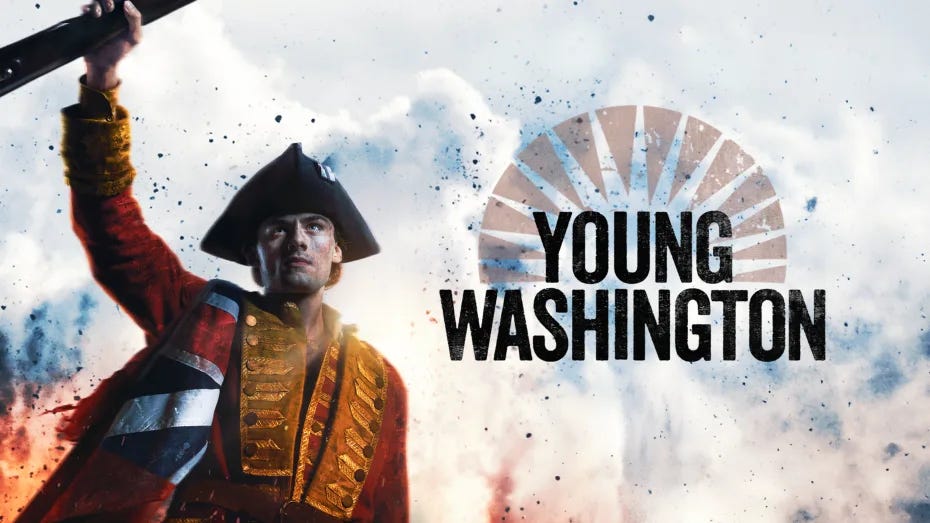
Last Friday I saw Young Washington with my teenage son. I expected to enjoy it well enough but this movie still caught me off-guard. It was flat-out beautiful, from the story to the characters and especially the visuals.
Why did it surprise me? Well, in my lifetime there haven’t been many movies or shows about the Revolution that tried to tell the stories with any fidelity to fact or spirit. I was in high school when A&E produced The Crossing, about the Battle of Trenton, starring Jeff Daniels as George Washington. As these things go, that was a fairly faithful movie, and any concessions to fact were done in the name of dramatic presentation. That same year we got The Patriot starring Mel Gibson, which followed a fictional character through what were some real events, or otherwise a real timeline.
Yet those films came a quarter-century ago. What have we had since? In 2014 AMC gave us TURN: Washington’s Spies, and in 2015 the History Channel offered up Sons of Liberty to commemorate 250 years since the Stamp Act. Both of these shows had appealing production values and played recklessly fast and loose with history, to the point where I wondered why they were made in the first place.
That was part of my trepidation for Young Washington; the other part was the studio. I have never watched an Angel Studios movie, not out of any animosity, but rather out of a lack of interest. They all seemed like they were aimed at an older audience with a preference for slower storytelling; maybe they’d rack up a few recognizable actors but the trailers just looked like big-budget versions of cheesy evangelical movies. (I don’t watch those movies and I take the whole family to church every Sunday.)
So why did Young Washington work? Because the creators knew the material, knew how to tell a story, and knew how to direct an excellent cast to make it all work correctly. On top of that, it looked gorgeous, what with the shooting locations, the wardrobe department, and the props they constructed. Whatever the budget was, they steered it all in the right direction and filmed in some incredible spots in Ireland and Virginia. The cinematography alone made the American wilderness look almost as epic and mythical as Middle-earth.
The story centers on George Washington right after he loses his father. He’s eleven years old and his half-brother Lawrence returns to Mount Vernon to help keep things moving. Young George struggles to accept the idea of class stratifications, and wants to be more than just a tenant farmer. Lawrence helps him read the classics and also trains him to survey land, something at which he excels. Later in life when Lawrence falls ill with tuberculosis (“consumption”), George replaces him in the militia, and finally has a chance to prove himself in the field.
During an expedition to survey land, he has a run-in with some Iroquois Indians who show him a French fort in the Ohio Territory—a land whose ownership is disputed by the British who bought it, the French who are on it, and the American Indians who have lived there for centuries. Washington, ever driven by ambition (and perhaps overestimating his abilities due to his lengthy reading) takes a small force back to the French to tell them to leave.
The back-and-forth of this effort go about as well as you’d expect. His Indian allies mostly want revenge for past grievances and his colonial subordinates murmur about his tactics. Ambitious and well-meaning as he is, he doesn’t know what he’s doing and he’s ultimately overrun by the French and their Indian allies. His militia takes heavy casualties, he surrenders with disastrous terms due to the language barrier, and he returns home to Mount Vernon in shame.
This is the real heart of the movie. He had somewhat humble beginnings, succeeded in making a name for himself beyond his station, failed, and spiraled into depression and doubt. His mother helps him remember who he is and what he set out to do with all this. After some reflection, he makes a second attempt to help the British repel the French from Ohio, using his hard-won knowledge of the terrain. This proves fateful for multiple reasons, and truly is the beginning of what would almost become a legend among different peoples in North America.
The climax of the film features a battle at the Monongahela River where French and Indian forces ambush the British soldiers and Virginia militia. Washington, who is laid up with dysentery, nevertheless forces himself into action to go save his Virginian comrades, vowing not to repeat the failure he subjected them to before. This sequence of events skews very close to what actually happened, including the death of General Braddock, Washington’s promotion in the heat of battle, and the fact that while his clothing was perforated by numerous musket rounds, he survived, leading to a belief among certain Indian bands that he had divine protection.
(It’s hard to look at most of his life in the military and come to any other conclusion, but that’s just me.)
A film succeeds or fails in one of two arenas: concept or execution. And more often than not, it’s the execution. A talented creative can make even a banal or ridiculous concept into something that impacts the viewer in the right way. Young Washington succeeds with a strong concept but it excels with the execution. There are only a couple of unsubtle lines in the script that are meant to get the history nerds nodding about future events. There are no modern sensibilities crammed anachronistically into the characters’ heads, no apologies for the way things were. Slaves and slavery existed as a matter of course, and since the film wasn’t about that, it neither glorified nor vilified it outright, it was just there and the audience is meant to see it in context. The film trusts the viewer to understand it all.
The cast then took that script and turned it in a great performance. William Franklyn-Miller plays Washington in his film debut—seriously, the guy is so green that he doesn’t even have a Wikipedia page. If I have any complaints about the movie, it’s that Franklyn-Miller’s wardrobe didn’t really flatter his build. He’s extremely tall and somewhat thin, and even if the coat and tricorn they gave him were period-accurate, they looked huge on him. That said, he looked comfortable in the role, his acting chops are good, and he sold it with his sincerity.
Several other unknowns fill in the supporting roles around him, and a couple of veterans got the call to play larger historical figures. Kelsey Grammar had a bit part as Lord Fairfax. Ben Kingsley appears a few times as Governor Dinwiddie, and Andy Serkis plays General Braddock. Mary-Louise Parker rounds out the big names with her portrayal of Mary Ball Washington. None of these characters are in the film for its whole length, just for specific interactions with Washington, and they all bring the gravitas of their experience with them.
I won’t pretend to be an expert on the complete chronology of Washington’s life, despite the number of books I’ve read on the Revolution. That would be a misfire anyway, since this movie covers the start of the French and Indian War. I looked up a couple of things after I got home and while there were a few creative liberties, they weren’t unrealistic to the spirit of what happened, just changes made so that the story could fit the beats and pacing of a movie.
George Washington did have a great affection for Sally Carry (Fairfax), but by the time he met her she was already married, not set to be engaged. Christopher Gist was a friend of Washington, he was fluent in Indian tongues, and he did save Washington from the Allegheny River after he fell off their raft. Gist was also present for the events at Fort Necessity, but he was forty-seven years old when that happened. The film depicts him as being roughly the same age as Washington. In real life he died in 1759. The movie changes that, and for a defensible reason.
Its portrayal of events is nowhere near as falsified as those of TURN: Washington’s Spies or Sons of Liberty. I also appreciated that its depictions of war, while earnest, were much more restrained than in a film like The Patriot. The warfare of the era was brutal, up-close, and terribly violent, but Young Washington gives you that sense without showing tomahawks entering skulls or cannons blowing off legs. My son, who’s sensitive to that kind of stuff, only averted his eyes a few times during the war scenes.
I say all this to point out why this movie surprised me despite its studio, whose offerings have never appealed to me: the people in charge of making it are vaguely conservative, vaguely right-wing Christians, and generally aiming their work at a Republican audience. I’ve been reading indie novels and comics for a long time now, and I’ll admit that a lot of right-wing art is just plain bad. The creators are ideologues first and artists second. Sometimes they can rein in their worst tendencies and make something readable (or watchable) even if its main purpose is to appeal to political values.
Young Washington knows how to be art first. The divine touches are in the script with a subtle but recognizable hand. George Washington isn’t looking straight into the camera to tell you to go to church on Sunday and vote Republican forever. This is the story of an ambitious young man who makes terrible mistakes and learns from failure. The effect is something timeless, relatable, and uplifting, as one hopes good art would be. For that reason I think it’ll get more eyes on Angel Studios as a whole.
Personally I saw a couple of their trailers before the movie that looked pretty good: Drummer Boy comes out in November, and looks like it was made with the leftover props from Young Washington, as it’s a musical historical piece about two brothers who end up on opposite sides of the American Revolution. The other was The Brink of War, about Ronald Reagan’s 1986 meeting with Mikhail Gorbachev in Iceland to discuss nuclear disarmament. Jeff Daniels plays Reagan, and Jared Harris steps into the role of Gorbachev. (I got a kick out of that because Harris also played Valery Legasov in HBO’s Chernobyl, where he had to answer to Gorbachev.) They also have an action thriller on deck with Alan Ritchson and Owen Wilson.
Maybe Young Washington is an exception, or maybe Angel Studios is about to hit its stride with films that still stick to their values while appealing to a broader audience. That can only be a good thing for the culture going forward.
In the meantime, if you’re looking for some great nonfiction about this era, check out The American Revolution: A History by Gordon S. Wood and Our Glorious Cause by Robert Middlekauff. I do intend to read Ron Chernow’s Washington: A Life at some point, but only after I’ve read Douglas Southall Freeman’s series on the man. The Founding era of this country is bursting with great stories that would make for a satisfying theater experience.
May Young Washington be the first of many.
Thank you. I read a lengthy bio of Washington when I was young (and there was arguably less twisting of history) and I now work on a lot of books involving the period or the area. I really appreciate the commentary on this, as we’re planning to see it soon.
This is a worthy idea- not too many media depictions of GW show him as a really young man (save for the untrue fable about the hatchet and the cherry tree). It might work well as a video companion to H.W. Brands' new biography of the General.