

Tomorrow I have a scheduled post about Christopher Columbus. This is a good primer for that post.
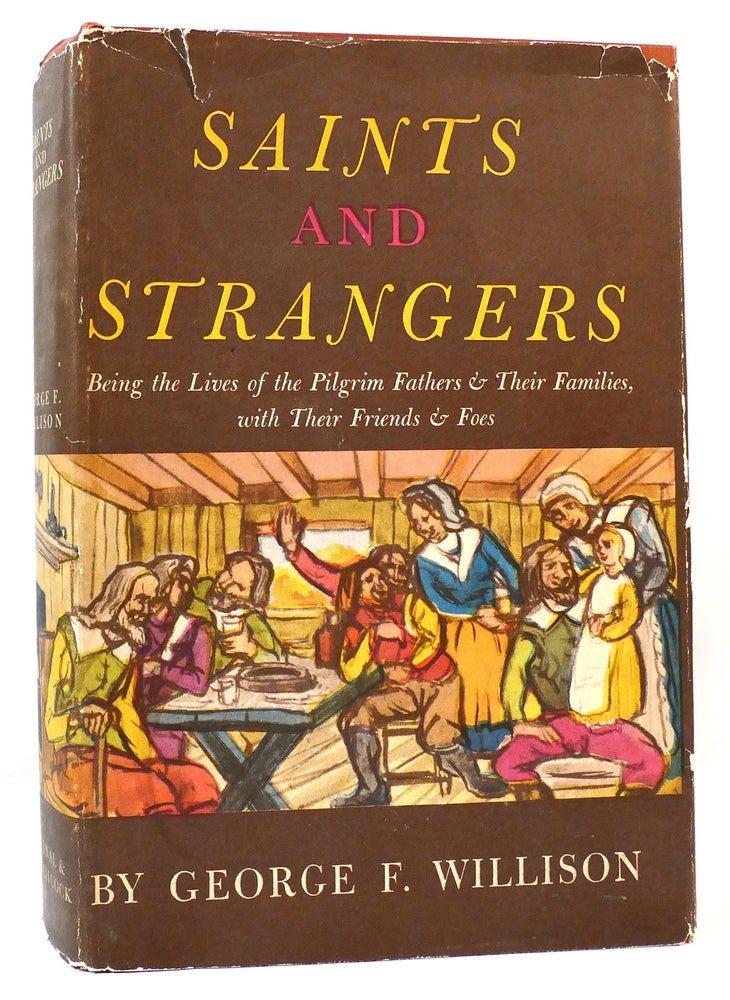
For the last few months I’ve been picking at SAINTS AND STRANGERS by Willison, a 1945 writeup of the Pilgrim Fathers and how they succeeded against the longest odds they could have imagined. Over the weekend I went camping near Wichita Falls (gorgeous part of Oklahoma) and I spent some time reading in the shade.
I’m through the thickest part of the beginning, which is extremely detailed (and thus at times very slow). Now I’m into the first year at Plymouth, a saga I’ve read many times and am quite familiar with…
…and it blows my mind that I’m still learning big, foundational things about that era.
Either that, or Willison gets some things tremendously wrong in his narrative here.
For simplicity, I’ll focus on two specific figures: John Carver, and Squanto. Carver was the first governor of Plymouth, and just about every other account that I’ve read about him puts his age somewhere in his mid-30s when he died (1621). But Willison goes on at length about how Carver’s death was a passing of the torch from one generation to the next, because he was in his 60s, and his successor (William Bradford) was 32.
This isn’t just a numerical mix-up, it is a profound marker of institutional change at Plymouth. My cherished Mayflower Pilgrim chart on my office wall says he was 35, while a Grok search says 56. (Grok cited that great whore of the earth, Wikipedia.)
I told it to give me something accurate, so it cited The Great Migration Begins: Immigrants to New England 1620-1633, a three-volume set published in 1995 that covers the lives of 900 families who moved to New England in a 13-year span. This confirms that his age was approximately 56, so even if it’s off by a decade, he wasn’t 35. It was indeed a generational change when Bradford assumed the role of governor.
Despite my poster being put out by Pilgrim Hall Museum (www.pilgrimhall.org), the age listed for Carver couldn’t possibly be right. This same poster lists John Howland’s age as 28, while other sources put him at 21, much closer to the age of his young wife Elizabeth Tilley.
Granted, out of all the Pilgrim books I’ve read, Willison is the first writer to make this specific comment about Carver’s age and what his death represented for Plymouth, or at least this is the first time it’s really caught my attention.
As for Squanto, Willison—again, in 1945—repeated a later-debunked claim about the Patuxet man, saying that his 1614 voyage to Europe (enslaved by an Englishman) was his second such trip, not his first. Apparently it was believed that another Englishmen, George Weymouth, took Squanto in 1605, then brought him back in 1614, only for Squanto to be one of 27 Wampanoags tricked onto Thomas Hunt’s boat and dragged back to Europe that very same year.
(I really struggle to think anyone would be that stupid.)
So while Willison gets Carver’s age right, he apparently gets Squanto’s time in Europe very wrong. If Squanto had spent literally half his life (and all his adult years) traveling with Englishmen, Bradford might have written about that in his detailed records of Plymouth’s early years. But he didn’t.
In summary, I’m reading my 8th or 9th book about Plymouth, the Mayflower, and the Pilgrims, and I’m constantly learning news things, while also double-checking other stuff I’ve read about it. In the end, you’re dealing with stories about people, recorded by people, who have their own flaws and agendas, and the best approach you can take is to consult a wide array of sources and scrutinize them with integrity.
This is relevant in the context of Columbus because I highly suspect that his most vociferous critics in 2025 are doing no such thing. They read the Internet, not books, and certainly not old books with primary sources. (Though as we see in Willison’s case, he can get things wrong too.)
For every opinion you have, challenge yourself. Read up on it. Read a lot about it. One book doesn’t count, especially without taking the writer’s biases into consideration. Challenge what you know—or think you know.
And for the sake of all sanity, stay the hell away from Reddit.