

“This Week in 1776” is an ongoing almanac of events from the American Revolution, mostly political and military in nature. I drew on these very loosely for my Engines of Liberty series of YA novels.
You should also check out The History List—they have an excellent merch store and occasionally they get valuable historical pieces that are very much worth their prices. I’m not sponsored by them, they just make great stuff.
(Sorry for missing last week, but I didn’t want to miss the 40th anniversary of Chernobyl.) This entry will cover April 19th-May 2.
Anniversaries and Such
I neglected to mention that on April 13th, Thomas Jefferson turned 33. When I was 33 I had finished Engines of Liberty, which, while exceedingly American, has not had as much of an impact on as many people. I digress.
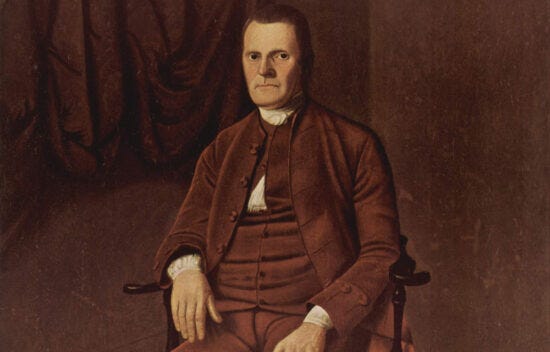
Roger Sherman of Connecticut, who would go on to sign the Declaration of Independence in three short months, turned 55 on April 19th—which also marked the one-year anniversary of Lexington and Concord, aka the Shot Heard ‘Round the World.
Beefing Up the Big Apple
Between the 19th and the 30th, Washington continues to fortify New York the same way he did to Boston, prior to the militia’s success there. These things took time. The first line was at Brooklyn, consisting of numerous redoubts and forts (Putnam, Greene, Box, Stirling, and Defiance.)
Manhattan saw the construction of street barricades as well as Forts George and Washington (heh), with the former near Bowling Green and the latter near Washington Heights today. Fort Washington gave them a good view of the Hudson, and over on the New Jersey Palisades there was Fort Lee (or Fort Constitution). Fort Independence covered the Bronx and Harlem.
These covered the land, and to impede the waterways they sunk old ships or dragged chains across the way so that ships couldn’t sail through. Firepower and drills were meant to be a later resort; Washington would rather keep the British from making a landfall at all, especially without a comparable American naval power.
But on that front…
Nous sommes ici!
The French start helping out the Americans because the Americans are pissing off the British, and the French really hate the British (this has been going on for some time.) At the outset they provided covert material aide—munitions, powder, that sort of thing—through intermediaries. While France was not moving against Britain in the open, they had begun a fruitful military and diplomatic relationship with the Americans that would soon bloom into something far more potent.
But more on that when we get there.
If you like American history, read the Engines of Liberty series for all ages.
My Amazon page has all my novels, including the critically-acclaimed FOSSIL FORCE for young boys, and the
I post video reviews on YouTube.
Subscribe here for more book reviews and for articles on what I continue to learn as I read.