

“Electoral Brawlage” examines the first inaugural address of each president in U.S. history, with some commentary and analysis. Check back on Mondays for more.
Subscribe to get these articles in your inbox. Become a paid subscriber to give me money, because I like money and I use it to buy books.
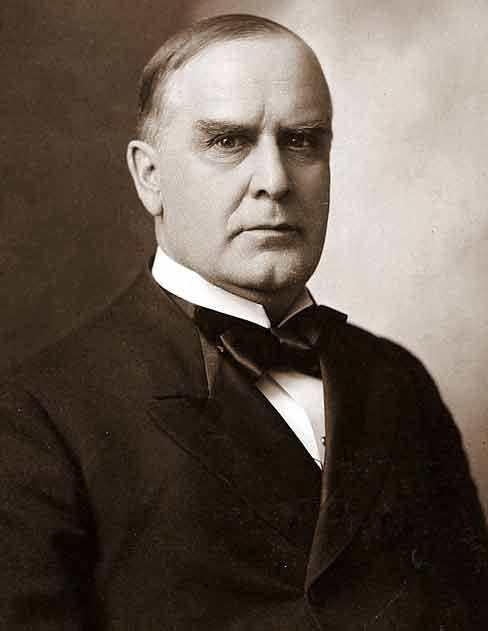
President William McKinley is one of those “in-betweener” guys whose legacy isn’t often on the forefront of our awareness. Can you name a policy he was known for? Maybe a gaff? Anything memorable that he said? I can’t, or I couldn’t before I read his inaugural speech.
The central issue of the 1896 campaign was money. I mentioned last week that “bimetallism,” or using both gold and silver to back a nation’s paper currency, was a hotly-debated subject. The Republicans favored a gold standard and protective tariffs, while the Democrats favored the use of both metals to ease post-depression financial burdens. (There was a depression in 1893.)
McKinley ran for the Republican Party. He was a former governor from Ohio. His running mate was Garrett Hobart from New Jersey. On the Democrat side, William Jennings Bryan ran with Populist Party support. This was a complicated prospect, and not the kind of thing we see often these days, but the Populists and Democrats were kind of like two drivers in the same car. They both nominated Bryan as their candidate, but the Dems had Arthur Sewall (Maine) as their VP while the Populists picked Thomas Watson (Georgia.)
If you’ve ever heard of William Jennings Bryan, doubtless you’ve heard of his “Cross of Gold” speech. He was known for being a powerful and talented orator, and he took a religious fervor with him when he spoke on the campaign. At the convention he delivered the speech, with restored audio found here:
130 years ago, people got fired up about actual matters of substance. Can you imagine? Now we’ve got whiners arguing over the Reflecting Pool and hoping it gets dirty. Gayest timeline.
Anyway, I have no idea how the Dems and Pops planned to resolve their different VPs if Bryan won, but it doesn’t matter, because he obviously didn’t. McKinley took the Electoral Vote by 95 (271 to 176) but only took one state more than Bryan (23 to 22). Such a huge disparity, even though he won the utterly worthless popular vote 51% to 46.7% (with an almost 80% voter turnout.)
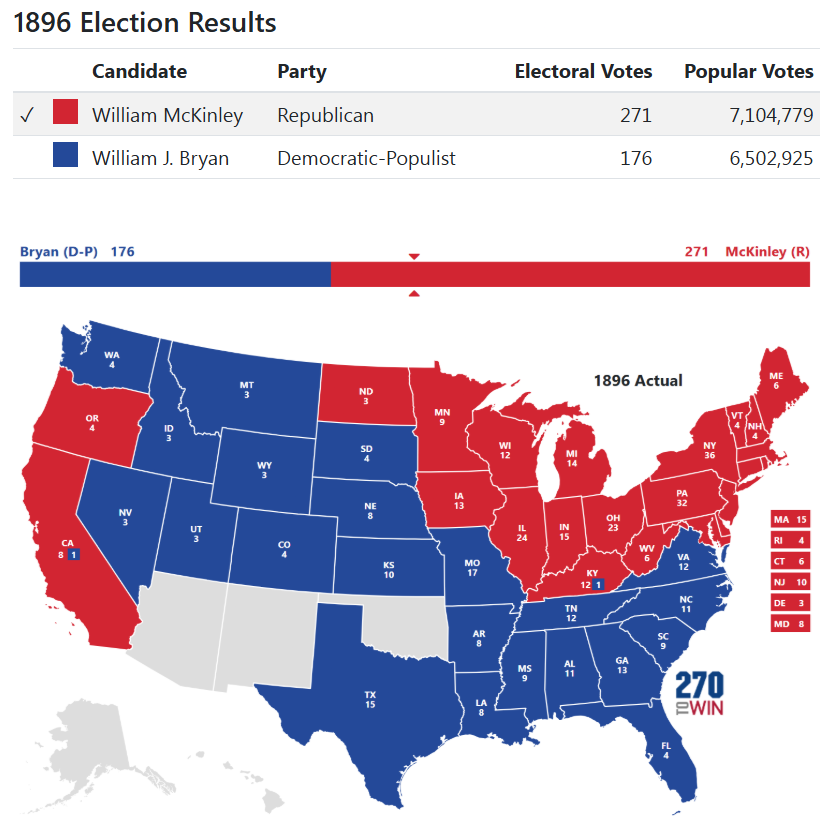
It gets even nuttier when you consider the difference in tactics. McKinley (53) outspent Bryan (36) by five to one, while Bryan traveled roughly 18,000 miles by train to campaign. McKinley’s money went to targeted mailers and local rallies. He barely traveled; people came to see him speak. The age and style difference was…man. Dudes weren’t even playing the same game.
His Address
Having won with a considerable Electoral victory, McKinley embraced the “mandate” given by voters, but didn’t invoke it as his first point; he went straight to faith and reminded the population what we are capable of when we remember God’s commandments.
Our faith teaches that there is no safer reliance than upon the God of our fathers, who has so singularly favored the American people in every national trial, and who will not forsake us so long as we obey His commandments and walk humbly in His footsteps.
(Somewhere in an old diesel pickup truck out west, Frank Rammage just sat up a little straighter.)
Then he went into the money question. As far as he was concerned, gold and tariffs had defeated bimetallism and now it was time to bite down. Like anyone with good fiscal sense, he admonished the country to understand the state of things as they were (depression) and that the government HAD to cut back on spending since things were tight.
Economy is demanded in every branch of the Government at all times, but especially in periods, like the present, of depression in business and distress among the people. The severest economy must be observed in all public expenditures, and extravagance stopped wherever it is found, and prevented wherever in the future it may be developed. If the revenues are to remain as now, the only relief that can come must be from decreased expenditures.
Whereas a modern politician might lay the blame of fiscal problems on the doorstep of The Other Party, McKinley spoke to the people about their own character and history, with an eye to the future, that we would get out of the financial ditch we were in.
It is inspiring, too, to remember that no great emergency in the one hundred and eight years of our eventful national life has ever arisen that has not been met with wisdom and courage by the American people, with fidelity to their best interests and highest destiny, and to the honor of the American name.
He wanted civil service reform to continue, the kind started by Garfield and continued by Arthur. He didn’t want foreign entanglements, wars of aggression or expansion, and sound foreign policy generally.
The bulk of his remarks centered on good conservative philosophy as well as national roots and unity. I like that he closed it out with this:
The North and the South no longer divide on the old lines, but upon principles and policies; and in this fact surely every lover of the country can find cause for true felicitation.
Let us rejoice in and cultivate this spirit; it is ennobling and will be both a gain and a blessing to our beloved country.
In a time of hardship, he was sane and positive, at least from the get-go. I’ll eventually read biographies of every president and I’m curious what else I’ll find when I dive into his life.
This was a good speech. Go read it.
Visit Nauvoo Supply to order HEARTLANDERS, the most American novel I’ve ever written. It’s like if National Treasure happened during Fallout with G.I. Joes.
My Amazon page has my other books, including FOSSIL FORCE for young boys and Engines of Liberty for all ages.
I post several times per week on YouTube.
Subscribe here for more book reviews and for articles on what I continue to learn as I read.