

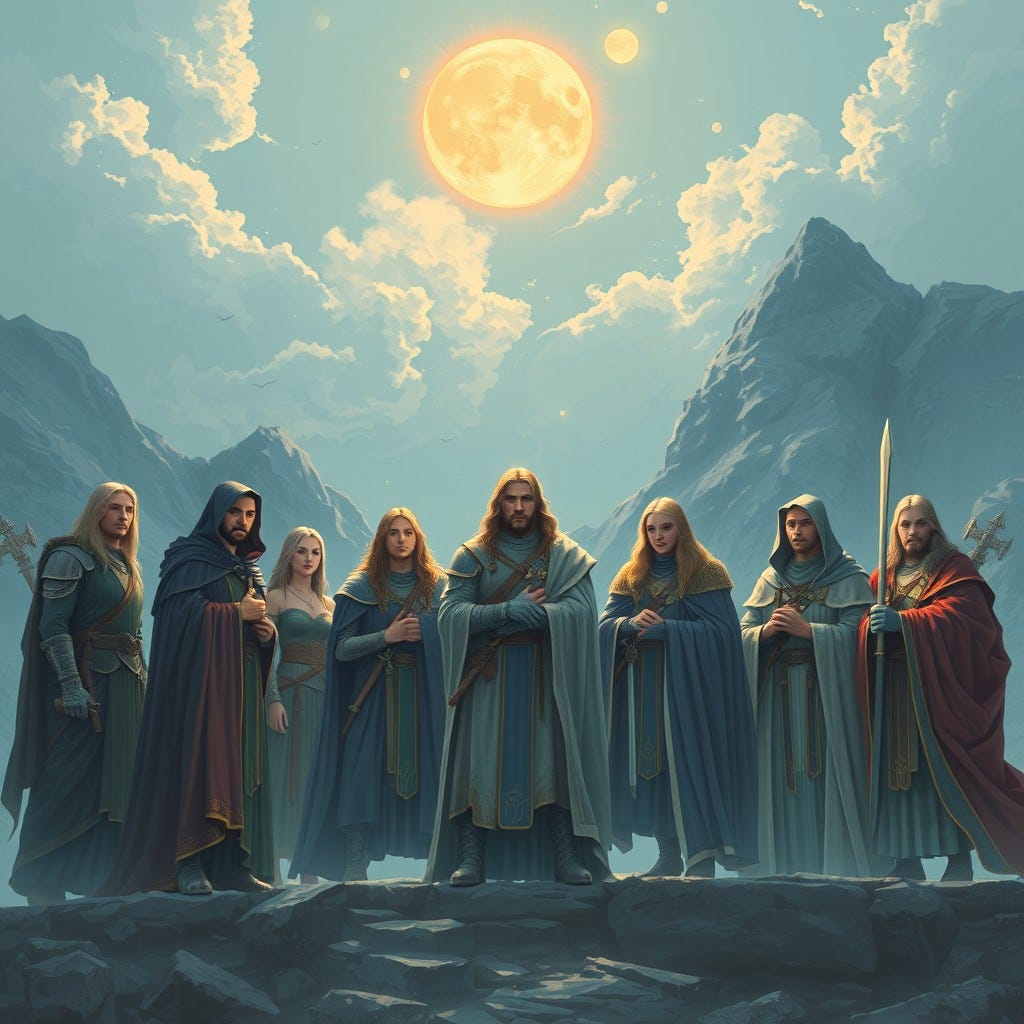
“The Valar” according to getimg.ai. I specifically typed “fourteen” but computers can’t count.
The Valaquenta
Linguistically this word tends to skew a little more toward the Latin, as “quenta” just means “tale” or “story.” Since this is about the Valar (the Elvish word for the Ainur, the fourteen immediate children of Eru Ilúvatar) then this is their story.
As you might expect, their origin is dramatic and their interests are timeless. They are literally the unseen hands that move throughout the world and make it work. I’ve compared them to the gods in the Greek pantheon, and so each Vala specializes in something different. There are seven lords and seven ladies. Melkor was once counted among the Valar but he rebelled and went his own way, so he’s out of the band.
The men are as follows:
MANWË: Wind, clouds, air. Always hanging out with Varda. King of the Valar.
ULMO: Water. Alone, always moving, rarely appears.
AULË: Earth. The smith of the Valar, makes things from the ground.
OROMË: The mighty hunter of monsters. Lord of the forests. Husband to Vána. Brother to Nessa.
MANDOS: Keeper of the Dead. One of the “Fëanturi,” masters of spirits. Brother of Lórien. Husband to Vairë. Also called Námo.
LÓRIEN: Dreams and visions. One of the “Fëanturi,” masters of spirits. Brother of Mandos. Husband to Estë. Also called Irmo.
TULKAS: Strength and joy. Absolute Chad. Loves to run around in the woods and wrestle. Married to Nessa.
And the ladies:
VARDA: Light and stars. Always hanging out with Manwë. Melkor tried to get her on his side and she dissed him.
YAVANNA: Fruit. Married to Aulë.
NIENNA: Grief and mourning. One of the “Fëanturi,” masters of spirits. She dwells alone. Turns sorrow into wisdom.
ESTË: The Healer. Wife of Lórien. Nocturnal.
VAIRË: The Weaver. Wife of Mandos. She keeps the histories, including names of the dead.
VÁNA: Springtime and flowers. Wife of Oromë.
NESSA: Dancing and delight. Patroness of deer. A hippie like her husband Tulkas, she loves running around in nature.
And the Maiar?
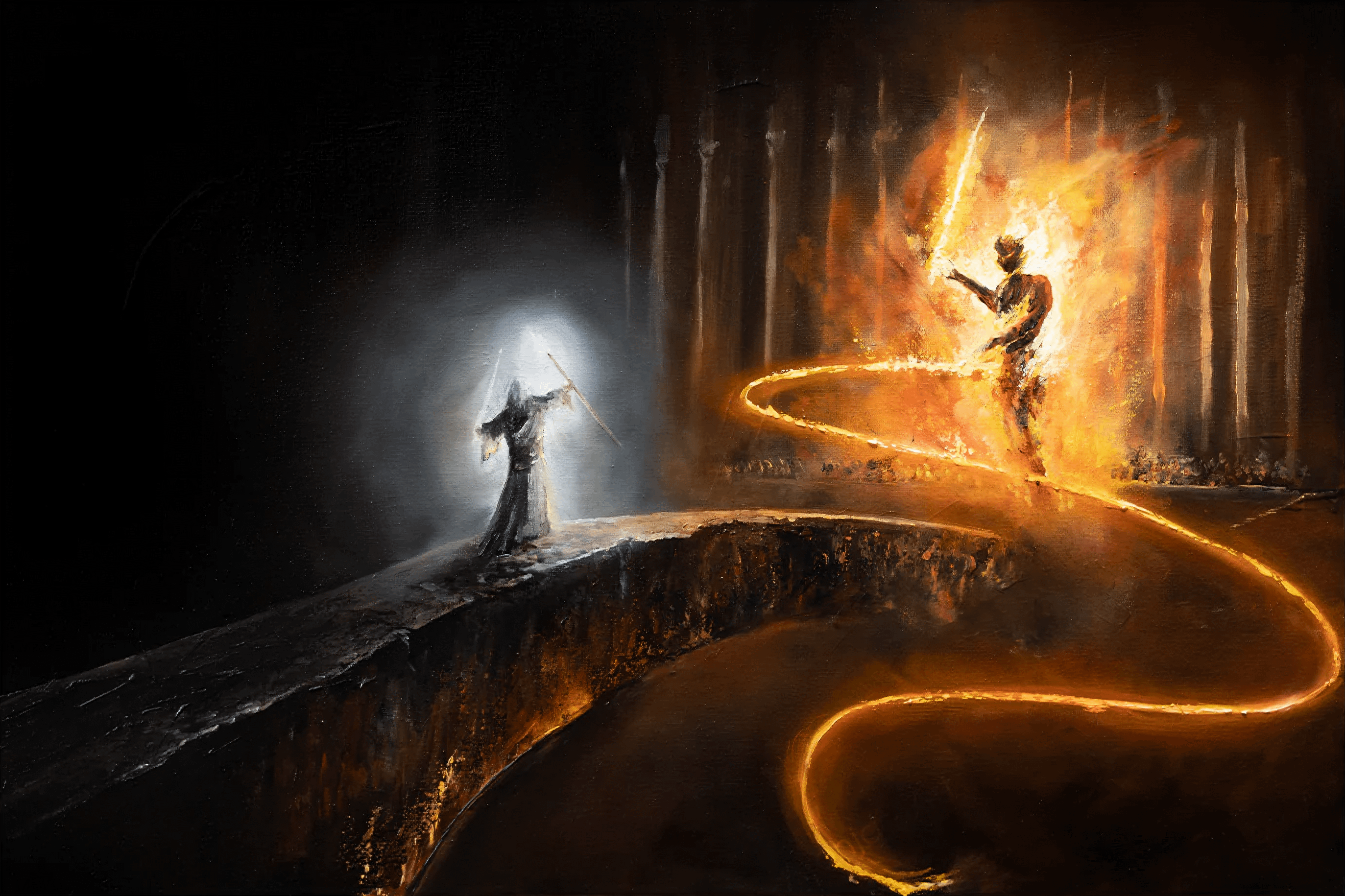
If the Valar are like gods, the Maiar are like angels or demons, depending on their allegiance to the Valar or to Melkor. Since I already spammed you with the fourteen names of the Valar, I won’t go into listing the Maiar here. The main takeaway is that they’re not as powerful as the Valar and they are subservient to them. Gandalf, one of the Five Wizards, is an example of a Maia. So is the Balrog of Moria. At the Bridge of Khazad-Dum, you were literally watching an angel fight a demon; a servant of Manwë versus an agent of Melkor.
Speaking of Melkor…
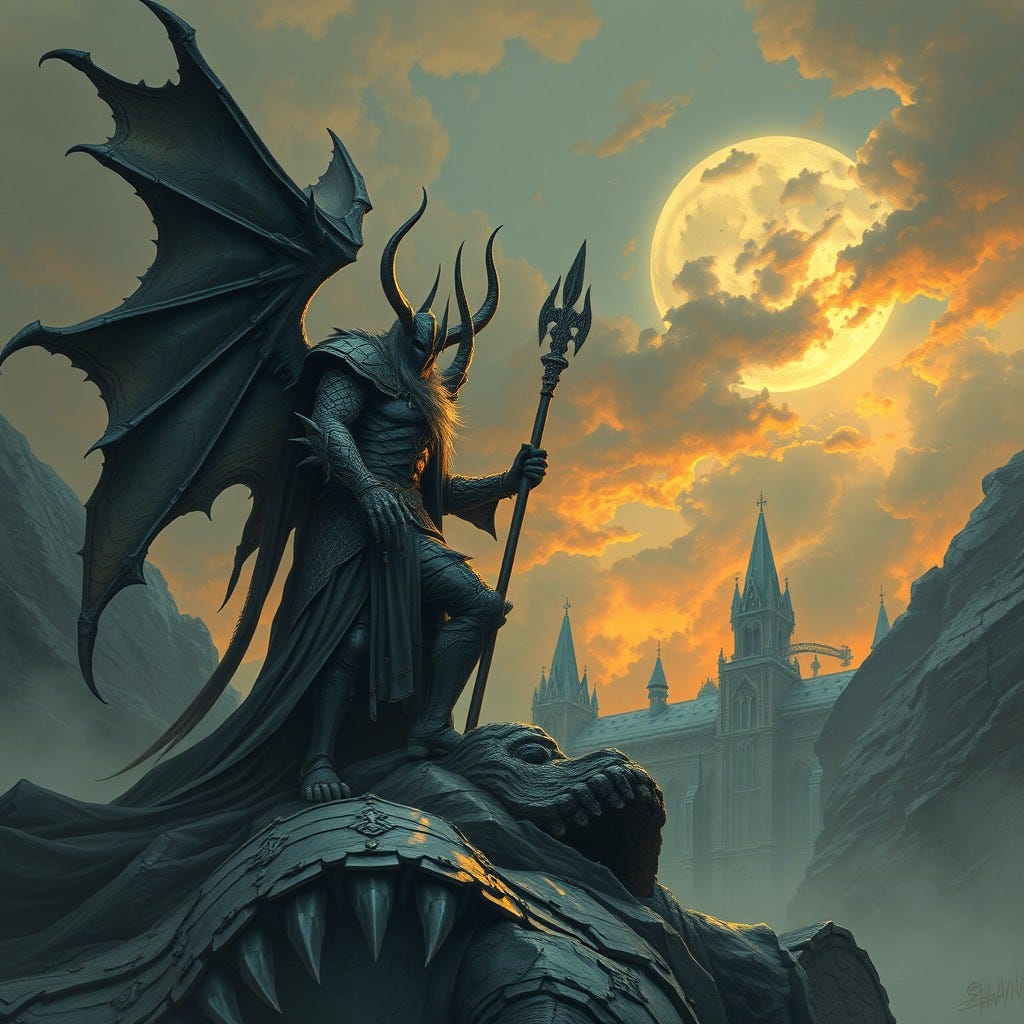
Because that name was given to him by Ilúvatar, against whom he rebelled, Melkor is no longer known as such, and instead goes by Morgoth. After his downfall he went to work perverting the labors of the Valar, taking what they made and turning it ugly, making it the antithesis of what they intended it to be. He especially made good use of the darkness and soon every living thing began to fear it as Morgoth’s territory.
The Valaquenta ends with a mention of the Balrogs in Morgoth’s service, though they are not individually named like many of the Maiar who serve the Valar. Their identities matter less to their master than those of their counterparts. The only significant name to pop up here is that of Morgoth’s lieutenant, Sauron. Of him, the Professor writes the following:
In all the deeds of Melkor the Morgoth upon Arda, in his vast works and in the deceits of his cunning, Sauron had a part, and was only less evil than his master in that long he served another and not himself.
But in after years he rose like a shadow of Morgoth and a ghost of his malice, and walked behind him on the same ruinous path down into the Void.
-The SILMARILLION, p. 24 (mass market paperback)
Final Thoughts
In reading The Lord of the Rings it’s easy to see that Tolkien knew the history of everything in it, all the way back to the first grain of sand, the first word that commanded it, and the beings that issued those commands.
I appreciate that the Valar have some degree of humanly recognizable characteristics, but I also like the ethereal quality that puts them beyond our understanding, as such beings should be.
I’m reminded of Peter Jackson’s execution of the film trilogy, how he always managed to cultivate a sense of wonder and spiritual awe by simply depicting something powerful and beautiful without making it relatable on every single level. You didn’t have to know every tiny piece about it to appreciate it for what it was.
Which in a sense is why I’m writing these fast summaries at all, so that you can dip in and out of this beautiful book, and thus dip in and out of the Professor’s incredible imagination.