

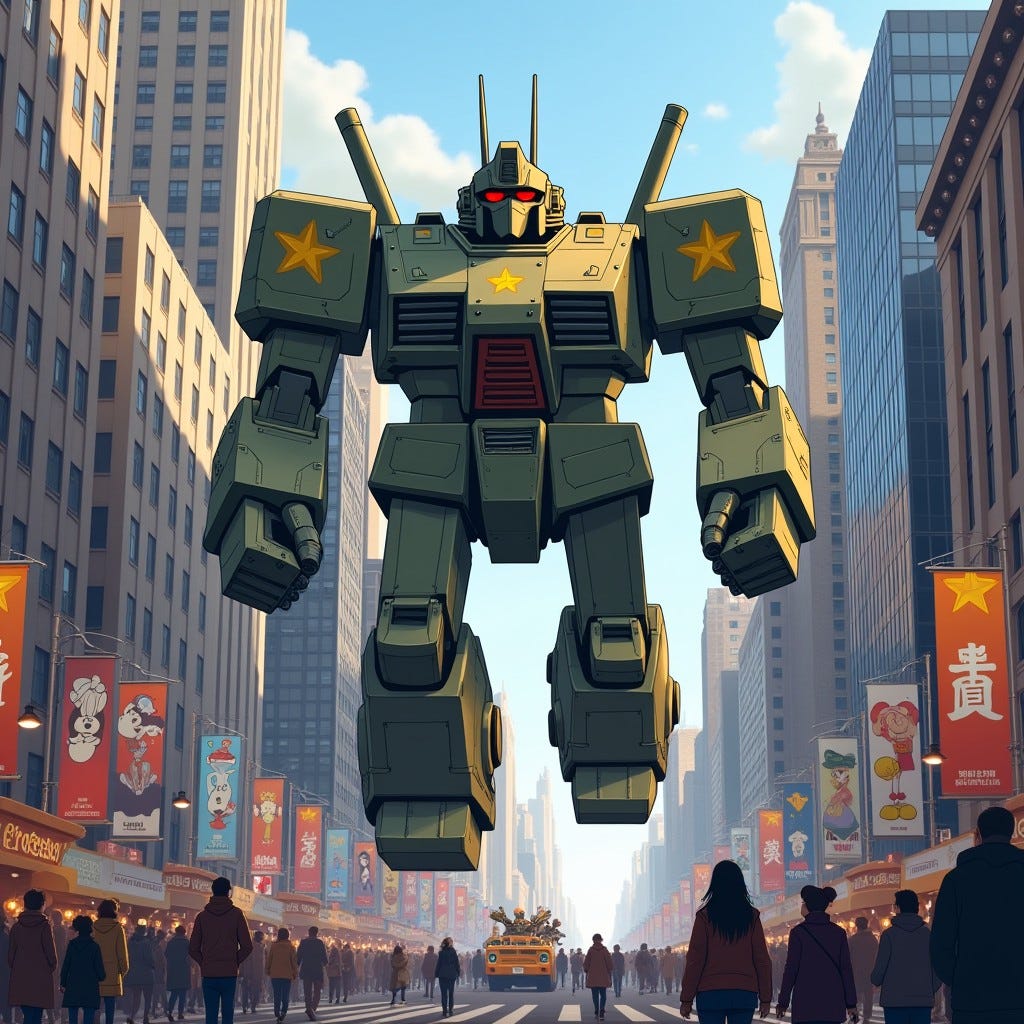
(AI image, not indicative of final robot)
I wrote this for an anthology pitch that wanted a giant hypersonic military robot that had a playful heart of a child. It got rejected, but it’s still a fun piece. I’m posting it in segments here.
WHEN PIGS FLY
Copyright 2024 by Graham Bradley
***
Turbines roared as two F-22 Raptors hit their takeoff speed, kissing the runway goodbye on a brisk November morning, veering northwest toward New York. McGuire Air Force Base faded to a small speck behind them.
“Tower to Hatchet One, come in Hatchet One, over.”
The lead pilot, callsign “Charger,” spoke clearly into the radio. This wasn’t his first sortie, but the first exciting one in a minute.
“Hatchet One, go ahead Tower.”
“Target has advanced swifter than anticipated and is now too close to civilian structures. Stand by and be ready to engage, over.”
“Copy.” Well, so much for exciting. He glanced out the window and saw Raritan Bay pass below. Whatever they were hunting, it had gone airborne from Stamford, Connecticut, over at the Mockheed plant. Still no word on exactly what it was or what it was doing, but it must have been sketchy if the brass wanted birds in the air.
“Hey Charger. Got one for you,” said another voice on the radio.
“Go ahead, Hotrod.”
“Drinks to whoever gets to shoot first?”
“Dammit Hotrod, you know they record this stuff,” Charger growled, looking out the window at his nine o’clock. He could hear that stupid grin on Hotrod’s face.
“All right, dinner for whoever gets the kill.”
“I’m not biting on that. It’s gonna be some idiot in an ultralight again. Probably wants a good seat for the parade,” Charger said.
“Then why not just fly a drone? And why call us? And why’s it coming from Mockheed? They put us in the sky ‘cause it’s something that needs shooting,” Hotrod said.
Charger groaned theatrically. Hotrod liked to run his mouth, flight recorder be damned. Supposing they had to shoot something, if anything went wrong he’d get martialed for recklessness, and the bets would damn him. Dude worked hard to be a pilot and he was going to piss it away on something stupid, and that was a bet Charger would gladly take.
“Tower to Hatchet One.”
“Go ahead Tower.”
“Divert to NYC and hold ceiling at eight thousand feet. JFK has been notified. Commercial traffic is being rerouted.”
“Copy. And the bandit?”
“Army has a Black Hawk inbound, and NYPD is mobilizing. Stand by.”
“Uh…copy,” Charger said again. The skin on his neck prickled. This wasn’t normal.
“Bet we get to pop something today,” said Hotrod, giggling.
***
Henry Watson yawned over his Keurig machine as it slowly brewed his morning cup. His wife and daughter were already out, and he’d slept late after crashing early last night. Too many long hours at the facility, all so he could be sure to get the holiday off. Hardly anyone else would be working on Thanksgiving but they expected him to pull extra hours; yes he was a genius programmer but around Mockheed-Larkin he was still the new guy, and that meant unpaid overtime.
Somewhere upstairs, his phone rang. His work phone. Henry let his head hang and counted to three, then dragged himself up the stairs. His contract required him to answer the phone. He found it next to his bed, on the floor. It was Grant, his supervisor.
“Watson,” said Henry.
“When did you load that OS update?” Grant asked, no preamble.
Henry rubbed his eyes. “At twenty-thirty-eight hours yesterday.” Mockheed counted military time, and he remembered seeing the clock on his laptop. “Did it not transmit?”
“Hah,” said Grant, in a way that didn’t sound amused at all. “It came through and something is hella wrong, Henry. I can’t remote-access your hard drive either. Why isn’t your laptop on?”
Frowning, Henry looked across the hall into his office. He’d left the laptop on his desk, but it was unplugged.
“Battery’s dead. Hang on.” He crossed the hall to plug it in.
“I am going to have your ass for this, Henry. What did you do to Minos? Damn thing has going haywire and you’re offline? You cannot be this incompetent—”
“Whoa, hang on with all that,” Henry said, his blood suddenly running a little warmer. “What’s with the abuse?”
“Turn on your damned television! Our bird flew the coop, Henry! Right after you uploaded its base operating system!” Grant shouted.
Henry froze. Even on his secured work phone there were certain things they weren’t allowed to say. Gritting his teeth, Henry flew down the stairs and turned the TV on; the local channel had footage of the Macy’s Thanksgiving Day Parade, which would pass by just a few blocks away. He was about to ask Grant what he was looking for when the camera shifted from oversized inflatable product mascots to something far more recognizable. Something he’d stared at far too long for the last two years.
The robot. Minos. It was outside of the hangar in Stamford. Hell, it was outside of Stamford. And it was flying.
Built with roughly the same dimensions as a storage shed, though more rounded in shape, Minos was a quadruped robot with a powerful E-core engine and hypersonic thrusters built all over its multidirectional fuselage. Paired with its four legs, it was an adaptable combat platform with rapid-delivery capabilities and learn-as-you-go intelligence. The legs had their own subservient operating system—something about different contractors getting different pieces of the project—but it was his job to write the main code.
He was still in the early stages of that process. Foundational logic coding began a week ago and he’d finalized the most recent iteration just yesterday afternoon. His laptop would have sent it to the facility, where Minos absorbed and integrated the new code for its base layer. The fine-tuning would come later.
For now, Minos only knew how to move around. It had no imperatives in the system, nothing to tell it to move around, or why. And yet, it was on the run. Flying.
“I…but…the heavy booster isn’t even equipped. Wasn’t,” Henry corrected himself.
“We know that,” Grant snarled. “The damn thing forced its way out of the hangar and into the propulsion lab. Took it three hours but it was able to fully install the other attachments, using the tutorials meant for our techs! Henry: the hardware was one hundred percent mission-ready. The software was the final step. You uploaded it, and now the thing is acting for itself. What the hell did you do?”
“There has to be some mistake,” Henry whispered, watching the TV as Minos rocketed southeast over Long Island Sound at an elevation of maybe seventy meters. A modest dip and it would be under the radar floor.
The news could only play the same four-second clip over and over, taken from someone’s camera phone on the ground, meaning wherever this was, Minos was already long gone. Henry ran back upstairs. The computer had booted up. With a practiced flurry of his fingers he logged in and ran a rapid replay of his last hours of productivity.
“Are you online yet?” Grant demanded.
“You can sync to mine in a few more seconds, it’s running slow.” Henry sounded distracted as he read yesterday’s report.
The computer noted an aberration: during his coding session he’d disappeared to the bathroom for about fifteen minutes. Since it was a Mockheed laptop, it video-recorded everyone who sat in front of it. His wife Janet had come in with their daughter Carly a minute after he’d gone to the bathroom; Carly was fussing and crying, and Janet held an iPad in one hand with a dead battery.
Henry’s heart sank. He instantly guessed what had happened next.
“Look, sweetie! Daddy’s computer is on! Here!” Janet had accessed a web browser and put on a video from Carly’s favorite cartoon, Piggie Wigstaff, some brainless jingle-toon about a flying pig who did aerial stunts. Janet would have been cooking around then…Henry watched the playback as Janet rushed back to the kitchen so dinner didn’t burn on the stove. Carly finished the ten-minute cartoon—all of this was summed up with time stamps—and spent just a few minutes talking to the computer, as if Piggie Wigstaff could hear her.
And Carly got replies. Only they weren’t from Piggie Wigstaff; they were from the AI client in Henry’s script program, always running in the background on his work laptop. Something Carly had said to the coding interface was now embedded in the Minos robot’s operating system. Something Henry had missed when he sent off the update at the end of the night.
Henry swore. Grant was right, he’d really screwed up. He should have closed the computer before leaving the room. Forget losing his job; this would land him in jail.
Grant was still talking. “I had to inform Colonel Andolsek ten minutes ago. That was not a fun call, Henry. They’ve got fighters in the air, ready to skunk this thing. I’ve sent Allred and Hill to come help you. You guys have to figure this out now before the Air Force blows apart a thirteen-billion-dollar contract.”
“Don’t send Allred and Hill, that’s too many cooks in the kitchen. Have you issued a docking command to Minos? What’s the response?”
“It tells us to screw ourselves, Henry. That’s not supposed to happen. We can’t take remote control! We’re sending new information parcels but it isn’t responding.”
Carly’s chatter with the AI had compromised the base operating system. Henry had always hated those stupid kid cartoons—Janet laughed when he’d told her they were devious, that the jingles were basically lab-engineered to program children. Carly had repeated the jingle back to the AI and played a wicked Uno Reverse card on the software. Who knew what Minos was capable of now?
“Allred and Hill can’t fix this,” Henry said. As a coder he was used to rapidly sorting through flow charts and logic trees. He couldn’t program machines unless he also thought like one. In an instant, he deduced the only thing that was likely to work.
Henry instantly ran to his room and threw on a pair of jeans and his worn-out old boots. He switched the phone to his earpiece and slid into a jacket just as a loud, heavy knock came at his front door.
“Dammit Henry, let the boys in and review the code with your team!”
“No time. I said they can’t fix this, Grant.”
“No, but they can—”
“I can do this if I get off the phone! Just keep the gateway open between home base and the prototype. Talk to you in a few minutes.”
“Don’t you hang up on me Henry—”
Too late. Allred and Hill knocked again. He didn’t have time for them.
If the robot wasn’t accepting orders from home base, it was most likely due to a subroutine that kept it from processing simultaneous updates. In the past, those had often sent advanced systems into crippling feedback loops due to the nature of how they were stacked and compiled. Minos had a new breed of value engine in its core processing system, though; if Carly had given it the wrong kind of imperatives, Minos would reject anything new unless it satisfied very strict requirements. There wasn’t time to troubleshoot.
Hell of a thing to juggle on Thanksgiving.
Henry disappeared into his underground garage. He started his old motorcycle, slipped the helmet on, and raced up to the road, headed for the parade route.
***
Janet Watson gently rocked the stroller back and forth on the sidewalk. As long as it was moving, Carly would coo contentedly in the seat, pointing at the floats and their oversized balloon mascots, giggling here and there at the ones she recognized.
“Mommy! It’s Supa-Mawio!”
“Yes, sweetie.”
“Mommy! Pikachu!”
“I see it, sweetie.”
Carly said something else, but Janet couldn’t hear it. Somewhere at the edge of the crowd noise there came a growing rumble, a dull roar that got louder and louder. Janet had been with Henry for eight years and in that time he’d taken her to a lot of air shows and military bases. She knew the sound of fighter jets when she heard them…
…which wasn’t often, in New York City.
A moment later she heard another engine noise, with the repetitive whump-whump-whump of helicopter blades. Frowning, Janet put a hand to her beanie and glanced up, expecting to see one of the aircraft from the news, or perhaps even the police. She did not expect it to be a dark black Army helicopter, doors open, with the uniformed legs of soldiers hanging out, and weapons bristling on the side pods.
Judging by the alarmed gasps from the crowd, she wasn’t the only one to take note of the Black Hawk. Helicopters never flew this close to the parade. Thoroughly confused, Janet’s instincts kicked in and she was just pulling the stroller back from the edge of the sidewalk when Carly let out a squeal of unbridled toddler joy, an intense sound that she reserved exclusively for one thing: Piggie Wigstaff.
Janet frowned and checked the program. Piggie wasn’t supposed to be here yet, there was still about a dozen floats to go.
The cartoon was the new billion-dollar sensation around the world, bigger than Mickey Mouse, bigger than Bluey. A whole chorus of children screamed with joy when the Piggie balloon came around the corner on Central Park Avenue, shoving in between the Paw Patrol and Charlie Brown. Wrapped in a brown leather jacket with wings on its back, Piggie wasn’t attached to a float; whatever was pulling her was in the air, dragging the massive balloon by only three taglines that caused her to keel sideways at an awkward angle, slightly above the others.
“PIGGIE!” Carly screamed, pointing with both hands. “PIGGIE CAN FLY! PIGGIE CAN FLY! MOMMY, IT’S PIGGIE!”
The juvenile battle cry of Piggie can fly! carried through the crowd. Some low-effort writer had gotten filthy rich off that trite phrase, and anyone in America with a child under six was tired of hearing it. Janet’s heart raced in her chest, though; everything in her told her that they were in danger. The Piggie balloon was early and the military was here. What did that mean?
As the parade trundled onward, an errant breeze caught the balloons and gently nudged Charlie Brown to the side, giving Janet an unobstructed view of Piggie’s chariot. She gasped. It looked a hell of a lot like that thing Henry was working on for Mockheed. She’d been permitted to get a look at the outside once, from certain angles—the fuselage, he called it, though it was a misnomer, due to its shape—and she recognized it even though it had gone through a few versions since then. This was supposed to be a drone. Some unholy combination of robot, fighter jet, and tank. It had a giant circular lens in the center of its body, which was painted a drab green with yellow technical markings over various parts. Four thick legs protruded from its underbelly, two of which were holding the taglines that tugged Piggie Wigstaff in its wake. The thing could fly, and its engine was surprisingly low-volume.
The circular lens twitched this way and that, as though it were scanning the crowd. Nervousness rippled through everyone around Janet; it seemed the others were noticing that this felt off, and the Black Hawk wasn’t helping things. Carly, oblivious, kept waving and shrieking at Piggie, begging the big balloon to notice her.
The robot did just that.
Whatever its unseen propulsion system was, it used it to steer off course and head toward the sidewalk, activating its PA system in the process and blasting the Piggie Wigstaff theme song through garbled speakers. Mixed with the polished product, Janet could have sworn she heard Carly’s voice in the playback, singing off-key at a hundred and fifty decibels. People clapped their hands to their ears. The robot stopped almost directly above them, staring down from fifty feet overhead, blasting the song for Carly.
Sirens wailed, and NYPD cruisers ran up the road toward them, and now the crowd started to panic. The Black Hawk moved closer, its rotor wash pushing the balloons back as it seemed to angle itself for a shot at the robot. Piggie floated backward, away from Janet and Carly, and before Janet could process anything else, the robot extended one of its free limbs in the direction of the Black Hawk, brandishing the illuminated barrel of a red laser. It didn’t fire, it merely showed that it could. The Black Hawk replied with two quick bursts from its main gun, riddling the robot’s armor with dents.
Pandemonium ensued. The cops barked orders through their own bullhorns, something about staying calm and dispersing, which nobody took to heart. The crowd moved like one organism in every direction, so long as it took them away from the battling air beasts. Janet couldn’t even hear herself scream as she whipped the stroller around and, trying not to have a panic attack, ran as fast as she could, glancing over her shoulder to make sure they weren’t being followed.
(Continued in Part 2)