

Updated for clarity at 11AM Central.--GB
***
In response to last month's Moroccan invasion of the Spanish city of Ceuta, I wrote the following essay for another website with a larger reach than TMR. The editors rejected it on the grounds that Ceuta has become “stale" in the news cycle.
The residents of Ceuta, who are now living with 40,000 thieves, rapists, and vagabonds in their city, would probably beg to differ. But here we are.--GB
“Banned Books” doesn’t mean what it used to; these days it’s usually the first display table you see at Barnes & Noble, buried in bland titles featuring every approved left-of-center idea. Like every other label in the age of permanent marketing, it’s an attention-seeking gimmick meant to conjure up images of burning paper in 1930s Munich. Quick, grab this before it’s illegal! In most cases the books serve as cultural war bonds (Look! I have THIS and it’s BANNED! Take THAT!) and I’d wager they often go unread on a shelf in a blue city apartment.
Today, true examples of a banned book are few and far between. Even if something isn’t available on a mainstream market like Amazon, the number of secondary sites, used book resellers, or private sales will keep a title moving. Sometimes a book goes out of print without a digital edition, making it harder to track down, but in the end that really just raises the price. They’re not any more banned than a barista’s self-pubbed trilogy about anti-racist vampires in Portland.
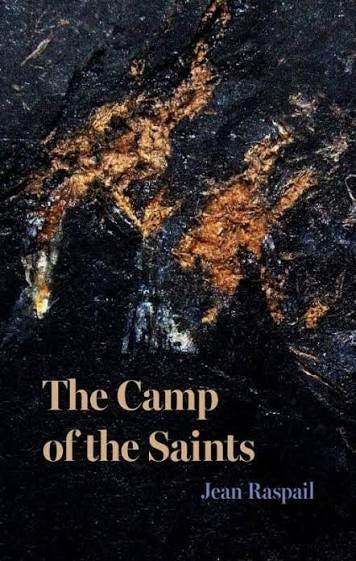
A true banned book is one that you’re not allowed to talk about. Something containing a socially verboten idea, a concept so heinous that Good & Decent People are incensed at the mere notion of its consideration. Doubtless you are once again thinking of Munich, but I’m not talking about Mein Kampf. That’s too obvious. No, for the most glaring example, we should move forty years ahead of Hitler to Jean Raspail’s novel The Camp of the Saints, which has been relevant in ways that few people understand.
Chances are you haven’t heard of Camp of the Saints unless you move in certain literary (or political) circles. Raspail published it in French in 1973, and it later had a limited print run in English in 1975, after which it went unavailable for a long time. An updated French edition came out in 2011, and Ethan Rundell translated that one into English for Vauban Press, which released it in 2025. The timing couldn’t have been more appropriate, as the book’s themes and questions are more pressing than ever—and you’re not allowed to discuss them in Polite Society.
What’s it about? In short: the threat of Third World migration to Western civilization. The “Great Replacement” (it’s no longer a theory.) Hordes of unwashed, unassimilated masses swarming over borders and onto beaches, cannibalizing the nations that receive them, as seen in Germany, France, the U.K., and most recently, Spain—before we even discuss America’s southern border. It’s happening on a wide scale and at an increasing rate of acceleration, and Raspail saw it coming long before the Arab Spring and the rise of ISIS that drove Muslims into Europe by the tens of thousands.
Raspail’s academic background took him to South America where he studied the declining indigenous cultures of Patagonia. Pattern recognition kicked in and while the methods, values, and ultimate goals of Third World invaders to Europe were different from those of the conquistadores in Argentina, there was an applicable question to both: if you have the means to survive an invasion, does it matter if you don’t have the will?
The scenario presented in Camp of the Saints depicts a pair of giant, barely-seaworthy freighters heading out of India with around 800,000 members of the lowest caste aboard. The ships are disgusting, overloaded, ridden with disease, and lacking in any measure of hygiene and social practices that a civilized Western nation would recognize. Raspail notes that the ships can be smelled before they can be seen. Their declared destination is France. They are going to ram the ships on the shore, storm the beaches, and simply take whatever they want. Food. Fuel. Homes. Lives. There is no ambiguity about their goal. Knowing this, the French are faced with an unignorable question:
What do we do to stop this?
As the plot unfolds, Raspail weaves in discussions between parties with varying interests across the ideological spectrum. On one end there are advocates of military intervention, saying they should open fire and sink the ships before they land. On the other end are there culturally suicidal members of the country who, having embraced open-mindedness to the point of self-hatred, are thrilled at the idea of the nation being consumed by something else. They celebrate the coming of the ships. Powerful institutions weigh in, including every department of the French government, the national media, and even the Pope. In between all their declarations you find a range of hand-wringing and denial from people who want the problem to go away but know that it won’t, yet they lack the will to do what is necessary to defend their civilization.
They have embraced a sort of mental poison that won’t allow them to see the binary choice: survival or erasure. The annihilation is always weighed against the gravest social sin of which the West can be accused, which is: you have to be nice to someone who calls himself a ‘refugee,’ no matter what. It doesn’t matter if he’s wielding a knife and covered in blood. It doesn’t even matter if he says to your face that he’s going to kill you and rape your children and burn your house down; he’s from somewhere else that’s poorer than where you live and you have to let him in. What are you, a racist? Are you a bigot? You should be terrified of these labels, good sir! Let the man in!
This is the idea that you can’t discuss, the unquestionable sin in the West. Whether Camp of the Saints was banned outright or simply unavailable due to rightsholder issues is not the problem. You’re not allowed to put this question to the public. You’re socially eviscerated for even considering it. The worst thing you can do is be “mean” to someone from the “Third World,” and if you do anything less than invite them in, pay for their life off the public dole, and even install them in government so they have power over you, you are a racist and a bigot.
Ask them how that’s going in Dearborn, Michigan, or in Minneapolis, Minnesota. They’re starting to feel it in parts of Chicago and New York City. Even deep Red states like Utah have it in Salt Lake City, where Democrats run as Republicans to implement the same model that has worked in the east.
You can’t say the local American population is being replaced. That’s a secular sin. That’s racist. That’s bigoted. You have to let it happen, and no matter how it happens, that’s not as bad as being labeled as such. These are the highest, most cardinal social offenses. This idea, this question, is what qualifies Camp of the Saints for the label of “banned book.” And in America, it doesn’t matter what color of city or state you live in: the question will come to you.
Do you have the will to advocate for your civilization’s survival?
It sounds simple enough, but we never get to answer these things in a vacuum. It doesn’t matter. Raspail studied the question for his whole life, and saw the results of different answers for decades. Camp of the Saints was his way of making the question understandable, and also demonstrating the ways in which the West tries to avoid it. To change the subject. To describe the consequences as anything other than what they are: replacement unto annihilation.
Again, you can see several iterations of answers to this question across Europe. Syrian “migrants” were deposited in small German towns in 2015 at a ratio of three, four, or five to one—sometimes higher—effectively erasing the native Germans from the homes of their ancestors. Paris, France has been taken over by similar demographics and there are thousands of videos on social media of robberies and knife attacks in that city alone. Britain recently published a report on its rape-gang crisis spanning the last two decades, and the organized nature of its perpetrators—Pakistanis—is hard to ignore. (For another novel that tackles that subject, see Bothelford’s Gone by Edward McClaren—but brace yourself, it’s a gut punch.)
And finally Spain saw its most dramatic example of outright invasion in the north African city of Ceuta (which has been Spanish for 500 years) at the end of July. Some 40,000 invading Moroccans were effectively escorted into the city by the Guardia Civil. The local police simply watched truckloads of men jump out in the road, run across bridges, or wade around barriers on the beach to enter Ceuta. They immediately set to breaking into homes, storming convenience stores, stealing whatever they wanted, and threatening the local population. Already there have been five reported rapes of girls under 14, at a hospital that maybe sees that number in a year. Somehow the civilized West is supposed to accept this is better than being called racist.
Raspail wrapped this phenomenon up in a narrative about two boats that loudly declared their intention to invade one specific country. In real life it’s happening in several countries, by varied means, but always with the same result, because somehow the West keeps talking itself into giving the same answer.
Well…not all of the West. The shining star of self-preservation in Europe is Poland, with Hungary in a close second, but there actually is a good example in the U.S., too. Of all places, Martha’s Vineyard—an island full of wealthy residents off of Massachusetts—showed how to handle the problem in September of 2022, when Governor Ron DeSantis (R-FL) sent them fifty Venezuelan “refugees” via plane. The Vineyard—which has 20,000 residents, pretty much all of whom make six figures a year at the very least—is a known sanctuary city, so they definitely had the means and the will to absorb four dozen hungry mouths.
Yet with smiles and self-congratulations, the residents of Martha’s Vineyard had those Third Worlders off their (rich, white) island in two days, never to return. No social blowback came their way. Somehow, for them, self-interest was the right answer. Why could that be?
Jean Raspail’s book continues to ask this question even after his death in 2020 at the age of 94. Again, you’ll never see it on a “banned books” list, and in this day and age, it’s not. Vauban Books and Ethan Rundell have seen to that, and we owe them a debt of gratitude for their work. Now you can access The Camp of the Saints at an affordable price, and the next time the subject comes up, you’ll have something really interesting to ask other readers.
I wonder what they’ll say.
Excellent writeup. That website's loss is my gain