

…but what about second Constitution?
2026 is America’s 250th birthyear. To celebrate, I’m highlighting 50+ significant American documents from our history. So far I have covered The Mayflower Compact, Patrick Henry’s Speech, The Lee Resolution, and The Declaration of Independence.
Subscribe to get these articles in your inbox, along with my regular book/comic/movie reviews. I also like money, and if you like me having money, become a paid subscriber. There’ll be special content for you, including original fiction, and early access to posts.
“This Should Be Easy, Right?”
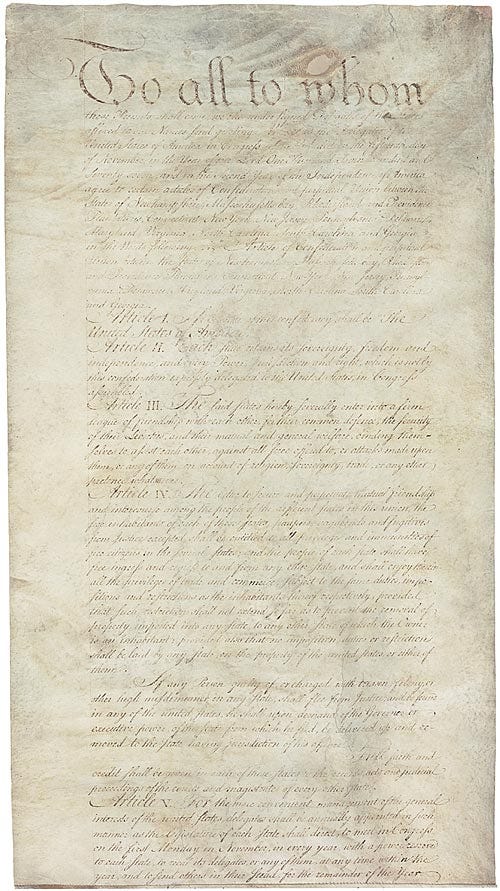
Before the Constitution was ratified in 1789, it was the subject of rigorous debate, input, and revision. That’ll be a subject for another day. What you’ll be less familiar with is the run-up to the Constitution, namely the document (or series thereof) that the colonies—States—first used to draw lines around themselves and define their relationship to one another.
These documents are the Articles of Confederation, officially adopted in 1777, and their sufficiency would be tested for a decade before being replaced by the Constitution. In 1787 they gave Hamilton, Madison, and Jay (collectively “Publius”) plenty to draw on when they penned eighty-five documents (The Federalist Papers) outlining their faults.
What’s in the Articles of Confederation? Well, you can read them all here. There were thirteen articles in total, dealing with everything from trade agreements to military treaties between the confederated States. Article 1 determined their name as “the United States of America.” Article 2 affirmed their individual sovereignty. Article 3 listed the conditions under which they would come to the military support of one another, and so on.
Article 4 allowed the citizens of one state to freely travel to another, unless they were criminals, and from there the terms of extradition were outlined. Article 5 set the terms for Congressional representatives to be sent from each state to the national stage once per year so they could handle matters of the entire confederacy from the perspective of their interests. You get the idea.
Personally I was impressed that multiples of the closing articles dealt with specifics on standing armies, state militias, and how they were to be organized/commanded. Whether it was even legal to have standing armies was a subject of on Article. States couldn’t handle foreign affairs with other nations unilaterally, but instead had to deal with the United States at large, and so on.
So what went wrong?
Well, in brief, the confederation of States (consisting of a few defunct names like “Massachusetts Bay” and “Rhode Island and Providence Plantations”) didn’t have enough centralized power to deal with the larger issues facing the United States as a whole. There was no executive branch, no Supreme Court. It was basically Congress trying to run everything, and the larger States bodied the smaller ones. This would contribute to Constitutional provisions like bicameral legislation and an Electoral College, for example.
In trying to form a central government that was deliberately hobbled (and thus unlike a monarchy), the Articles of Confederation created an entity that was too impotent to do many things that a monarchy needed to do for its own growth and protection. It couldn’t levy taxes, which in theory is a good thing, and was the subject of much debate over the years (“The power to tax is the power to destroy”). Foreign relations were tricky. Who spoke for the nation at large? Who negotiated commerce on behalf of thirteen states? If something isn’t working, how do we amend it?
That last part was especially troubling, if you consider just how hard it is to amend the Constitution now, and that doing so is somewhat easier than amending the Articles of Confederation. The Founders were rightly and understandably wary of centralized power. The Constitution was a second (superior) draft of a process that they attempted with the Articles of Confederation. By putting it into practice, they found out what its flaws were.
Any engineer or military strategist will tell you that no plan survives contact with implementation. Legal theory is no different. What sounded good on paper had some problems in practicality, and the early States at least gave it a shot of several years to figure that out. Once they knew it didn’t work, they went back to the drawing board, and the Articles of Confederation were placed in the archives.
America rocks.