

A New Series Appears!
Welcome, welcome, Happy New Year and suchforth. 2026 is America’s 250th birthyear and we here at Trucker Man Reads are all about that life. To celebrate, I’m highlighting 50+ significant American documents from our history—documents you’ve probably heard of and also probably never read in their entirety. (This is not condemnation, I have not read many of them myself.)
In addition to the documents, I’m also covering every President’s first inaugural address, with a few asterisks, because the transition between executives has not always been seamless. (Assassinations, resignations, and so on have made for a few hiccups in continuity.)
Subscribe to get each of these articles in your inbox, along with my regular book/comic/movie reviews throughout the year. I also like money, and if you like me having money, become a paid subscriber. There’ll be special content for you, including original fiction, and early access to posts.
No.1: The Mayflower Compact
It will not shock anyone that I have read this myself, and not just because it’s short. I’m a bit of a Pilgrim fanboy. “That’s my tism,” as the kids say. I went down a rabbit hole in 2018 and never came out. Now I’ve ready close to twenty books on this subject, so I know a fair bit about it.
What’s the Mayflower Compact? Well, the skinny version is this: the Pilgrims sailed from England to America in the fall of 1620. They hit a few speed bumps along the way, due to weather, problems with their boat, and more. They were originally aiming for Virginia but the Mayflower was not a powered vessel, and Captain Jones could only work with what the winds gave him. They rode a higher latitude than they wanted to, and thus ended up north of Virginia, in modern-day Massachusetts.
Why was this a problem? Because according to English laws at the time, Virginia was subject to King James but Massachusetts was not, and if the Mayflower landed in a place that was not England-flavored, it could create legal complications—not least of which would mean a problem with the servants. They could claim their contracts with their masters were null, and disappear into the wilderness, leaving the colony undermanned and vulnerable.
(Those vulnerabilities would come anyway, but they didn’t know that when they were still on the ship in November of 1620.)
Effectively they were landing in a place with no English laws, and they needed to establish those laws on the fly in order to avoid existential threats to their organization. The Pilgrims had a contract with the Second Virginia Company (merchant adventurers—basically the investors that paid them to go build a colony and send back goods) and the contract was for an intended location. Cape Cod was not that location. Between the weather and the time of year, they couldn’t get to Virginia, so they needed to turn Massachusetts into England, in a way that was legally defensible.
(George F. Willison, who wrote SAINTS AND STRANGERS, also puts forth a theory that landing too far north might have been intentional for a few reasons, but it’s not conclusive.)
Thus the Pilgrims drafted the Mayflower Compact, and every man of age signed his name to it. Here is the text in its entirety:
In the name of God, Amen. We whose names are underwritten, the loyal subjects of our dread sovereign lord King James, by the grace of God, of Great Britain, France, and Ireland King, Defender of the Faith, etc.
Having undertaken, for the glory of God, and advancement of the Christian faith, and honor of our king and country, a voyage to plant the first colony in the northern parts of Virginia, do by these presents solemnly and mutually in the presence of God and one of another, covenant, and combine ourselves together into a civil body politic, for our better ordering and preservation, and furtherance of the ends aforesaid; and by virtue hereof to enact, constitute, and frame such just and equal laws, ordinances, acts, constitutions, offices from time to time, as shall be thought most meet and convenient for the general good of the colony: unto which we promise all due submission and obedience. In witness whereof we have hereunder subscribed our names; Cape Cod, the 11th of November, in the year of the reign of our sovereign lord King James, of England, France and Ireland eighteenth and of Scotland fifty-fourth, Anno Domini 1620.
Who signed it? As I said, men who were old enough. Among the passengers, that totaled forty-one. Half of them would be dead by the summer, due to starvation, exposure, and disease.
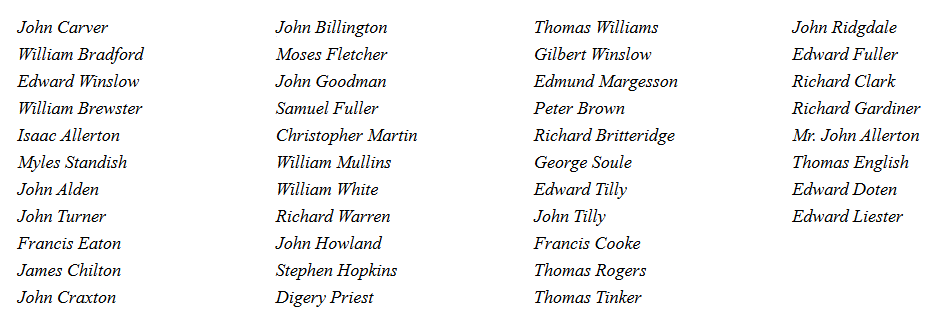
It remains a significant American document because John Adams and other northern men—descended from these by blood, soil, and tradition—were inspired to follow their example and form their own “body politick” through signature and accord. The Pilgrims weren’t trying to establish a pattern of documentary constitution, and the idea of uniting around a written agreement wasn’t novel in English law; that didn’t matter, it was one of a few factors that the Founding Fathers looked to as they made plans for the new nation.
Then as now, men of New England put great stock in their ancestry from the Mayflower, their connections to Plymouth, and their longevity in the English-speaking realm of North America. While John Carver signed his name to a document affirming Plymouth’s loyalty to King James, John Adams would sign one declaring his nation’s independence from King George over a hundred and fifty years later.
Ultimately, both men would sign their accords to the same purpose: the stability and future prosperity of their people and their homes. This is what makes the Mayflower Compact a significant American historical document, perhaps even the first.
Whenever I mention Plymouth, I’ll invariably get Virginia Supremacists in my mentions proclaiming that Jamestown was established thirteen years prior, making it the first English colony in America—to which I say “No duh.” My ancestry runs straight through Appalachia and into Virginia, back to England and Ireland. I’m well aware that Jamestown beat Plymouth by over a decade.
The difference is that Jamestown was established by royal charter, according to plan, and nobody had to improvise for its founding, whereas Plymouth didn’t have to be legal. Everything went wrong from the word ‘go’ and they wrangled civilization into it.
They showed up in a place with no English law and basically drafted a soft constitution to make it so, with the anticipation that the Compact would have legal recognition back in England. One colony made a plan and stuck to it. The other one refused to surrender in the face of ever-evolving hardship. The calendar can’t negate that.
Anyways. Read the Mayflower Compact. Read any of the books I’ve recommended on this subject before. Above all, remember: America is awesome.