

“Electoral Brawlage” examines the first inaugural address of each president in U.S. history, with some commentary and analysis. Check back on Mondays for more.
Subscribe to get these articles in your inbox. Become a paid subscriber to give me money, because I like money and I use it to buy books.
Executive Vacancy
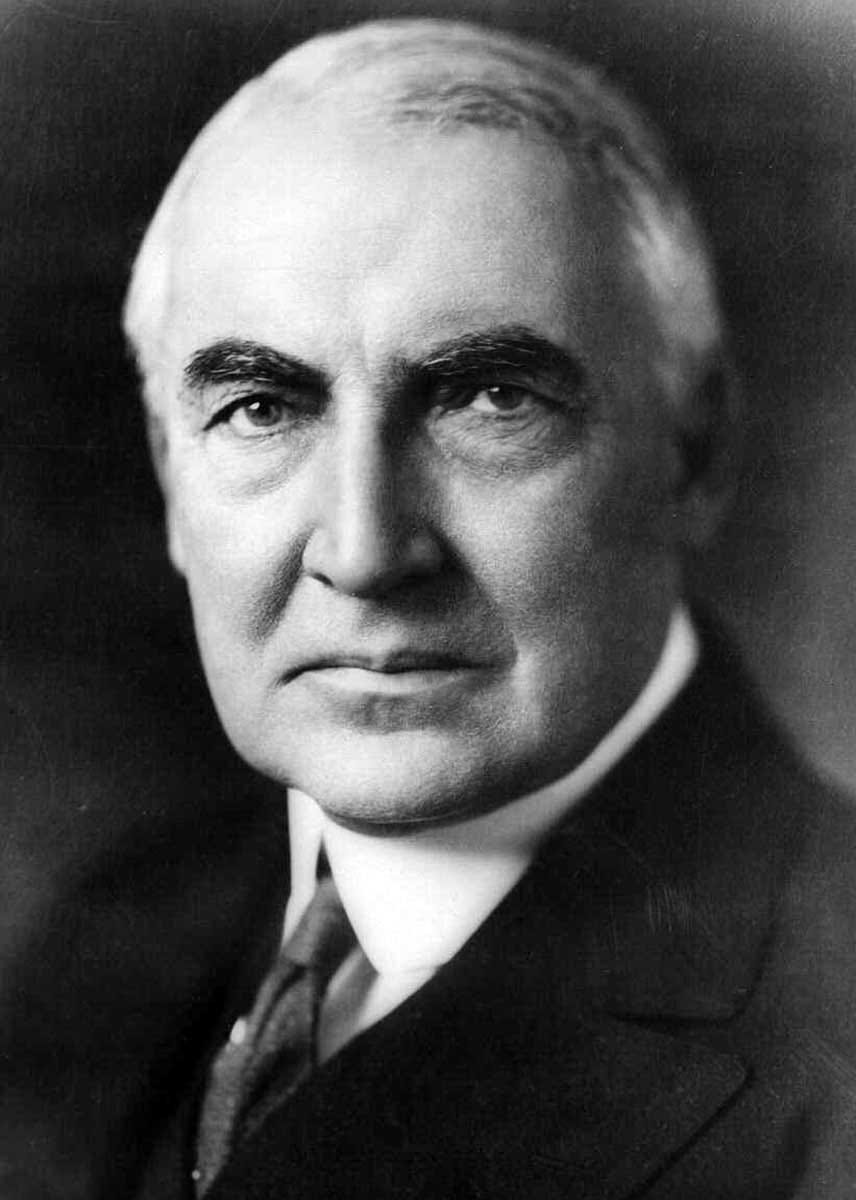
Warren G. Harding, our nation’s 29th president, is like William McKinley in that he died in office and most people today remember little about him. His election in 1920 was a preview of dueling philosophies that would shape the next two decades of American presidential politics, mostly because of the men on the vice presidential side of the tickets.
In 1920, the Republicans won in a landslide. People were tired of Wilson and the era of Progressivism, and an economic recession (paired with a postwar period) had everyone ready for a change. The GOP nominated Harding, who had most recently been a Senator out of Ohio, and the Democrats put up James M. Cox, who was the governor of Ohio.
We’ve been putting up with Ohio for too long, IMO.
Their VPs were Calvin Coolidge, governor of Massachusetts, who garnered national fame with his handling of the 1919 police strike, and Franklin D. Roosevelt, the Assistant Secretary of the U.S. Navy.
Isn’t is strange, Charlie Brown, that both times we got into a world war, FDR was involved…
Not going down that rabbit hole. Let’s talk about 1920!
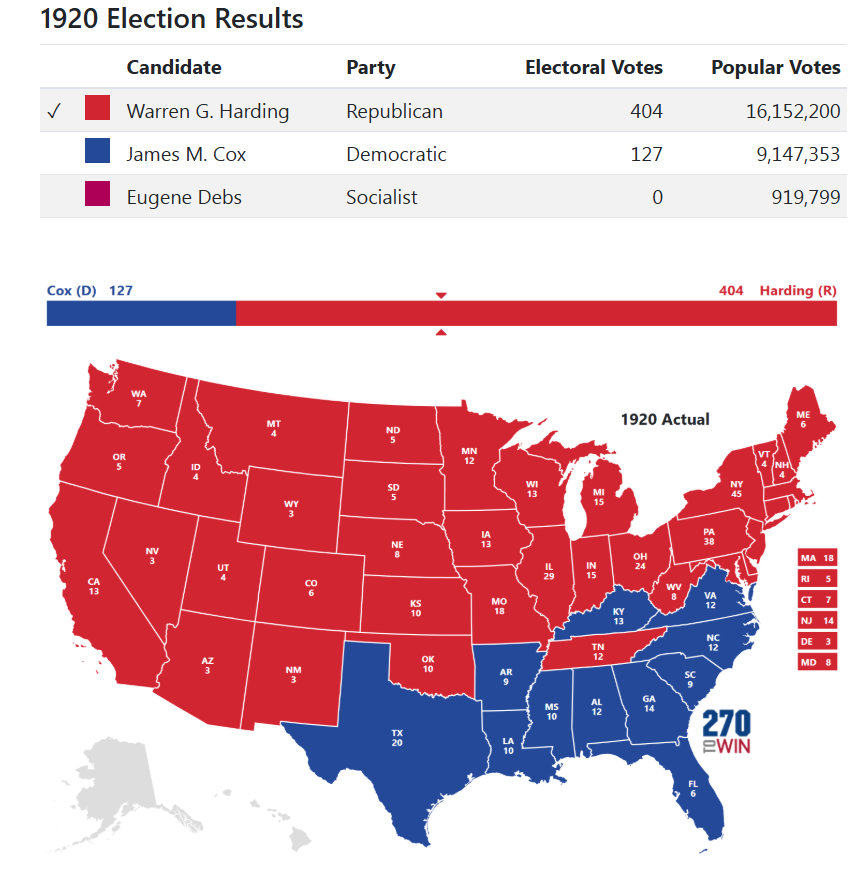
An electoral map like this is why people say “ThE ParTiEs SWiTcHed!!!”
The only thing they switched it tactics, and most of that centered on demographic targeting. Any electoral heat map from before the Civil Rights Act will have significant differences to a map from after, and those differences only get more stark with each successive decade.
Nevertheless there was a time when the South was a Democrat stronghold and the Northeast was hard Republican territory. We’ll see that change around the sixties.
Harding/Coolidge beat Cox/Roosevelt by almost 280 Electoral votes and 7 million popular votes. The state breakdown was 37 to 11. If Warren G. Harding was a Constitutional amendment, he would have passed.
One of the major drivers of high election turnout was the recent ratification of the 19th Amendment, which granted the right to vote to women. This may also have contributed to an uptick in Eugene Debs’ increased vote returns, despite the fact that at the time of the election he was in prison, where all socialists belong.
The Speech
When one surveys the world about him after the great storm, noting the marks of destruction and yet rejoicing in the ruggedness of the things which withstood it, if he is an American he breathes the clarified atmosphere with a strange mingling of regret and new hope.
It won’t surprise anyone that Harding’s inaugural speech in March of 1921 focused very heavily on the aftermath of the Great War. He starts by addressing the folly of the League of Nations, if not by name then by concept, and then progresses into the state of things socially and economically at home.
The recorded progress of our Republic, materially and spiritually, in itself proves the wisdom of the inherited policy of noninvolvement in Old World affairs. Confident of our ability to work out our own destiny, and jealously guarding our right to do so, we seek no part in directing the destinies of the Old World.
It’s a very readable speech, much like Teddy’s in 1905, and not like Taft’s in 1909. This is a father and a friend, not a lawyer speaking.
Perhaps we can make no more helpful contribution by example than prove a Republic's capacity to emerge from the wreckage of war.
War never left such an aftermath. There has been staggering loss of life and measureless wastage of materials. Nations are still groping for return to stable ways.
We contemplate the immediate task of putting our public household in order. We need a rigid and yet sane economy, combined with fiscal justice, and it must be attended by individual prudence and thrift, which are so essential to this trying hour and reassuring for the future.
We must seek the readjustment with care and courage. Our people must give and take. Prices must reflect the receding fever of war activities. Perhaps we never shall know the old levels of wages again, because war invariably readjusts compensations, and the necessaries of life will show their inseparable relationship, but we must strive for normalcy to reach stability.
The text of the speech really shows what the economy of the day looked like, and how most people lived—on farms, or in industrial towns, and how those towns were affected by the sudden arrival of the Great War into their lives. Harding wanted to rebuild from that as directly as he could, and in a way that was sustainable. It would involve many practices that were direct opposites of Wilson’s philosophies.
I speak for administrative efficiency, for lightened tax burdens, for sound commercial practices, for adequate credit facilities, for sympathetic concern for all agricultural problems, for the omission of unnecessary interference of Government with business, for an end to Government's experiment in business, and for more efficient business in Government administration.
And his closing is just beautiful.
Service is the supreme commitment of life. I would rejoice to acclaim the era of the Golden Rule and crown it with the autocracy of service. I pledge an administration wherein all the agencies of Government are called to serve, and ever promote an understanding of Government purely as an expression of the popular will.
I have taken the solemn oath of office on that passage of Holy Writ wherein it is asked: "What doth the Lord require of thee but to do justly, and to love mercy, and to walk humbly with thy God?" This I plight to God and country.
We don’t remember Harding much, but we should. He was the right man in Wilson’s wake.
Visit Nauvoo Supply to order HEARTLANDERS, the most American novel I’ve ever written. It’s like if National Treasure happened during Fallout with G.I. Joes.
My Amazon page has my other books, including FOSSIL FORCE for young boys and Engines of Liberty for all ages.
I post several times per week on YouTube.
Subscribe here for more book reviews and for articles on what I continue to learn as I read.
Thank you for sharing this! I've always been fascinated by Harding, perhaps because he has been discarded by history. We need to learn more about his important presidency. The lack of curiosity among historians is alarming. What else don't we know? Thank you for highlighting his words. Great article!
Nominated and elected for one reason only. He looked presidential. Otherwise a real airhead who spoke bloviating, empty nonsense.