

“Electoral Brawlage” examines the first inaugural address of each president in U.S. history, with some commentary and analysis. Check back on Mondays for more.
Subscribe to get these articles in your inbox. Become a paid subscriber to give me money, because I like money and I use it to buy books.
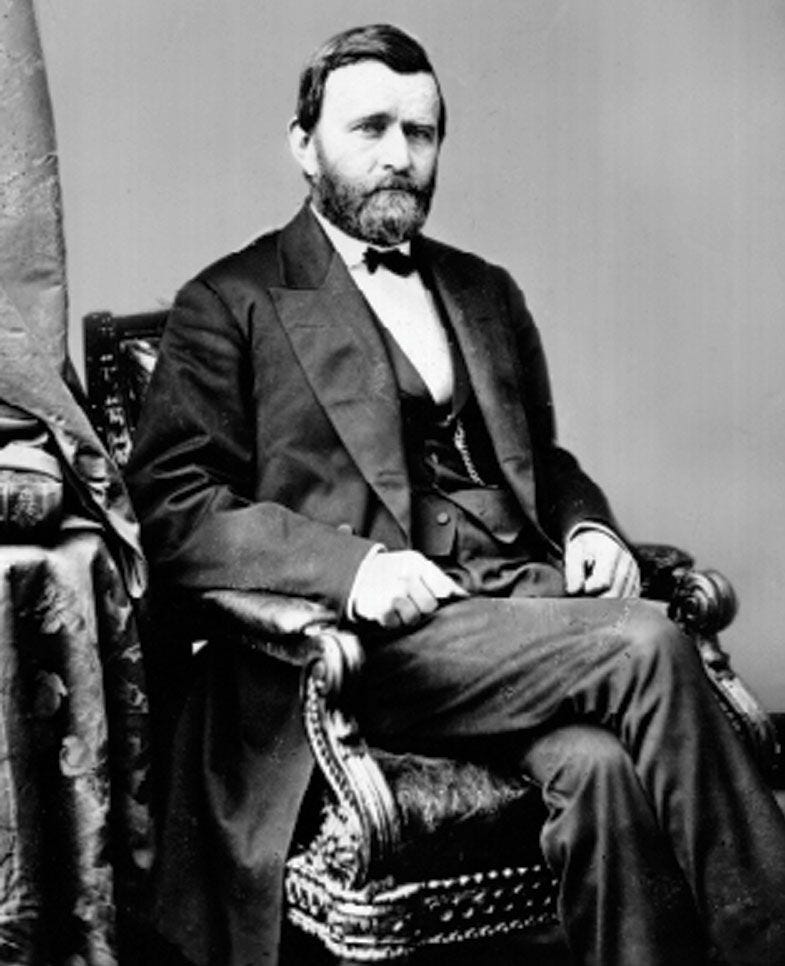
By the rules of masculine ad hominem, Ulysses S. Grant should never have become one of our greatest presidents: he was a ginger manlet (5’8”) whose job at one point was to sell firewood on the street corners of Saint Louis, he was so broke. He would eventually be given total control of the Union Army, and four years later he would be President. By the end of the war, men with whom he had attended West Point and had participated in his wedding would surrender to him.
Bro leveled up.
The election of 1868 came not quite at the end of a turbulent era, but in the middle of one, caused by the previous turbulent era. The Civil War was over and Reconstruction was underway in the South. The last man to win a presidential election had been shot a month after the start of his second term, and his successor was impeached, then came within one Senate vote of being removed from office. Unsurprisingly, Andrew Johnson did not win the Democratic nomination for president in 1868.
That honor went to Horatio Seymour, governor of New York (former). His VP was Francis Preston Blair, Jr, from Missouri. (Grant’s was Schuyler Colfax from Indiana.) Blair was popular in Missouri and therefore the South, while Colfax was the Speaker of the House.
The race was closer by popular vote than by Electoral, but I remind you once again that popular vote is not relevant for our purposes here, and only low-T crybaby losers (who can’t drive stick) use it as a metric for any sort of validity. Grant took 53% of the popular vote and 26 of 34 states, for an EV total of 214 to 80. It turns out that 1) winning the CW and 2) running on a platform of “Let us have peace” is a winning message to a war-weary nation.
So What Did He Say?
Every executive so far has started his time in office with something to the effect of “Boy this is terrifying and humbling, God help me…” but U.S. Grant had lived through the worst war on American soil, and had his fear burned out of him. He opens his inauguration thusly:
I have taken this oath without mental reservation and with the determination to do to the best of my ability all that is required of me. The responsibilities of the position I feel, but accept them without fear. The office has come to me unsought; I commence its duties untrammeled.
From there he lays out his policies and his approaches to the immediate problems the country faces: Reconstruction, application of law, and the war debt. Laws will now apply equally to everyone (can you even imagine) and if you don’t like a law, vote to change it. (This was back when the voter base wasn’t flooded with illegals from hellholes on the public dole and so your vote had a lot more impact.)
Laws are to govern all alike—those opposed as well as those who favor them. I know no method to secure the repeal of bad or obnoxious laws so effective as their stringent execution.
Sound fiscal policy was also on the docket. There would be taxes and such, aggressively temporary ones, and once the war debt was dismissed those taxes would go away (and they did.) He also made mention of recent ore discoveries in the Mountain West that could be exploited to enrich the nation in the wake of the conflict. (San Francisco’s Gold Rush was 20 years in the past by this time, but the Comstock Lode was only 10 years old and still being developed.) He looked forward to future strikes and finds that would continue to fuel America’s rise.
His most consequential foresight may have been this:
The young men of the country—those who from their age must be its rulers twenty-five years hence—have a peculiar interest in maintaining the national honor. A moment's reflection as to what will be our commanding influence among the nations of the earth in their day, if they are only true to themselves, should inspire them with national pride.
If every executive could have such a focus on the nation’s future leaders, damn, we’d be a lot better off.
The rest of the speech is short and to the point, as a military commander might issue it. Foreign policy? We want everyone to get along and we’ll be nice to you, but if you cross us, we are kicking you directly in the balls. Indians? I wanted them treated well, civilized, Christianized, and given citizenship. Suffrage? We need to settle this now and y’all should take a good look at the propose Fifteenth Amendment.
In conclusion I ask patient forbearance one toward another throughout the land, and a determined effort on the part of every citizen to do his share toward cementing a happy union; and I ask the prayers of the nation to Almighty God in behalf of this consummation.
You need to read Ron Chernow’s 1,100-page biography of our eighteenth president, simply titled Grant. No bull, this man was one of the greatest presidents we’ve ever had and was instrumental in the peaceful execution of the Reconstruction. I read it back in 2020 and it was excellent. Easily made my best-of-year list and I will read it again.
I still need to get a copy of his personal memoirs, which he wrote and finished just a few days before dying. The sale of those memoirs settled his estate’s debts and set up his widow for the rest of her life.
If you become a paid subscriber, I’ll use those greenbacks to add a copy of those memoirs to my library.
My Amazon page has all my novels, including the critically-acclaimed FOSSIL FORCE for young boys, and the Engines of Liberty series for all ages.
I post several times per week on YouTube.
Subscribe here for more book reviews and for articles on what I continue to learn as I read.