

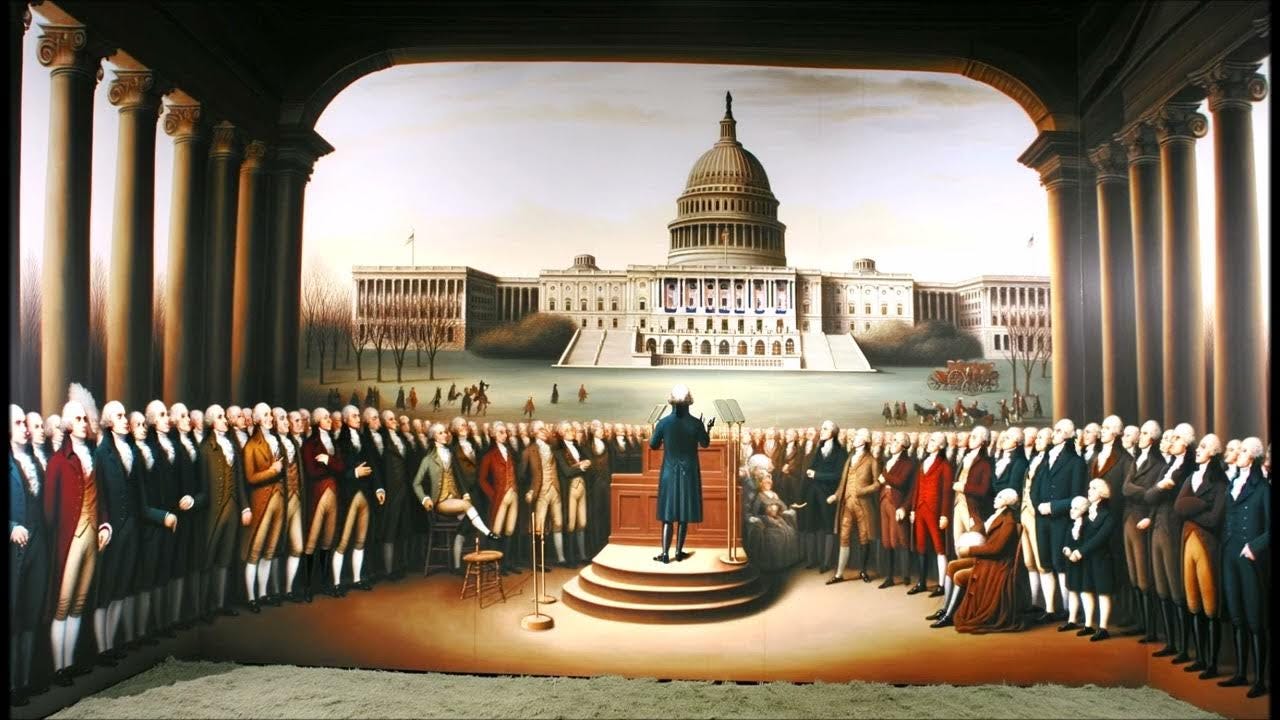
“Electoral Brawlage” examines the first inaugural address of each president in U.S. history, with some commentary and analysis. This is the third installment. Check back on Mondays for more.
Subscribe to get these articles in your inbox. Become a paid subscriber to give me money, because I like money and I use it to buy books.
In His Own Words
Here’s a link to the address in its entirety.
Jefferson was the third man to hold the highest office in the land. Father George still left huge shoes to fill, and John Adams had only succeeded him for four years. The traditions and examples of the office were still in their infancy and Jefferson understood the burden upon him to establish them well.
During the contest of opinion through which we have past, the animation of discussions and of exertions has sometimes worn an aspect which might impose on strangers unused to think freely, and to speak and to write what they think; but this being now decided by the voice of the nation, announced according to the rules of the constitution all will of course arrange themselves under the will of the law, and unite in common efforts for the common good.
Like Adams, Jefferson never wore the uniform and took up arms for the physical part of the Revolution. He wasn’t out there in the fields and valleys shooting Redcoats and Loyalists. He didn’t pay the price in blood, but he paid it in intellect and philosophical labor, which was just as critical, or perhaps even more so, to making sure that there was something meaningful left in the wake of the Crown’s laws.
Anybody can do the combat side of a revolution. Pick up a gun and shoot someone, repeat as necessary. The critical question is: what comes next? Jefferson was a key figure in making sure that what came next not only mattered, but would endure. After serving in two other offices at the federal level, he now held the highest one.
…it is proper you should understand what I deem the essential principles of our government, and consequently those which ought to shape its administration.
The fourth paragraph of his address is lengthy and thorough. I won’t recap the whole thing here, but he lists the principles that he holds in the highest value, probably in order, and it should surprise nobody that these mirror the Bill of Rights.
…a well disciplined militia, our best reliance in peace, and for the first moments of war, till regulars may relieve them:
—the supremacy of the civil over the military authority:
—economy in the public expense, that labor may be lightly burthened:
—the honest payment of our debts and sacred preservation of the public faith:
—encouragement of agriculture, and of commerce as its handmaid:
—the diffusion of information, and arraignment of all abuses at the bar of the public reason:
—freedom of religion; freedom of the press; and freedom of person, under the protection of the Habeas Corpus:
—and trial by juries impartially selected.
The only one of these that feels like an odd duck to me, a lifelong city slicker, is the inclusion of the encouragement of agriculture, but I should remember that most of these men were either farmers, or descended therefrom. Agriculture was especially key in the South, and Jefferson was a Virginia man through and through.
In fact, 5 of the first 7 presidents were from Virginia, and the only two Northerners were a father-and-son duo named Adams, from Massachusetts. But that’s a point to be emphasized in another context later.
Agriculture is still hugely significant today but it’s not on the majority of Americans’ minds because we’re technologically advanced, and more of us live in big cities. Nevertheless we ought to pay more attention to this industry because the cost and availability of food—to say nothing of the Fed’s willingness to mettle with the processes integral to it—really affects our day-to-day.
You can argue that law is ethereal, but agriculture is extremely tangible, and we all rely on it. But I digress.
In the penultimate paragraph, Jefferson says the following:
With experience enough in subordinate offices to have seen the difficulties of this the greatest of all, I have learnt to expect that it will rarely fall to the lot of imperfect man to retire from this station with the reputation, and the favor, which bring him into it.
He’d been Secretary of State and Vice President. Now he was assuming office of the Commander-in-Chief. He knew he wasn’t going to please everyone and that not everyone would like him when it was all over. Thus he closes with this:
Relying then on the patronage of your good will, I advance with obedience to the work, ready to retire from it whenever you become sensible how much better choices it is in your power to make. And may that infinite power, which rules the destinies of the universe, lead our councils to what is best, and give them a favorable issue for your peace and prosperity.
There’s a humility and a willingness to serve that we don’t often see in our leaders these days. Most people don’t know much about Jefferson, other than the meme about him having sex with one of his slaves and thus every black American is related to him. (More likely than not this is bullcrap, but people get their historical information from Key & Peele sketches these days, so that’s your electorate for you.)
(For more on that, check out L.A.C’s video essay.)
In closing, Jefferson approached the office with wisdom and sobriety, maintaining the same perspective and virtues that had carried him through the Revolution for the past two and a half decades or more. We’ve hardly had a man more prepared or equipped to do the job since him.
For videos of these articles and more of my book reviews, subscribe to the YouTube channel. Thank you for reading.
Jefferson is my second favorite founding father. Washington has to be first, since he handed away an empire.