

So hey. You guys know me. I’m the Mayflower guy. Some dudes get really interested in trains, I got really into a boat full of English pilgrims who landed in Massachusetts just over 400 years ago. I think they’re neat.
This November marks 5 years since I uploaded a rather timely video to YouTube and caused my channel to take off like crazy. All I did was point a shaky camera at a poster of Mayflower survivors and talk off the top of my head about their trades. Now that video sits at 650k views and it will probably hit a million this fall.
In that time I’ve continued my reading about these people and this time period. I’ve already sorted through thousands of comments on the original video. And maybe one in a hundred will come back with something like “Hurr durr, these people were all terrorists and thieves who killed the Indians,” at which point I come unglued.
Because that’s bullshit.
And I know this, because I read.
And I know they don’t know this, because they don’t read. They get all of their educational programming from TV dramas, written by morons in an ideological bubble. So here we are.
Any reader of history will tell you that things are far more complicated than any drama is willing to convey, especially a drama written by antagonistic ideologues. You can say true things without making a true statement, kind of like that Brian Regan joke:
“Adolf Hitler was rejected as a young man in his application to an art school. One thing led to another and the United States ended up dropping two atomic bombs on the sovereign nation of Japan”.
Both of those statements are accurate. Hot damn though, there’s some material on the cutting-room floor…
It’s also technically correct to say that Civil War officer Nathan Bedford Forrest was 1) a slave trader, 2) a Confederate, and 3) a member of the KKK, but those statements combined don’t consider that he 1) was born into the family trade, 2) told his black subordinates he’d free them whether the South won or lost, and 3) joined the KKK thinking it would promote national unity. The more it delved into racial ideology, the less he wanted to do with it, because the war changed his attitude toward black people.
“But Graham! You’re forgetting about King Phillip’s War in 1676, when the Pilgrims killed the Wampanoag chief who helped them! They cut off his head and put it on a stick!”
No, Internet Turdwaffle, I have forgotten nothing. “King Phillip” was the Christian name of Sachem Metacomet, son of Ousamequin, who was the Massasoit (Great Sachem) of the Pokanoket people (a Wampanoag tribe.) After Ousamequin died, his son Wamsutta became the next sachem, but before he long he died as well, and the title fell to Metacomet.
From there, a dispute arose over whether certain lands that Ousamequin had sold to the Pilgrims (over the course of several decades) were his to sell, and whether they were or not, the Pilgrims had paid for them. Metacomet broke the Pokanoket alliance with Plymouth and instead allied with a rival colony, demanding “his” lands back, lands that the Pilgrims had already been farming and living on for a while.
Contention accelerated, small groups on both sides sniped at each other, and before long there was all-out war between the Pilgrims and the Indians. The Pilgrims won, but they suffered greatly, and in punishment for the violence he waged and the peace he destroyed, Metacomet was decapitated and yes, his head was put on a pike as a warning to never bring war and suffering like this to an innocent people again.
But the Internet Turdwaffles don’t know any of this. It never popped up in their TikTok feed.
Read Book, Learn Thing
My willingness to explore the actual histories of so-called “controversial figures” has only amplified in the last five years, as I’ve watched absolute bastards tear down statues of men who were orders of magnitude more courageous, noble, and accomplished than they’ll ever be, simply for being found guilty in the kangaroo court of mob opinion.
This is why I’ve opposed tearing down statues of Confederate leaders, because it was never going to stop there. They’ve torn down Teddy Roosevelt, they’ve torn down Thomas Jefferson, they’ve torn down George Washington. It’s never about the facts or merits of their claims, they just want to destroy things. That alone is reason enough to oppose them, but as an amplifier, the true stories of these people are awe-inspiring, in their day and in ours.
(I said this in 2020 after reading REBEL YELL and I’ll say it again now: Stonewall Jackson was an American badass and deserves to be remembered and celebrated just as much as Robert Smalls. Who’s Robert Smalls? I’m not surprised that they don’t teach about him. He was a Republican politician in the post-Civil War South. During the War he stole a CSA ship and sailed it through a blockade to turn it over to the Union. And he was black. They also don’t teach you about Stand Watie. That’s a subject for another day.)
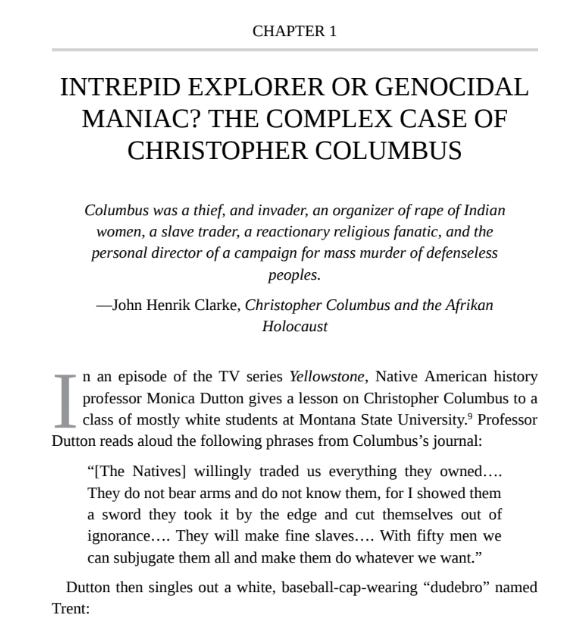
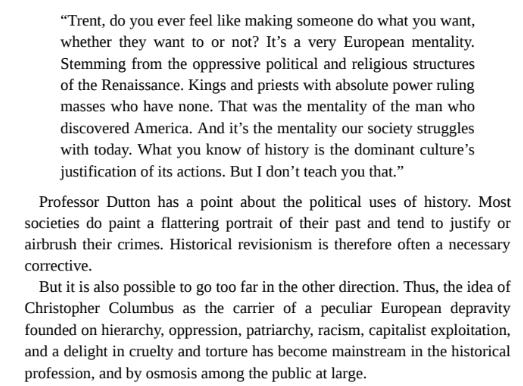
The point of all this is that the truth is the best disinfectant to pop history and the racial grievance fiction that it commands you to accept as fact. My problem is that I don’t have the time to source specific facts to rebut specific claims every time they rear their ugly heads, like this one that makes the rounds from that Kevin Costner production about Indians. No, not that one, the other one.
There are Historians, and there are Ahistorians. The above scene was written by the latter.
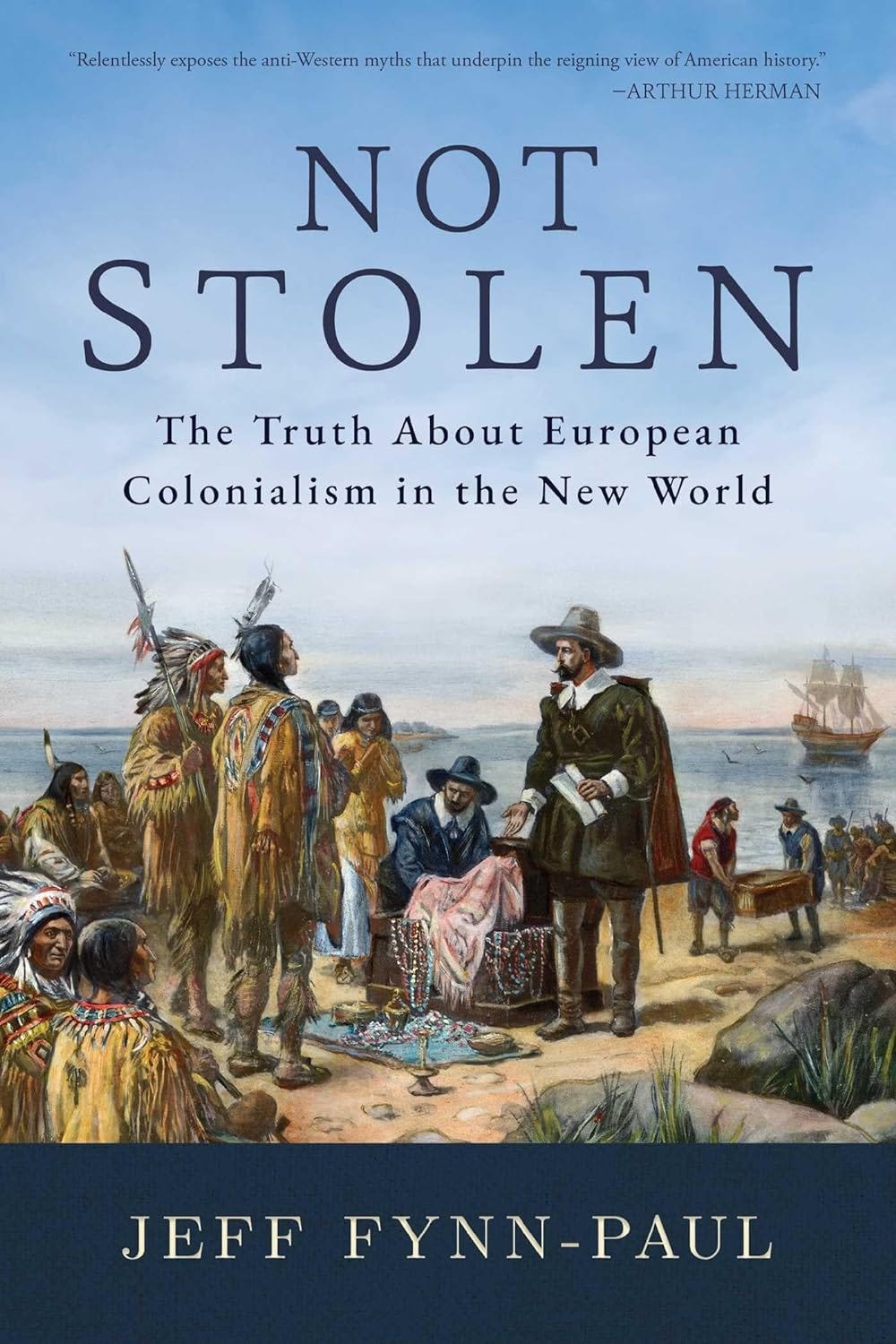
And it brings me no shortage of joy that writer Jeff Fynn-Paul tackled this scene head-on, right out of the gate, in the opening of his brilliant book NOT STOLEN, which I just read this week.
Take a minute and read these, I had to screencap them from the ebook. I also own the paperback. The book came out on Audible recently but I’d already purchased it and wanted to hold off.
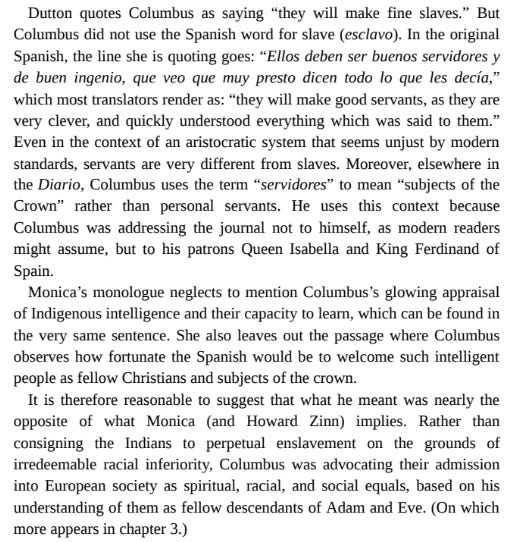
Reading that third passage was like slugging down a cold Gatorade on a hot day. Not only am I a fluent Spanish speaker, I have been so for more than half my life, I have lived in Spain, and I have read the journal of Columbus’ first voyage (admittedly in English). The word “servant” was used in the translation I read, which is a direct translation of servidores (“servers”) and has nothing to do with the notion of slavery.
But the Ahistorians love to make hay out of this quote. It is their Bible, their chief cornerstone of Sounding Smart Whilst Being Wrong. “Oh look, Columbus himself said this.” No, he didn’t, you’re a jackass, and you owe the world an apology.
(Several years ago, cartoonist The Oatmeal tried to get people to celebrate “Bartolome De Las Casas Day” instead of Columbus Day. Oats used this quote specifically, lauding De Las Casas for his “humanity” and Amerindian advocacy…
Too bad Oats didn’t read far enough, because according to Charles C. Mann, De Las Casas suggested replacing Amerindian Slaves with black ones. Soooooooo….)
It’s not just Columbus
Fynn-Paul has put together the most comprehensive book on this phenomenon that I have read to date. He starts with Columbus and goes through the whole roster of so-called villains, addressing the Spanish conquistadors, the English, the Dutch, the French, the Pilgrim fathers, the Revolution era with the Founders, the Westward Expansion, the 1970s progressive explosion, and more—all the way up to the BLM riots in 2020, and how we got to where we are now.
This book could have been 800 pages and I would have gobbled it down. Fynn-Paul covered all of this in 400, succinctly, thoroughly, and fairly. This isn’t an argument for its own sake; these are facts of history arguing against a malicious political narrative for the sake of sanity.
The humanities, as a field of study, are often considered separate from the sciences. In Fynn-Paul’s closing statements of the book, he expressly treats history as a science because it does deal in cold hard facts, and it can be corrupted by narrative and deception. The more we find ourselves inundated with the corporate-sponsored work of Ahistorians, the more we’ll need writers like this to plant their feet and push back.
I’m glad Fynn-Paul wrote this book. He did it better than I could have hoped for.
I’ve read 70 books now in 2025, and this is the 7th to make my best-of-year list. It’ll probably be at the top. Go read it.
See you out there.