

Picture this: you’re a writer, but also a physicist, and you’re friends with some incredibly brilliant people in different scientific fields. There’s a Current Day political debate going on and you’d like to tackle it in your writing, but you’re not sure how.
One day you’re sitting at home and watching a movie about the Scopes Monkey Trial, wherein a man was put on trial for teaching evolution in a state-funded school, and that was against the law.
The teacher, Scopes, violated the law intentionally so that it could be tested in court and thus establish some sort of legal precedent in the ongoing debate between fundamentalists and modernists.
You, the physicist-writer, suddenly get an idea: when this case actually happened (1925), evolution in education actually was a hot-button topic. What’s the hot-button topic in state-funded education right now? You’d be hard-pressed to find a button hotter than transgenderism, or any ideology of its ilk.
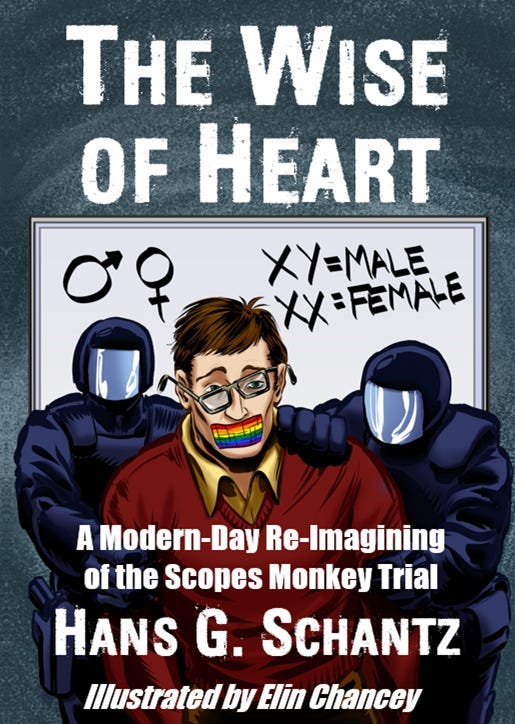
And thus, Hans G. Schantz came up with the seed of THE WISE OF HEART, which retells the Scopes Trial and centers the issue firmly on gender identity issues.
Note: that button takes you to an affiliate link, if you purchase through there then I will earn a small commission. Thanks.
The Story
Much like the Scopes Trial, our story begins with a teacher intentionally violating a new statute called the GAIA Act, which issues guidelines for state-funded schools and what they can/can’t teach with regard to biological sex, gender, “preferred pronoun” usage, and so on. He does this in coordination with the school and local politicians so that the Act itself can be tried in court, otherwise it’s just paper law. There’s no application for it until it’s been tried.
For the defense, our main character Mike has a red-blooded pro-life heterosexual male lawyer/politician named Chad. For the prosecution, the state hires a soft AOC stand-in named Roxy who enjoys a large social media following and has set her eye on a White House run.
From there the case gets underway, and Schantz relies heavily on transcripts from the Scopes 1925 case, rewriting the current-day gender/sex arguments to follow the beats of the 1925 evolution/creation arguments, and this is where the book does some of its best work, ramping up the excitement and drama in the way that great legal thrillers do.
The Characters
While Mike, Chad, and Roxy take the bulk of the page time, we do have a supporting cast around them and this is where I’m going to confess that I’ve already forgotten a lot of their names. I read this book two weeks ago and I read around a dozen books per month, sometimes this happens.
Nevertheless, I remember the roles these characters played. Mike has a longtime girlfriend who is opposite him on the political spectrum, though Mike himself is not a hardline right-winger; he’s a biologist on a tenure track and wants to advance his career, but he won’t compromise hard science to get there, and he teaches biology.
His girlfriend also works in education and her mother is the school superintendent. She’s got it out for Mike and she doesn’t like that her daughter is dating him. The girlfriend also has purple hair a lot of the time, but she and Mike have a healthy relationship at the core. The relationship is put to the test throughout the trial as she presses him to apologize to a student who he “misgendered,” and Mike refuses to do so because he knows he did nothing wrong.
This conviction drives the dramatic center of the story. The supporting cast are there to represent other adamant worldviews, but even though they offer a limited range for the narrative, they’re still enjoyable to read for the most part, and they keep the story moving.
The Good
I’ll admit that I struggled with this book in the beginning; as it is with all political fiction, I worried about the tone and whether it would be preachy or heavy-handed, and there are tidbits throughout that’ll come off that way depending on your political intensity. Once the trial begins and the story hits its stride, it does some of its best work, and lays out a perspective that often gets drowned out in the public discussion of sex and gender issues.
This is an excellent stress-test of the arguments around biological sex and so-called gender identity, poking holes in their logic and limitations where possible, and pushing committed characters to defend their positions. In this way the book preserves a current-day argument for the future in the same way that the Scopes Trial gives us a detailed look at a debate a hundred years ago.
And one of the underrated elements of the book was a glimpse at 2020s-style media coverage of the case, with several small-brand Internet personalities descending on the town to cover it with their own biases, all of whom were convinced they were right. The hardcore liberal brands himself as a semi-Buddhist logic adherent. The hardcore conservative smothers his speech with hyperbole and sponsorship reads. There’s even an alt-right drag queen that feels like a stand-in for the infamous “Lady MAGA” dude that used to go viral a lot.
If you follow more than two or three YouTubers who cover news, court cases, or ongoing cultural phenomena, you’ll read these little side character additions and nod your head in agreement. Schantz nailed that aspect of it as he let the story unfold.
But back to the trial itself, not only does Schantz lay out the case for biological fact, he also lays out the history of gender studies and the sordid characters behind the curtain. In fact, this book might be the first time that a lot of people hear what John Money did to the Reimer Twins, may he burn in hell forever.
Google that one with caution.
The Bad
I want to be fair here, and not just hype up this book because I backed it during the crowdfunding campaign. I also like Hans and I know him through social media. But since I would say these things if I didn’t know him, they’re still true.
While legal dramas are at their best when there’s also drama outside of the courtroom, THE WISE OF HEART had a little too much of that drama, and as a result it lost its focus. It stopped being just a commentary on sex and gender issues, and became a commentary on Antifa-style domestic terrorism, on abortion, and on Covid vaccines as a social status.
Chad and Roxy—the lawyers representing both sides in court—had a romantic entanglement in the past, but since Roxy hates him now, she accuses him of having raped her, and also brags about how he got her pregnant but she killed the baby without telling him. (She gets a little descriptive about the abortion process too, to twist the knife.)
Mike and [Girlfriend] have a fight near the end of the second act, but then they make up and she gives a public confession of her newfound conservative traditionalism. When the case is over she even makes a public spectacle of having the judge marry her to Mike right there in front of everyone, so that they can start a family and move to a farm somewhere. That’s cool and all, but it also felt a little on-the-nose.
The most severe part deserves a spoiler warning. If you don’t want to know, skip the next paragraph and go do “The Conclusion.”
Spoiler…
Spoiler…
Spoiler…
Roxy, the AOC-type character, is set to announce a run for the White House after the case is over. When she shows up for her presser outside the courthouse, surrounded by her adoring fans, she also boasts that she has a Band-Aid on her arm from her recent sixth booster. Then, while giving her speech, she comes down with a rapid onset case of “died suddenly,” which did happen to a concerning number of people from 2021 to 2022 (and probably still does, I don’t know), implying that the vaccine once again claimed the life of another vax cheerleader.
Again, it’s not that I have a problem with an in-story portrayal of this real-world occurrence, it’s just that in this book about a trial of an educator who teaches science, there’s suddenly a lot of other issues taking the stage. It stopped being about what it was about and tried to be about four or five other things.
And I haven’t even mentioned the Antifa stuff. While all of these things are real, and even likely to happen in the event of such a trial, stacking them on top of each other felt heavy-handed and unfocused.
[End Spoilers]
The Conclusion
Ultimately, Schantz swung for the fence on a highly sensitive issue and he hit it out of the park, as long as he was focusing on that issue. Since this wasn’t going to be a series, I imagine he wanted to comment on a few peripheral aspects of the case and the cultural in which it was set, which could explain the other issues getting pushed into the story.
The important thing is that it succeeded in what it set out to do: retell the story of a hundred year-old trial in a way that is highly relevant for us today, and will be for future generations to study. I gave it four stars out of five.
Content Warning
Given that it’s a book about biological sex and gender, as well as abortion in some spots, there’s a bit of sex talk, and a couple of F-bombs. A few bits of religious blasphemy too. And some rioters blow up a few cars.
Why Read It?
I’ve been consuming legal analysis as entertainment pretty steadily for the last three years or so, and I’ve gained an appreciation for compelling fiction that can also teach hard facts with good arguments. Schantz succeeds in what he set out to do and presents a set of talking points that are easy to digest and worth understanding.
So check it out and let me know what you think.