

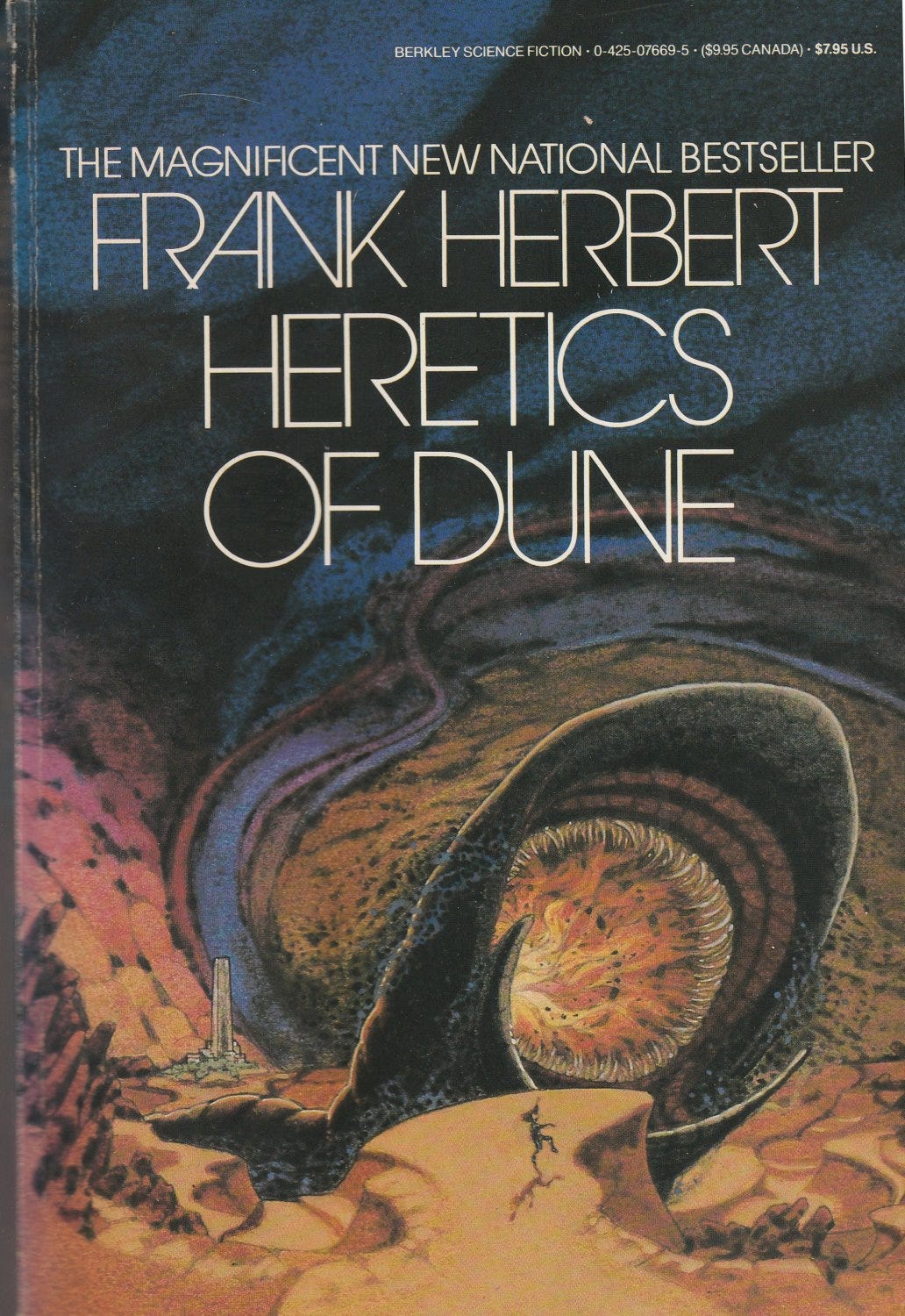
Earlier this year when I read GOD EMPEROR OF DUNE, I realized that the Dune saga was becoming too much for me in terms of its scope or its purpose. I found myself doing that split-brain thing where Right Graham and Left Graham try to decide whether I still like this thing that I previously enjoyed. (exhausting, I hate it, don’t do it)
Well, after muscling through that unforgiving tome, I took some time off and then picked up HERETICS OF DUNE this week. I got about an hour into the audio, offloading goods from my truck 500lbs at a time, and suddenly realized “Holy crap I could not give less of a damn about this book or this series or what the heck is going on in it any longer. My interest died with Paul Atreides.” So I stopped the book and sent it back to the library.
There is such a thing as too much, and I find out what it is when I stop caring about what’s happening in the story.
I liked Dune when it was about Paul and his wife and his children. I liked it less when it was pretty much only about the planet of Arrakis, with thousands of years of history in between volumes.
On its face that’s not a bad concept—a setting can change, characters can offer new perspectives or have new goals, it’s all good. Personally I’m a student of Earth history and I’m still digging through everything that’s happened on this planet before I got here. But therein lies the rub: what’s my motivation to read six volumes, totaling thousands of pages, about a fictional galaxy twenty thousand years into the future? What am I supposed to gain from this that would be more readily beneficial than reading actual history and philosophy?
Once Paul dies and Leto II becomes the main Atreides, the story doesn’t become so much of a commentary on power, humanity, government, economy, ecology, destiny, religion, etc; it’s a lot of reflection on human history in the brain of a drugged-out schizo who’s trying to more or less “solve everything” and just ends up flipping tables everywhere.
Which, to an extent, can be said about a lot of powerful people in human history. Once again, therein lies the rub: any observations made by Herbert through Leto II are more blunted and less relevant than reading actual nonfiction about the past.
This dovetails with a novel I read this week, or rather, re-read for about the fifteenth time: THE HORK-BAJIR CHRONICLES, by K.A. Applegate. It’s an event book in the larger Animorphs saga, and my personal favorite of the series overall. It’s about the downfall of a peaceful planet that gets caught between two interstellar empires, resulting ultimately in their enslavement. Not a happy story, yet beautiful in its tragedy. That’s a hard feat to accomplish.
There is a prologue/epilogue wrapped around it where it’s told to a human character by an alien descendant of the central figures. When the epilogue hits, the human more or less says “Well, that sucks,” and he doesn’t feel any better than he does when the story started. At this point the alien tells him “Yeah but the story isn’t over.”
Which was true: THBC was like a prequel series to the main Animorphs run, and that series starts with Earth already under invasion, just in secret. Since Earth and her people are the central focus of the series, what is past is prologue, and the story of the Hork-Bajir gives the humans a better understanding of where they are in their own story.
This works on a meta-level for me as a reader. What’s the point of the fiction I read? Entertainment is great but I think edification is the ultimate goal. That’s why I have content standards for what I read. I’m not edified by reading excessively graphic violence or sex or any of that stuff. It’s why I hated the latter half of the Red Rising series. It’s why I won’t read more Game of Thrones sequels. It’s why most of what Hollywood and mainstream pub has to offer will never interest me.
There is no serviceable, beneficial, edifying point to that kind of fiction. Nothing to take from it that builds me up in the real world. They can’t justify it, they can’t defend it, they can only get angry when you point it out, and call you names for not participating in it.
Getting immersed in fiction is fun, sure. But I don’t live there. I live here. And spending time there really needs to be for my betterment here. If I can obtain that betterment in a more practical, applicable way, then I’m inclined to do so.
And that’s where I’m at with these latter Dune novels. They’re not graphic or offensive or anything like that…(though I have heard there’s some weird sex cult spinoff of the Bene Gesserit that I haven’t gotten to)…it’s just that they’re boring. They’re boring while they’re trying to illustrate bad patterns of behavior that seem ingrained in the humanities.
If I want to understand that, I’ll just read the same classics that Herbert read as he brainstormed this stuff.
DUNE was a brilliant piece of classical sci-fi, and MESSIAH/CHILDREN both rounded out a satisfying arc about Paul Atreides and his kids.
I think that beyond that, I really don’t have any interest in where it goes from here. Five thousand years after Paul, with Arrakis changing over and over again, and spice doing this, or worms doing that, and ten or twelve gholas of Duncan Idaho running around, trying to remember who he is and what he did back in the day…it’s just too much.
“The story isn’t over.” Correct. MY story isn’t over. And MY story, unlike some of these book sagas that never end, is a lot more important.
So that’s where I’m at. Thanks to Herbert for a superb trilogy, this is where I part ways and bid you adieu.