

Chapter 21 is called “Of Túrin Turambar.”
Subscribe for free and get the last six months of all posts. If you pay for the CrackerStack, you get the paywalled content and you help me buy books, so thank you.
A Note to the Reader
“Of Túrin Turambar” is one of a few chapters that also exists as its own book (“The Children of Húrin), like “The Fall of Gondolin” or “Beren and Luthien.” These books are replete with annotations, poetry, and alternate drafts that Tolkien made over the years. Unlike the complete Lord of the Rings trilogy—and in fact, similar to much of The Silmarillion, “Of Túrin Turambar” is at its core a tragedy, and right out of the gate that gives it a great deal of heavy lifting to perform.
Tragedy as a genre or a story element is all too present in the entertainment we get out of the 21st Century. Your most emotionally stunted colleagues, eternal pessimists who find no joy in anything, will heap praises on tragedy because it’s “realistic,” because it parallels life (or rather, their life), and thus it is “honest.” Anything else is a lie. They are Big Boys and Big Girls for enjoying tragedy and you should just go back to watching The Disney Channel, you who are not Big like they are.
This is cope. Calling fictional tragedy “honest” is often a Scooby-Doo mask for calling your own life disappointing, and for not having an adult method of understanding that disappointment. They never squared their own mental picture of how life should be with the glaring mental picture of what life often is, and so fiction is not allowed to be optimistic, ambitious, or hopeful. YOURS can’t be because THEIRS isn’t. It shouldn’t embrace the yearning for greater, the values of heroism, the purity of true love. It can only be as nihilistic as the dour future to which the hopeless have resigned themselves.
To which I say: ha! Shut up. Life can be disappointing yet I will not resign myself to that. I’ll remain optimistic, I’ll choose to look forward to a day of peace and rest, and I’ll work to make that happen as time goes on. As part of that effort I will feed my soul the very best stories I can find, stories of endurance and love and triumph and recovery, stories of family and decency even in a world that has those other ugly things in it.
And yet.
There are times when fictional tragedy has a purpose to serve.
Without it, we might forget why real tragedy exists, and what the best role is that we can play with regard to it.
Therefore, effective fictional tragedy works most often as 1) a cautionary tale, or 2) an affirmation of how one ought to act even in the face of overwhelming trials.
If you’ve read my review of THE BALLAD OF SONGBIRDS AND SNAKES—which is the origin story for the villain of The Hunger Games—you know that his story is the former, while “Of Túrin Turambar” is the latter. Tolkien has created a hero that is equal parts Beowulf and Oedipus. Yet even in a life defined by pain and suffering and loss, one man with a lifelong curse of Morgoth hanging over his head never stops trying to fight the good fight.
He makes mistakes, and people he loves will die because of those mistakes, but unlike previous stories in The Silmarillion—like the Kinslaying, or Maedhros’ imprisonment by Morgoth—the story of Túrin is one of a man living a tragic life that was thrust upon him, not primarily one that is of his own making.
In a way I find echoes of Frodo’s tale in the life of Túrin, but I’ll save my analysis of that for the end. The summary itself will be brief.
The Life of One Man
Túrin is the son of Húrin, who died fighting a horde of Orcs in the Fifth Battle (previous chapter). Húrin held the line for Turgon to escape back to Gondolin, and for his self-sacrifice he received a lifetime of pain and punishment from Morgoth. The Dark Vala forced Húrin to sit in a throne on top of his fortress and watch him kill the children of Ilúvatar all across Beleriand. Morgoth also placed a curse on Húrin’s entire bloodline, so that’s going to affect some major people among the children of Men.
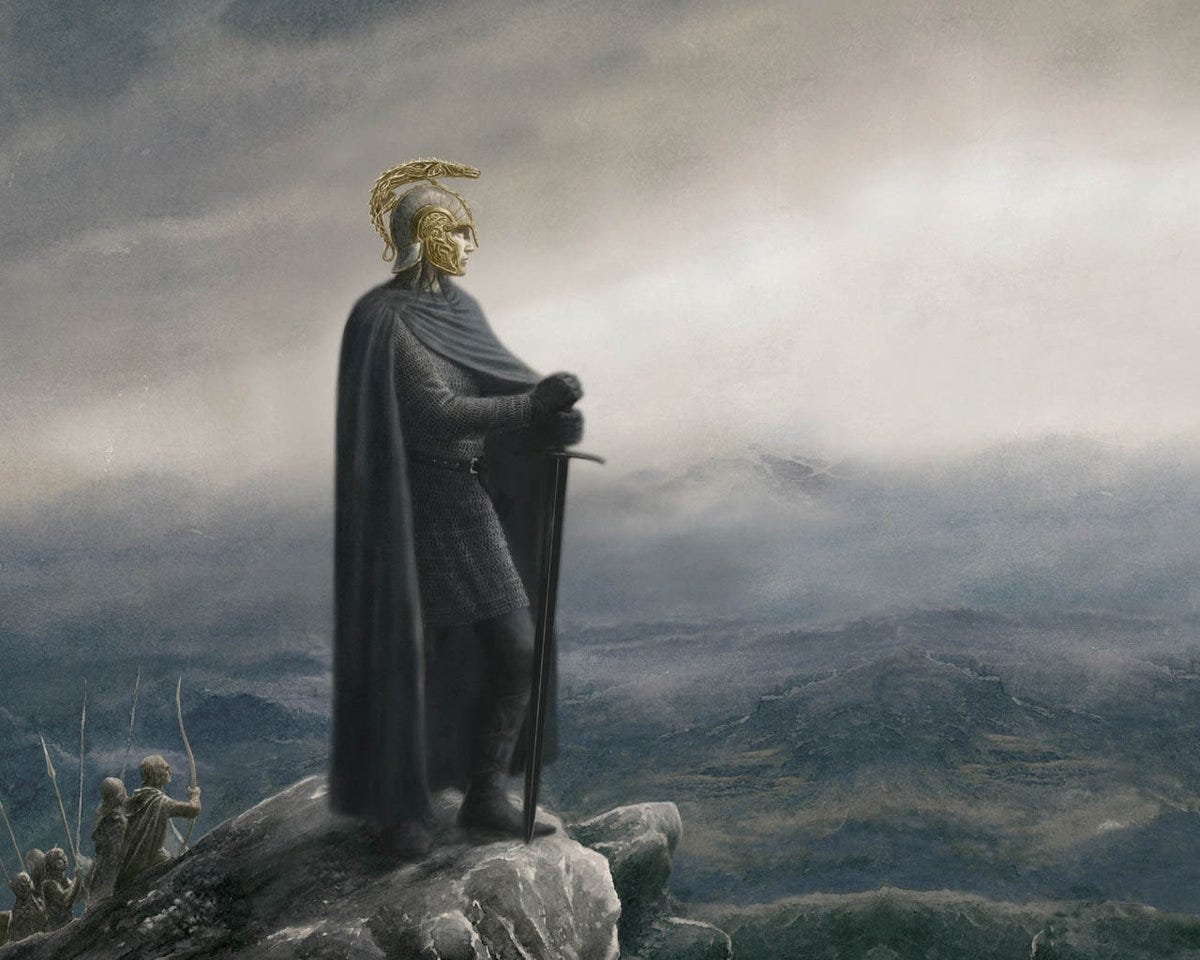
The reading of the chapter is rather straightforward; Túrin spends some time in Doriath with King Thingol, who respects him for his ancestry, as Húrin is one of few men who Thingol likes. Turin also makes friends with a Dwarf named Mim and an Elf named Beleg. He gains a powerful sword called Anglachel and a dragon-helmet that grants him (more or less) invincibility, as far as how well he fights when he wears it. He goes into hiding when numerous family members die. He leads a band of outlaws. He roams around and uses aliases all the time. It’s a hard and sad existence, but Morgoth put a curse on him to suffer, and suffer he does.
At one point he’s even captured by Orcs and as he’s being rescued in the dark, he gets his sword and accidentally kills one of his friends, thinking in the confusion that it was an Orc shadow bearing down on him. In another instance he begins a romantic relationship with a woman that he later learns is his sister. Túrin is a descendant-relative of Beren, and while he parallels that ancestor in his ranger skills and combat, his life is nowhere near as pleasant, least of all when it comes to women.
He becomes a named foe of Glaurung, the dragon, who is able to put spells on him and make him see false things. This also causes confusion and despite Túrin making what he thinks are good choices, people he loves end up suffering because of his actions. He does ultimately kill Glaurung in the end, yet in his quest there are others who die, others who he loves, adding to his repetitive cycles of woe and pain.
The story culminates in his suicide, due to the anguish he carries over his actions—one of very few Tolkien characters to ever go out that way. A painful ending for a man who didn’t have a shot from the get-go, yet he kept trying to live the best way he thought he could.
What This Means for Us
In comparing Túrin to Frodo, we have two main characters who are utterly broken by the weight of the dark curse they carry; one basically had a spell put on him by an angry god, and the other carried a physical vessel of the most powerful evil in the world around his neck for six months. While reading Túrin’s tragedy, I remembered an interview that Tolkien gave when talking about Frodo’s actions at the Cracks of Doom, and the unmatched weight he had on his soul from carrying the Ring.
I’m paraphrasing here: Tolkien didn’t think that Frodo’s collapse should be any more immoral than a collapse from losing a limb or becoming paralyzed, because in many ways it was a physical and mechanical breakdown under a load that he was not equipped to carry. What mattered was that he still tried, and between that and his friends, he succeeded, even if he came out of it scarred.
Túrin, sadly had no one left at his lowest moment, and had plenty of big mistakes in his past that he couldn’t keep carrying. That pain and anguish were no more of a moral failing than Frodo’s actions were after so much contact with the One Ring. The point is that for us, here in the real world, we need to remember: these are fantasy stories. Whatever you’re enduring, it’s not the curse of the most evil dark force in existence. It’s just life. Others have beaten it and you can too.
Sometimes that’ll mean getting help because you can’t do it on your own. Frodo had Sam, Túrin had nobody. I won’t offer my thoughts on the morality of suicide beyond saying that we’re commanded by God in this life not to murder, and that most assuredly includes ourselves. Personally I’ve never had to talk anyone down off a ledge, so if you’re reading this and you’ve found yourself there, call a hotline, because someone on the other end will know how to talk with you.
It should be reassuring to us that Morgoth isn’t real. He’s just a construct in a book for expressing ideas in a mythology. You’re not cursed, you’re just having a temporary setback, and tomorrow is another day. Get there. Then get to the next day, and the next. Túrin lived in a fictional time when two Maiar chased each other across the sky with sun and moon leaves. His cursed life certainly bore down on him but for most of it, he was able to keep enduring, until he ran out of friends and he had nobody left to turn to. Should you ever find yourself that far down the rabbit hole, you can still call a phone number. That’s a good thing.
And I think that’s the value of this particular tragedy. Túrin was broken by a lifetime of abuse at the hands of a fallen god. Whatever you’re up against in this world, you can overcome it, even if you need a little help.
Get your paperback copy of the Silmarillion and read along! This is an affiliate link, so if you buy a copy through here, I’ll get a small commission.