

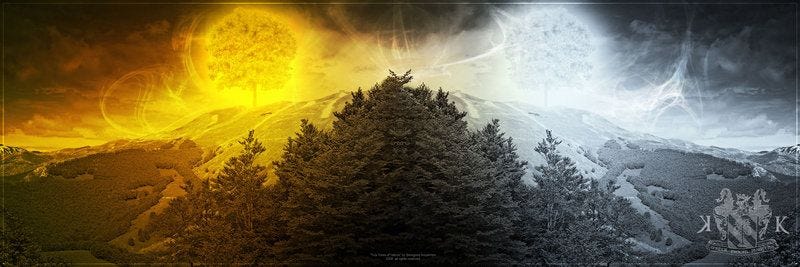
Valinor is covered in shadow and vapor after Melkor’s assault. Manwë is able to push the vapors back with his wind powers, and that reveals the extent of the damage.
The two trees, Laurelin and Telperion, are destroyed. The divine Light in them is gone out forever and its only remnant exists now in the Silmarils, which are indestructible. The problem is: can the Valar demand that Fëanor give them up?
An Angel Meets Its Limit
We’re introduced here to the concept of uniquely crafted works, which I’ve touched on before. Yavanna, the Vala of plants and trees, says:
Even for those who are mightiest under Ilúvatar there is some work that they may accomplish once, and once only.
So it was for Yavanna in making the trees, and for Fëanor in making the Silmarils. Manwë asks Fëanor to give up some measure of his creation to restore the divine light, at which point Aulë (the Maker) intervenes, saying that they’re making a huge request of the Silmarils’ creator.
Fëanor does eventually answer, saying that even if he is able to break the Silmarils, he can’t make them again, and that would break his heart. (Remember that Elves can die of grief.) He becomes wary of the Valar, remembering seeds of mistrust that Melkor planted in him before, and soon he becomes convinced that the Valar want to steal his creation from him.
While all of this is going on, messengers arrive to inform everyone that Melkor had assaulted the north, where Fëanor was exiled, and while all this council was going on in Valinor, Melkor killed Fëanor’s father Finwë, then cracked open his vault and stole the Silmarils anyhow.
Along Came a Spider
You’ll recall that Fëanor’s birth name is Curufinwë, but also that his mother named him Fëanor, meaning “spirit of fire,” and here that fire becomes a true force. He is bigly pissed and he’s going to do some very bad things in the name of recovering the Silmarils. It is here that we get the name “Morgoth” as a replacement for Melkor; Fëanor renames him this, and it means “The Black Foe” of the World.
It sucks to note as well that even if Fëanor had granted the Silmarils to the Valar, they all would have found out the jewels were stolen anyway, which is devastating enough. Now on top of that there is a schism between the Elves and the Valar, and they’re trapped in darkness.
While they’re having their spat over in Valinor, Melkor (Morgoth) and Ungoliant are still on the run, headed to Middle-Earth (remember it’s a separate continent) with the Silmarils. They travel far to the north and cross the ice between the lands, headed for Angband, Morgoth' s old armory. Ungoliant gets hungry again, because she’s always hungry, and she demands that Morgoth fork over the Silmarils for her to eat them. He says no and they get into a huge fight—and here’s the surprising thing, she almost solos him. In fact she’s got him on the ropes when he summons a nearby army of Balrogs to come to his rescue, beating her with flaming whips in a scene that would be worthy of a Hieronymus Bosch painting.
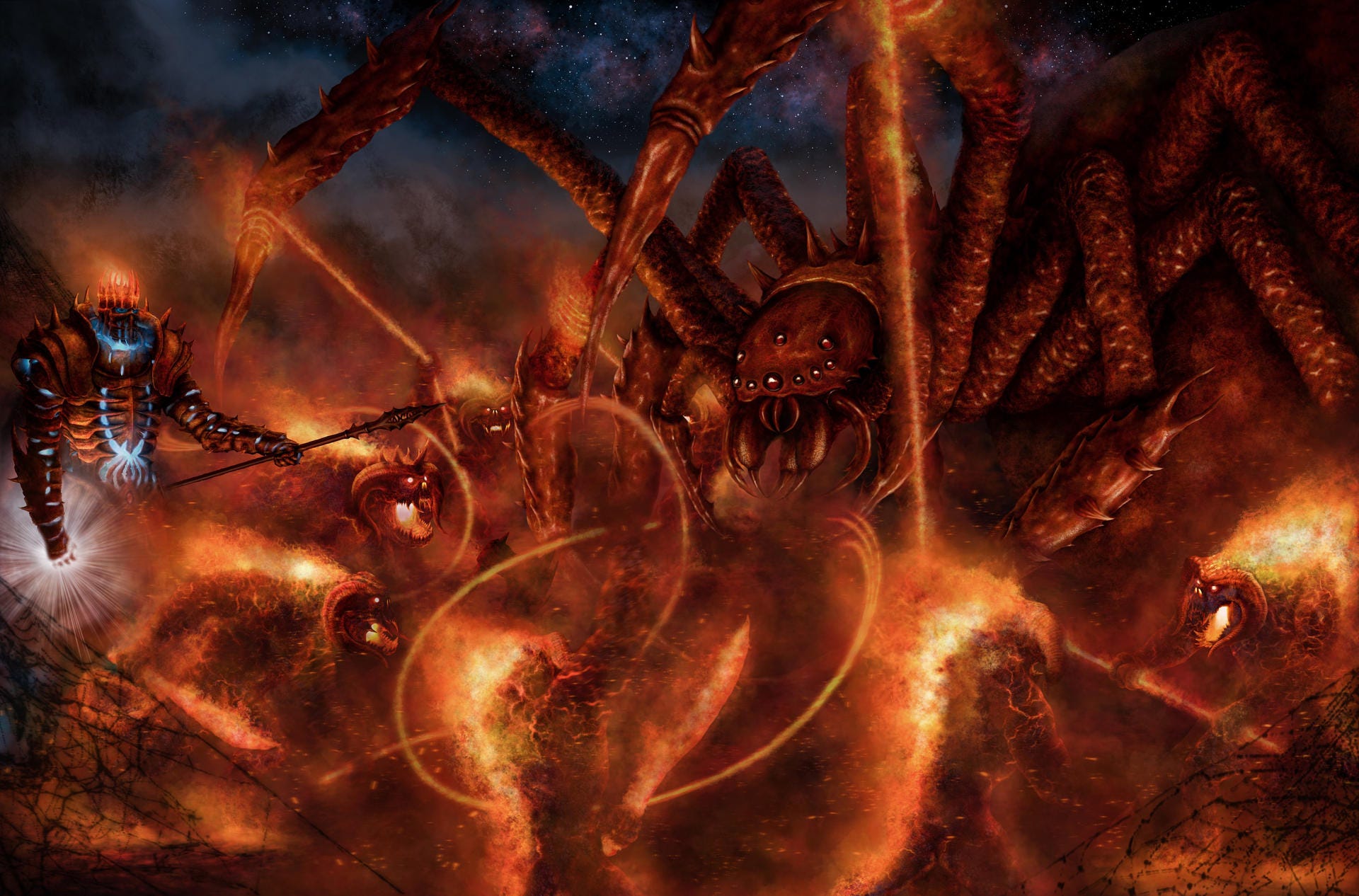
Balrogs v Ungoliant, by JovanDarkArt
Now on his throne in Angband, Morgoth makes a crown of iron and puts the Silmarils in them, calling himself King of the World. Even though the Silmarils burn him (because he’s evil and they’re the flaming gem version of Thor’s hammer) he endures it out of pure greed.
Sometimes the Rubicon Crosses You
Fëanor doesn’t cool his heels in Valinor. It’s time to go on the offensive. A very offensive offensive. He gives a speech to rile up his fellow Noldor, and they’re caught up in his fire and fury, and they decide to charge across the continent, cross the sea, storm Middle-earth, and take back the Silmarils. This won’t be easy and he’ll need them to stay angry to stay on task; if they think about it too much, they might talk themselves down from doing what they have to do.
Or at least, what they think they have to do. What comes next is one of the greatest tragedies in the Silmarillion, called the Kinslaying.
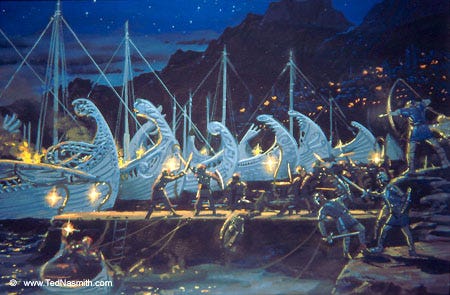
When Fëanor and the Noldor reach the sea, they have to decide how to cross. They are makers by nature, yet they’ve never had need to build ships, and if they stop to take the years necessary to do so, Fëanor knows he’ll lose his grip on their anger. Another group of Elves, the Telerí, live by the sea and they have their own fleet of ancient ships, and he demands that they hand them over. The Telerí refuse, because to them those ships are like the Trees to Yavanna, or the Silmarils to Fëanor: sublime constructs that can never be reproduced, and the pride of their people. They won’t have them sent to war and risk their loss.
If Fëanor wants to keep his people angry and motivated, he’s out of options. He orders the Noldor to kill the Telerí and take their ships.
Yeah. It’s pretty bad. The Noldor obey…and soon many of them come to regret it. The Noldor fracture, and only a part of them remain loyal to Fëanor. He takes these ones aboard a few ships and flees to Middle-earth, leaving the other Noldor to face the consequences with the rest of the Telerí.
I don’t think I need to tell you how to feel about that. Fëanor is a mighty character, but he is overcommitted to his most excessive qualities. Among the many things that Tolkien says through this character, perhaps the most glaring thing is the hazard of a charismatic leader and a people willing to follow him.
It remains to be seen whether the Noldor are successful in their quest for retribution. I can only remind you that this is a story of the Fall of the Elves.