

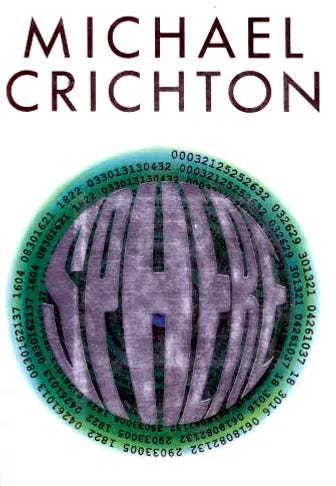
Since I’ve been on this Crichton kick for the last little bit, I decided to reread Sphere for the first time since middle school. It came out between Congo and Jurassic Park, and like most of his 1980s oeuvre, it got a film adaptation later on (1998). Here’s the basic premise:
A team of scientists gets called up by the Navy after a massive spacecraft is found at the bottom of the Pacific. It’s intact, it’s American, and, inexplicably, it’s from the future. Inside its cargo hold is a giant metallic sphere whose purpose is not immediately apparent, but as the scientists begin to interact with it, the environment around them becomes increasingly hostile. It’s up to Norman, the oldest member of the team and its resident psychologist, to solve the puzzle of the sphere before they all wind up dead.
Of all Crichton’s greatest hits, Sphere is the most Lovecraftian one, playing with elements of cosmic horror, but doing so from an angle of hard science—even with its limits. You’ve got the standard staples of a Crichton story to walk you through it: there’s an aged, overworked protagonist (we’ll call him John Science), a borderline romantic female colleague (Stacy Seduction), and another professional who has an antagonistic relationship with John Science, even if it’s one of mutual respect (his name is Dave A**hole.) Throw in an overbearing but underprepared authority figure (Bob Navy) and an expendable tool that nobody likes (Mike Dead) and that’s pretty much it. The plot develops at a good clip, and there are conversational asides at appropriate intervals to hash out the science of what’s going on.
Nobody can figure out the sphere at first. Inexplicably, Dave A**hole is the first one who deduces how to open it and go inside, though he forgets what he did in there pretty quickly. Later Stacy Seduction enters the sphere and she too is forgetful of her experience. Finally, in a moment of high stakes and high stress, John Science (a psychologist) goes inside the sphere, and makes contact with the entity inside.
All this time he’s been trying to figure out what the sphere is, why it’s on the ship, how the ship came from the future, how it showed up on the ocean floor, and more. In his preliminary discussions with the others, it was decided that the sphere—being futuristic technology—might be flat-out too advanced for them to really understand it. They use the analogy of taking a TV back to medieval times and showing it to even the most educated person they could find; he’d think it was witchcraft. Even if it was Isaac Newton, it would take him years to explain the science of how it all works, but it does. And what does it do?
Somehow the sphere amplifies the power of the human mind so that it can make manifest the things in our subconscious, be they magnificent or terrible. Harry, the mathematician, has nightmares about a giant squid, and wouldn’t you know it, one starts attacking the habitat. Beth, the zoologist, dreams of discovering new species on the ocean floor, but when she does, they…don’t come out right. Norman, the psychologist, just wants to figure it out and go home, but the sphere’s power seems to make that all but impossible.
In the end they’re able to escape, and even go so far as to use their powers to erase the sphere from existence. That kind of power is too much for mankind. Someone would use it to destroy them all. Even a small handful of the smartest people the Navy could find caused immeasurable damage in a confined environment. And why was that?
“The ability to imagine is the largest part of what you call intelligence. You think the ability to imagine is merely a useful step on the way to solving a problem or making something happen. But imagining it is what makes it happen.
“This is the gift of your species and this is the danger, because you do not choose to control your imaginings. You imagine wonderful things and you imagine terrible things, and you take no responsibility for the choice.
“You say you have inside you both the power of good and the power of evil, the angel and the devil, but in truth you have just one thing inside you - the ability to imagine.”
The entire book can be distilled into this single passage. Everything stems from it. Crichton was the master of blending several tones, elements, even genres into one story, and in Sphere we get a profound philosophical observation that underpins everything else that happens.
We can imagine things. An object that immediately turns our imaginings into physical manifestations—without the labor involved in the process of doing so by hand—would create wonders and horrors alike. And without social guardrails to help us contain those creations within safe and moral parameters, chances are we would skew towards horror.
We can argue until we’re blue in the face as to why, but I think it makes the most sense. In many ways, Crichton’s sci-fi novels are cautionary tales about what we take for granted. Congo? You take your knowledge of primates for granted (minor.) Jurassic Park? You take your knowledge of genetics for granted (problematic.) Timeline? You take your knowledge of the linear nature of time for granted (extremely dangerous prospect.) Sphere? You take your control over your imagination for granted.
And if the barrier of difficulty between concept and execution were to fall—if you no longer had to physically build something in order to make it exist—what would you quickly make? Even by accident, and with no correction to your errant thoughts? Would you trust yourself with such a power? Would you trust a friend? Would you trust an enemy?
Good and evil are religious notions. Religious lines are one of many that separate us from one another, but we are still united in our ability to simply imagine things. Taking our ethereal conjurations and immediately making them real in an overlapping space is a recipe for disaster, unless we have a shared code of conduct. (We don’t.)
I think I generally understood Crichton’s concept back in the day, but I appreciate it a lot more now that I’m older. The things that you imagine, that you feed yourself, that you cook up in your mind as part of your narrative for understanding the world, matter. The imagination is a loaded gun—not good or evil, just potent. Capable.
This is worth thinking about as AI accelerates the process of creation, cutting the distance between conjuration and realization.
Handle that power carefully in the space between your ears.