

The final week of February, 1776, saw action in Boston, Philadelphia, and North Carolina. The latter featured actual combat and such.
Boston (The Tahn)
Henry Knox is pulling a train of artillery from Ticonderoga to Cambridge at Washington’s behest, fortifying the siege of Boston as the spring thaw looms. Troop shortages and meager supplies forced him to be patient and methodical with the resources he had on hand: once the action kicked off, he’d need to stick to a solid plan in order to force the Brits to retreat and abandon the city.
It’s like my friend Adam says: restrictions are good for creativity. (Although this is mostly cope over the fact that punk rock bands are eager to make music but slow to develop talent—you’re not George Washington, you just like the sound of a cheap guitar plugged into a bad amp).
Philly
Ben Franklin, John Adams, and other Founding Fathers continue to address the legal, political, and logistical side of the war with the same caution and maturity as General Washington, especially as regards Britain’s “Prohibitory Act”—the naval blockade designed to throttle the flow of goods through the colonies. If Washington had to make tough decisions with men and powder, the Founders had to do the same thing with food and money. It made things tense, and they would always welcome any good news. They got some from…
North Carolina
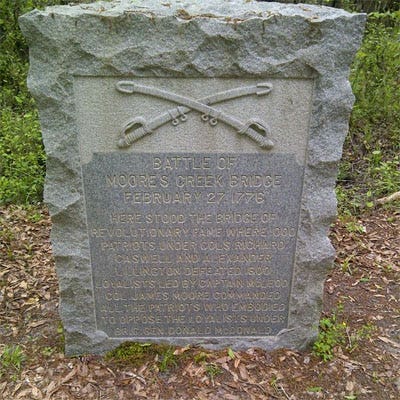
Way down south, on February 27th, around sixteen hundred Scottish Highlanders and other Royal-Loyals marched up the coast at the behest of Josiah Martin, the Crown-appointed governor of the colony. While they had good numbers at first, they faced losses along the way, usually from desertion or supply issues. (Turns out you have to feed these guys, who knew?) By the time they hit a place called Wilmington, they’d lost maybe half their original number.
Then they hit another snag: a thousand colonials, led by Richard Caswell and John Lillington, blocked them on Moore’s Creek Bridge, hitting them with the classic “You cannot pass.” The Royals said “Bet,” and it was on.
The Royals sent a few dozen guys across the bridge in the middle of the freaking night, playing bagpipes to keep their spirits up, and wielding melee weapons, like broadswords and stuff. The Patriots responded in the most American way possible and—get this—they shot the British with guns. And this bridge, mind you, kind of sucked. It wasn’t very wide, it was missing planks, the wood was slick, and let me say it again: this did this at one in the morning.
The Royals lost between 30 and 70 dudes, including their commanding officers, one of whom was shot like 20 times. The Americans only lost one guy, Private John Grady, who died from a gunshot wound to the back of the head, which unfortunately means it could have been friendly fire. He lived for almost a week after that and died on March 2nd. The whole battle lasted only three minutes.
John Grady’s brother Alexander was also present for the battle. He survived into his late seventies, and died almost exactly forty-five years after the battle on February 26th, 1821.
My Amazon page has all my novels, including the critically-acclaimed FOSSIL FORCE for young boys, and the Engines of Liberty series for all ages.
I post several times per week on YouTube.
Subscribe here for more book reviews and for articles on what I continue to learn as I read.
Have you looked into the Battle of Valcour Island? For me, it’s a major pivotal point in the war.