

A couple of years ago I tried watching the AMC show Turn: Washington’s Spies. It’s one of those historical fictions that is about 8% history and 92% fiction, playing very fast and loose with the facts. I ultimately bailed for that reason, combined with every character just being horny and adulterous as all hell, making it a tedious watch.
That said, the show gave me my first real introduction to the figure of Robert Rogers, a Scots-Irish woodsman who led the Queen’s Rangers on daring missions against Rebel spies during the Culper era. He was depicted as a cunning and entertaining leader (true) with a dangerous set of woodsman skills (also true) who was dispatched by the King to directly counter the efforts of Washington’s spies (what) and was later burned by the King because he Knew Too Much (WHAT).
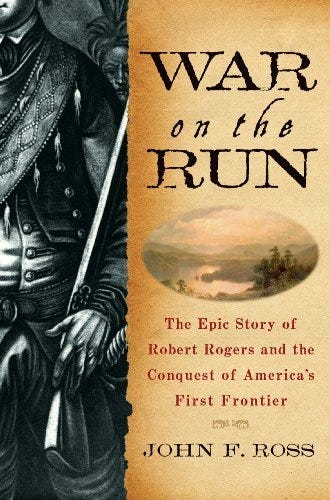
I didn’t know the extent of the liberties they took until I read WAR ON THE RUN. After reading this huge book, I can say that 1) I understand why they created their own version of him, because he didn’t actually participate in the Revolution, but 2) his life was pretty interesting all on its own.
He was a celebrity back in Europe, and a playwright, but he was born here in North America in 1731, just three years after his parents immigrated. His woodsman and tracking skills were a product of his upbringing. His dirt-poor father had to break a tract of land with nothing but Scottish grit and some corn—both for themselves and for planting. These are people that grew crops so they could eat them and wear the husks and use the cobs for tool handles, that’s how piss-poor broke they were. You want something, you need something, you go into the forest and try not to get your ass kicked by a tree so you can make it. Oo-rah.
His parents went through peaks and valleys of success and poverty, due to land ownership changing between the gentry, or political lines being drawn this way and that (the division of Vermont and New Hampshire, for example). This was back in a time when the landed gentry had rights and the rest of you working-class scum could go **** yourself (I cannot IMAGINE why a Revolution became necessary…)
Thus Rogers grew up The Hard Way and earned skills and a reputation as a badass proto-mountain man, learning tricks from the Indians and making himself indispensable in the face of the howling wilderness (heh.) When the French and Indian War broke out, he became a hot commodity and was put in charge of a detachment of men, and he did his best to keep them alive.
What he didn’t know was that he was responsible for them financially, and war can rack up a big bill. Since he didn’t have a lot of assets to his name, when the bill came due he was flummoxed and angry, as well as powerless to change anything. This resulted in him returning to England and going to court over the charges, and the final verdict landed him in debtor’s prison.
(The modern-day American political machine is fapping itself blind at this level of power, but I digress.)
Rogers tried a bunch of other ventures to clear his debts, none of which were successful. He had to declare the equivalent of 18th-century legal bankruptcy, signing any and every earthly asset in his name over to the King, in order to get out of prison. Then he returned to North America in 1776, hooooo boy, there was some Stuff Going On, and his erstwhile homeland had changed.
Unlike his TV show counterpart, Rogers didn’t play a huge role in the Revolution, although he was responsible for outing Nathan Hale as a spy, leading to his execution by hanging. (“My only regret is that I have but one life to give for my country.” That guy.) The final significant years of Rogers’ life were spent looking for the Northwest Passage, a sea route from the Atlantic to the Pacific through the Canadian Archipelago. The Admiralty of the English Navy had a 20,000 pound prize out for anyone who could successfully chart it, and this would definitely solve his financial problems.
(The route wasn’t sailed successfully until the 20th Century, as far as I know.)
Anyway, the real merit of Rogers’ life for us in the 21st Century is his impact on wilderness warfare—a combination of tracking skills, evasion, and terrain manipulation to give one an advantage over an enemy force, to the extent possible. The book concerns itself with a great amount of detail from the French and Indian War, and the narrative can suffer at times under the weight of names and dates. Rogers was a hard woodsman but an intelligent one as well, and he beat it into his men that you had to be equal parts cerebral as well as physically durable to survive this form of warfare.
To date, Rogers’ 28 Rules of Ranging are still used for training US Army Rangers. Like many figures of his day, there are those who chronicle a number of his misdeeds, including episodes of warfare against Amerindians that resulted in the deaths of women and children. Often these accounts leave out that this style of war was waged in both directions, and that many of the Native tribes inflicted barbarism upon innocent Americans as much as they could.
It was a bloody time in the history of the continent. The peace we currently enjoy is the aberration, as any well-read person will understand. Spoiler alert, people in the 18th Century killed each other. Roughly. Often.
Anyway, I thought this book was really good, if slow as the war chapters dragged on. Rogers wasn’t the showiest figure of the war so he enjoys less modern-day notoriety, outside of niche interests (like the Rangers.) Nevertheless he’s an interesting figure and worthy of study.