

“Electoral Brawlage” examines the first inaugural address of each president in U.S. history, with some commentary and analysis. Check back on Mondays for more.
Subscribe to get these articles in your inbox. Become a paid subscriber to give me money, because I like money and I use it to buy books.
Teddy Roosevelt technically did and didn’t have two terms; he served in an era where there were no term limits, it was just a matter of tradition that a man would not go beyond a pair of them, though a few had tried. (The GOP wanted to run Grant a third time, remember that?) Doubtless in Teddy’s mind he had only really gotten to campaign and win under his own name once, but we’ll come back to that next week. For now, his time in office was coming to a close, and the GOP needed to look to the next man up.
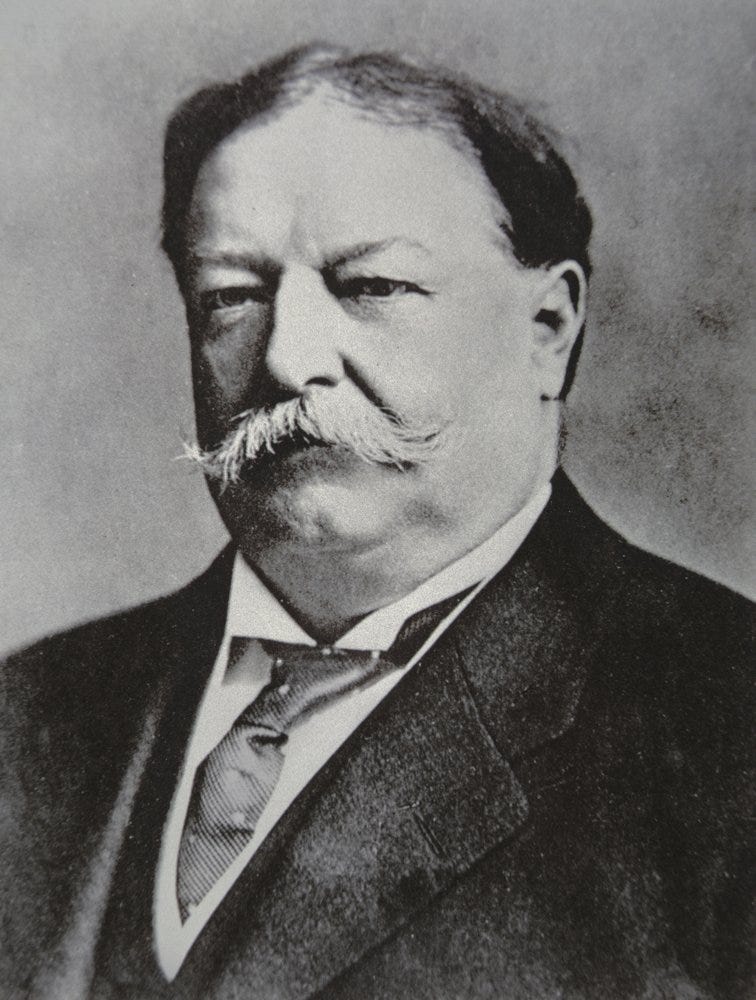
Secretary of War William H. Taft was just the man. He mostly had a legal background before being appointed to Teddy’s cabinet, though one would think after looking at his resume that he might serve better as Attorney General than the head of the War Department. Nevertheless he must have made an impression, because he won the nomination in 1908.
Most people only remember him folklorically for his size; he was 5’11” and tended to gain weight as his career went on. He was well over 300 lbs by the time he left the White House. His post-presidency years would include a stint as Chief Justice of the Supreme Court, appointed by President Harding in 1921, but I’m getting ahead of myself. For now he’s the only President to have also served on the SCOTUS bench, which is a neat fact.
Taft’s running mate was James Sherman, a congressman from New York. His opponent was William Jennings Bryan, a speaker from Nebraska known for his talents as a fiery orator ability to find new ways of getting his political a$$ kicked on the national level. This was the third time in a row that the Democrats picked him to be their guy. He lost to McKinley. He lost to Teddy. He would lose to Taft, and the Dems would finally figure out that he wasn’t The Guy.
Unrelated: did you hear that Kamala Harris is exploring a 2028 run? Lmao.
Bryan’s running mate was John Kern, a city-level official from Indianapolis. It’s hard to find a more human form of beige than that. It obviously didn’t help.
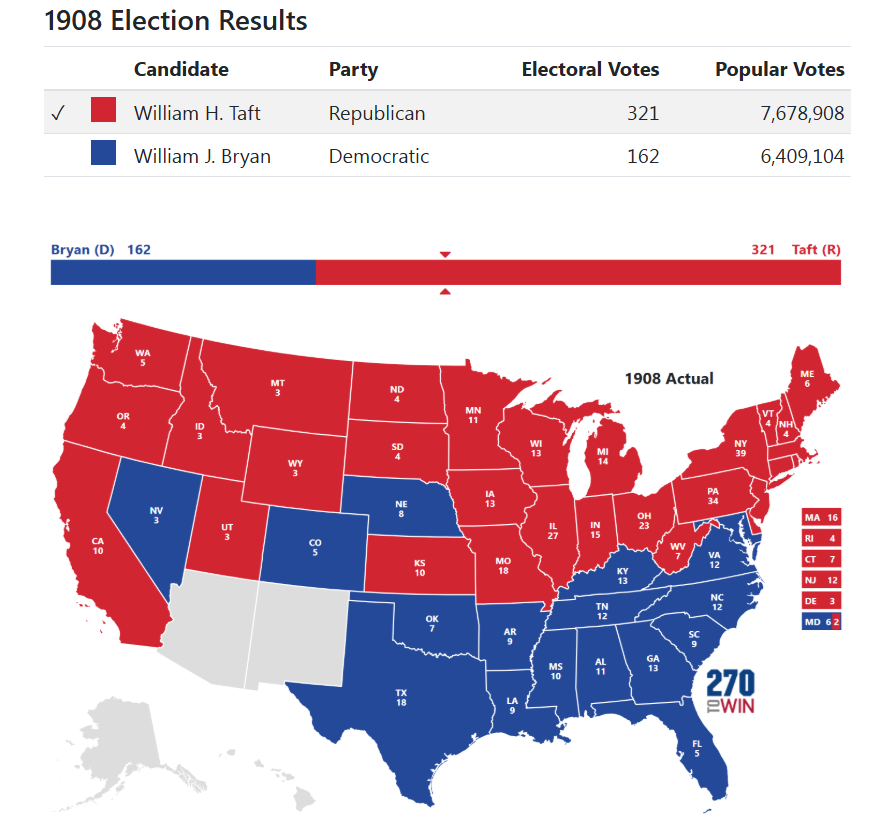
Taft and Sherman took 51.6% of the popular vote (worthless), 29 states (nice), and 321 Electoral Votes (the actual points that win you the game.) Bryan/Kern got 43.1 %, 17 states, and 162 states. The remaining 5 percent or so went to Socialist candidate Eugene V. Debs, but that’s only the popular vote, and much like socialism itself, that doesn’t win you anything. (Also the popular vote won’t starve and kill you.)
This was Oklahoma’s first presidential election; they achieved statehood in 1907 under Roosevelt, but the mostly-Southern voting bloc went along with its neighbors and picked the Democrat.
The Address
Full text here. I’ll be honest with you guys, this one is not a page-turner and I had to skim a lot of it. Where Teddy’s speech was more relatable and inspiring and commanding of your attention, Taft was very formal, practical, and lawyerly in his speech. It sounded more like he was making a case to a judge than he was talking to an electorate. That was how he spoke for his whole career, so I get it, I just wish it had landed better.
His points of focus were as follows:
Tariffs: He wanted to make sure that the costs for goods and materials produced domestically was equal to the cost of those same resources abroad, thus encouraging domestic production. The Dingley Act addressed this.
In accordance with the promises of the platform upon which I was elected, I shall call Congress into extra session to meet on the 15th day of March, in order that consideration may be at once given to a bill revising the Dingley Act.
Trust-busting: Teddy’s administration worked on civil service reform, an idea that now dates back two decades to Garfield, and Taft wanted to keep those going.
I should be untrue to myself, to my promises, and to the declarations of the party platform upon which I was elected to office, if I did not make the maintenance and enforcement of those reforms a most important feature of my administration.
Government efficiency: He didn’t like waste and he also knew that underfunding the government would hinder its ability to work properly. So he laid out his principles for the government’s operation under his leadership.
The obligation on the part of those responsible for the expenditures made to carry on the Government, to be as economical as possible, and to make the burden of taxation as light as possible, is plain… But when the desire to win the popular approval leads to the cutting off of expenditures really needed to make the Government effective… the result is as much to be condemned as the waste of government funds in unnecessary expenditure.
Conservation: He also aimed to continue Teddy’s policies toward the conservation of natural resources. Nobody really associated Taft with the outdoors, and with good reason, and no president can really contend with Teddy for that trophy anyhow. Nevertheless:
The putting into force of laws which shall secure the conservation of our resources, so far as they may be within the jurisdiction of the Federal Government, including the most important work of saving and restoring our forests and the great improvement of waterways, are all proper government functions which must involve large expenditure if properly performed.
Foreign policy: Where Teddy said “Speak softly and carry a big stick,” Taft said the following, which isn’t as poetic or memorable, but nevertheless reaches for the same object:
We favor every instrumentality, like that of the Hague Tribunal and arbitration treaties… in order to maintain peace and to avoid war. But we should be blind to existing conditions… if we did not realize that, with all the nations of the world armed and prepared for war, we must be ourselves in a similar condition, in order to prevent other nations from taking advantage of us.
In the end we see a guy who understood that the outgoing boss was tremendously popular, and while it might have been politically fatal to try to repeat Teddy’s performance, Taft could at least head in the same direction with his own words and in his own way.
But as we’ll see next week, the substance of this speech didn’t prevent a schism from forming between Teddy and Taft. The 1912 election was when things really started to unravel in this country.
Visit Nauvoo Supply to order HEARTLANDERS, the most American novel I’ve ever written. It’s like if National Treasure happened during Fallout with G.I. Joes.
My Amazon page has my other books, including FOSSIL FORCE for young boys and Engines of Liberty for all ages.
I post several times per week on YouTube.
Subscribe here for more book reviews and for articles on what I continue to learn as I read.