

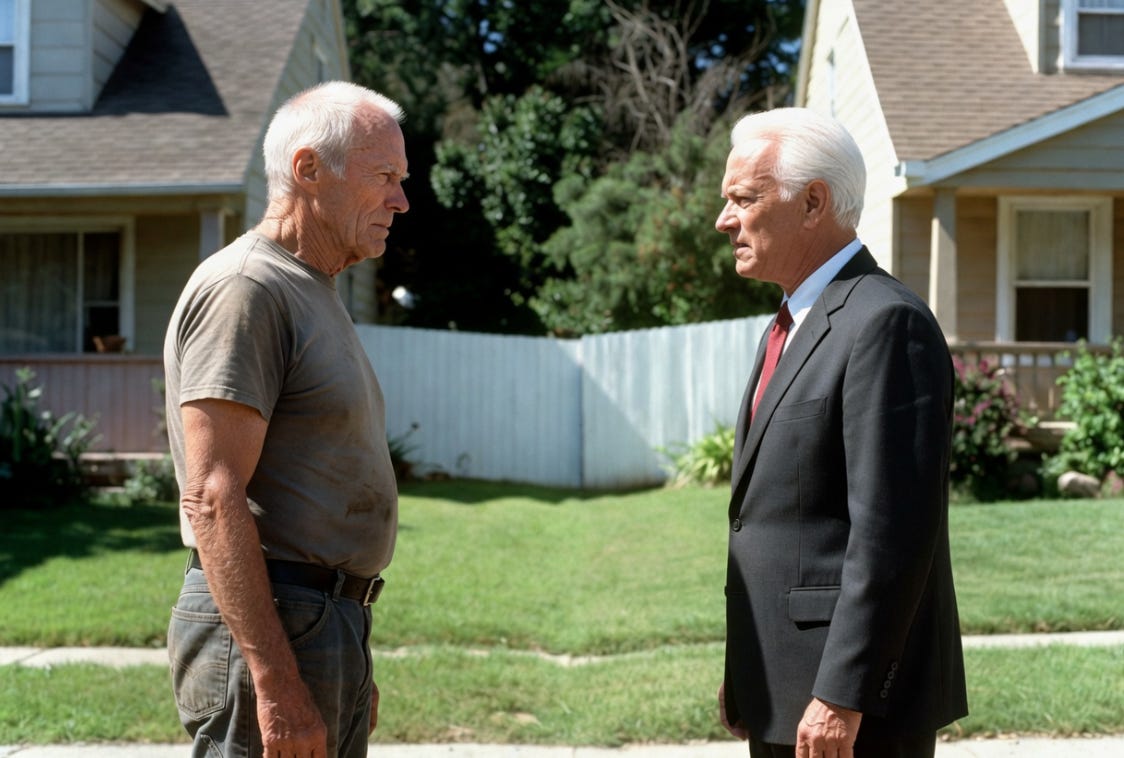
This whole “Graham writes about the sexes” arc began when my family and I were watching Transformers One a while ago, which depicts Megatron and Optimus as friends before they became sworn enemies. My wife asked me why so many stories go that way, and I told her it’s the male version of an “enemies to lovers” romance—a trope that is very popular with The Gals.
At first I was joking, but as I thought about it, I realized I had accidentally stumbled upon one of those quiet truths. I’ve pontificated about this before so I won’t exhaust the backstory, suffice it to say that once you recognize the pattern, you see it everywhere. A male audience doesn’t mind a combative protagonist who is an enemy to most of the people in his orbit, while a female audience is predominately concerned with people getting along (even if it takes most of the book to get there.)
If you’ve just read that paragraph and you’re rushing to the comments, STOP. Seek help. Or save the therapist fee and remind yourself that this is a generalization, I don’t care about exceptions, exceptions just mean the rule exists, and this rule exists.
Highlighting exceptions is annoying for multiple reasons, not least of which because it means you’re not actually thinking about what I’m saying. This time though, I’m going to throw the Excepters a bone…
…only the bone will prove once again that this rule is a firm one.
Here’s my thesis: the 2008 film Gran Torino and the 2012 novel A MAN CALLED OVE are the same story, but the former is for men and the latter is for women.
“But Graham I’m a man and I didn’t like that movie and I liked that book and my girlfriend didn’t like the book but—”
STOP NOW. STOP. This is not the bone. Wait.
Gran Torino
Walt Kowalski (Eastwood) is a Korean War vet from Lansing, Michigan. He used to work at the Ford factory in Detroit. At 80 he’s retired and just became a widower. His kids have all grown up and moved out of the neighborhood, which has since been taken over by the incoming Hmong (Southeast Asian) community. Walt coughs up blood, hasn’t been to Catholic confession in a while, and basically hates everything.
His kids and grandkids all suck. They’re materialistic and are more or less waiting on him to die so they can inherit his stuff—the house he’s taken care of, and the 1972 Gran Torino that he bought right off the factory line where he used to work. After his wife’s funeral, his kids try to get him to move into a retirement home, and he’s infuriated at the idea that he can’t be independent. He tells them off and they’re gone until the end of the movie.
Shortly thereafter, Walt catches a neighboring teen, Thao, trying to steal his Gran Torino as part of a gang initiation. (The Hmong community has brought gang tactics and violence to Lansing, and it has only gotten worse over the years; Walt has watched the neighborhood decay as a result, and this amplifies his pre-existing dislike of them.) Walt scares Thao off, which gets Thao in trouble with the gang, and they show up later to beat him up.
This all goes down on Walt’s lawn. He saddles up with his old M1 Garand from the war and tells the gangsters in no uncertain terms to GTFO or he’ll kill them.
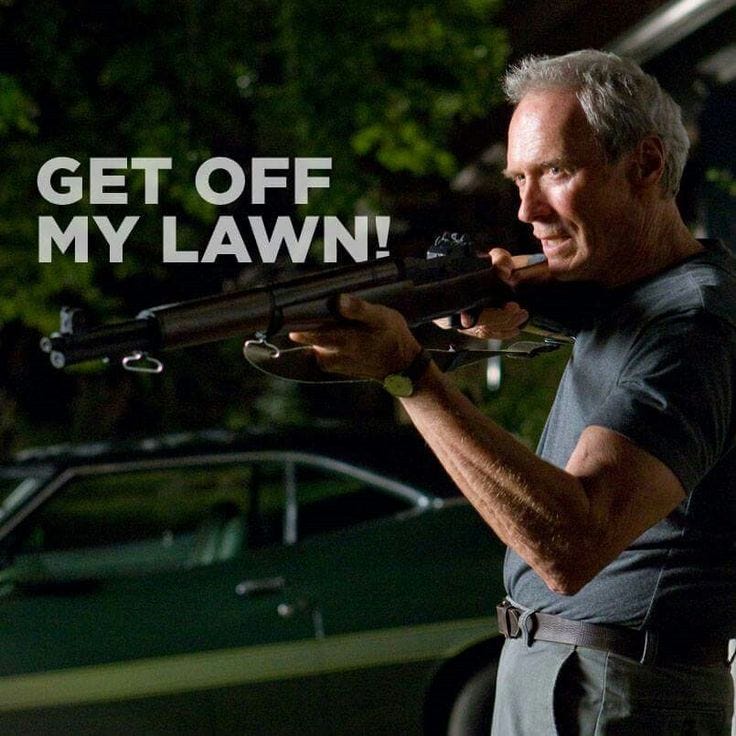
The Hmong neighbors immediately take a liking to Walt (despite being cold to him before) and he begrudgingly starts to warm up to them in return. Once he realizes that Thao is being pressed by the gang and that he doesn’t have a father figure, Walt takes the kid under his wing and teaches him manly stuff.
The gangs still get up to their gang business though, and things accelerate between them and Thao—and by extension, Walt. One night the gang members rape Thao’s sister, Sue, and they draw a line in the sand. Walt and Thao saddle up for a fight, only at the last second Walt locks Thao in his house and goes to face the gangsters alone.
Walt’s finishing move is ice cold. Throughout the movie he’s been charitably harassed by his late wife’s priest from the local Catholic church, who wants him to come in and confess his sins before he dies. It’s implied that Walt is still carrying things he did during the war. Walt’s close to death due to his smoking (the coughing up of blood reminds us of this) so his clock is running out, and he knows it. The neighborhood has gone to hell, the gangs run the place, people are terrified so they all Didn’t See Nothin’, and unless someone makes a bold move, nothing will get better.
So Walt quietly gets ready to die. He buys a suit. He goes to confession. Then he draws the gangsters out to where there are plenty of witnesses, throws up a literal Hail Mary, and fakes like he’s pulling a gun. The gangsters gun him down. The neighborhood, who love Walt, all turn on the gangsters and report them to the cops, and they go down for murder. Suddenly they All Saw Somethin’.
In the wake of Walt’s funeral, his greedy family show up for The Goods, only to find that Walt left his stuff to the Hmong, and Thao has inherited the eponymous Gran Torino.
A Man Called Ove/Otto
“Ove” is pronounced like “Uva.” It’s a Swedish name, and the original book is set in Sweden. There was an American adaptation in 2022 starring Tom Hanks, and his name was changed to Otto, so for the sake of visualization I’m going with Otto from here on out. But I have read the book.
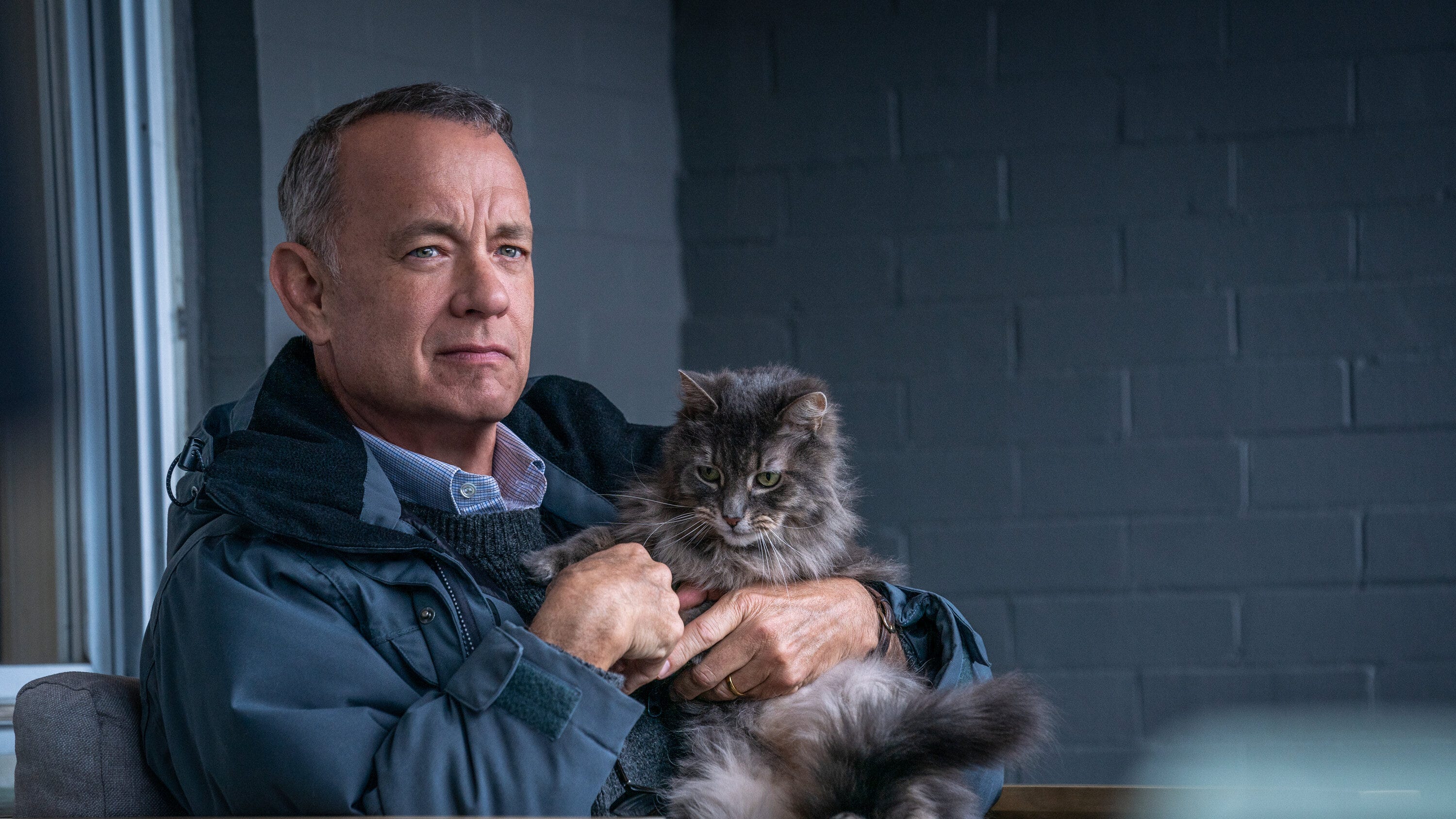
Otto lives in a close neighborhood where everybody knows everybody’s business and they’re all subject to an HOA that nobody likes. A short while after Otto becomes a widower, he starts planning his own suicide because life without his wife is not worth living. There are frequent interruptions to his suicidal plans, or they otherwise go awry, much like the 1980s John Cusack film Better Off Dead. In many ways this story is a dark comedy.
As Otto tries to kill himself, he increasingly—and against his will—gets caught up in his neighbors’ beef, and their various hijinks cause him to flashback to meaningful anecdotes in his life. Otto’s mom died when he was in elementary school and his father died when he was in high school. Otto got a job in construction so he could learn how to fix his father’s house, but right after he did so, the house burned down (no insurance) and he had to move.
Later he tried to enlist in the military but he had a heart problem that left him with the equivalent of a 4F designation. As he goes to the train station to leave, he meets a woman named Sonja who eventually becomes his wife. They start a life together and are soon expecting their first child.
Then an auto accident not only paralyzes Sonja, but causes her to miscarry, and now she and Otto will never be parents. She’s stuck in a wheelchair for the remainder of her life and becomes a teacher. In her fifties she comes down with cancer, and that’s the beginning of the end.
Otto’s life is always complicated by bureaucracy. I don’t know how this is depicted in the Hanks movie, but in the book Otto (Ove) had come to distrust “men in white shirts” as these were always the agents of bureaucracy—whether it was the housing authority, the insurance companies, doctors, or the HOA. (There is a Swedish equivalent in the book.)
Two major families in the story are neighbors who live opposite Otto: Anita and Rune on one side, and Patrick and Parvenah on the other. Anita and Rune are fellow Swedes, same ages as Otto and Sonja, and the wives were even pregnant at the same time (though Anita was able to give birth.) After Rune became a father, Otto’s friendship with him soured. Eventually Rune had a stroke, and despite Anita being able to take care of him, the Swedish HOA (mingled with some other public authority they have) tries to force her to put Rune in a care facility.
Patrick and Parvenah (she’s Iranian) are younger parents and she’s extremely pregnant, as well as being a little bit indifferent to social boundaries. (She regularly intrudes on Otto and interrupts his suicide attempts.) While annoyed and curmudgeonly at first, he warms up to the family over time, despite himself.
While the book is a series of vignettes from Otto’s life, the main conflict centers on the authorities trying to institutionalize Rune, and the neighborhood comes together to tell off the men in white shirts. They succeed, and everyone lives happily ever after, and Otto dies a few years later but not from suicide. Another young and expecting family moves into his house.
Walt and Otto are the same
You’ve got two old guys who have watched their neighborhoods change over the years, for the worse. (Walt doesn’t like the Hmong, Otto doesn’t like anyone.)
They distrust formalized authority and have far more confidence in their own skills. (Walt resists the priest’s intrusions throughout the film while Otto has a lifelong enmity with the white-shirts.)
They acquire large collections of tools and are good at working with their hands, to the benefit of their neighbors. Walt built the car he drives, and his shed is full of tools that have a purpose, which he explains to Thao, while Otto focuses on using the right tools and materials for various jobs.)
Teaching foreigners about cars plays a central role. (Walt stops Thao from stealing the Gran Torino, and then the car becomes a symbol of bonding and passing the torch. Parvenah needs to learn how to drive, so Otto/Ove shows her in a Saab, though she doesn’t want to drive stick.)
Both men soften their animosity toward their neighbors by the end, ultimately doing things that they have put off for a long time. (Walt goes to confession. Otto teams up with people for the benefit of Anita and Rune.)
In the case of Otto, we even have the trope I mentioned at the beginning, where he was friends with Rune. With their wives having synchronized pregnancies, the husbands built baby cribs at the same time. Their friendship went south mostly out of Otto’s doing, though I don’t recall it being explicitly spelled out in the text—the clear implication was that losing his unborn child cause Otto to resent his neighbor, something he would have to repent of later.
Walt, meanwhile, was never friends with the Hmong people prior to his encounter with Thao, and didn’t see them as any different from the North Koreans that he had to fight and kill more than fifty years ago. They were all Asians to him.
Walt and Otto are different
Among the first distinctions—and perhaps the most significant—is the fact that Walt joined the military and Otto couldn’t. Few things would have had a heavier impact on Walt. He regularly referenced his service throughout the film and he was rather blunt about it.
I used to stack f***s likes you five feet high in Korea... use ya for sand bags.
—Walt Kowalski
The long-awaited confession features a war story where he killed a child soldier that was trying to surrender to him, and he did so without being ordered. The psychological and spiritual toll of such an act is impossible to understand for those who haven’t done it.
The second distinction is Walt’s family; after Sonja’s accident, Otto lost the chance to become a father. After the war Walt got married and had a few sons, though again the relationship with them wasn’t a good one. Aside from the previously mentioned materialism, there was the generational divide and gap between values. Much like Otto’s resentment toward Rune, Walt resents his son for selling Japanese cars instead of American ones.
Otto does have regular blow-ups throughout the book where he loses his temper, shouts someone down, or calls out their stupid behavior. Ever-present headphones are a particular annoyance to him and he gets in his jabs on people who don’t think critically, or at least don’t think with his form of criticality. These moments contrast with the times when he restrains himself, says nothing, or just quietly glares at something. Otto at least has a brake pedal.
Walt, on the other hand, is abrasive as a baseline, and never apologizes for it. He refers to the Hmong openly, to their faces, as “gooks” and “zipperheads.” Even in a polite conversation with Sue he calls her “dragon lady” and she takes it in stride. When confronting a group of black gang members Walt calls them “spooks” and “spades,” and also tells a joke about “a colored guy,” (though he never uses the Nuclear Word, funnily enough.)
It’s this aspect of both characters that sent me down this rabbit-hole to begin with; Otto encounters a man wearing makeup and deduces that he’s gay, so he gives him (his version of) a tough time about it. Later on, Otto softens and convinces other characters to accept the man’s homosexuality. He even helps him move in with his boyfriend when during the closing chapters of the story.
Never at any point in Gran Torino does Walt have a sit-down with the Hmong and say “You know, now that I see you as human beings, I’m sorry for all those mean words I said.” That’s not what the story’s about. He’s old, he’s set in his ways, his character is shaped by his life experiences, and like any ironclad male-coded character, he’s convinced he’s right.
His arc is immensely personal and he stays true to his own values, but he has to respond to opportunities in a different way than he might have expected. His own kids turned out to suck. He got a second chance when he met Thao and could help him be a better man. In turn, this act—and the need to resolve local gang violence—got Walt over the hump with his other objections, setting him up for the self-sacrifice to save his neighborhood.
The Appeal to the Sexes:
My saying is “Women prefer peace, men prefer war” when it comes to stories. A broad stroke, I know, but generally accurate. What makes Walt Kowalski appealing to the male viewer is not the fact that he went to war in Korea, but that he’s still going to war in modern-day Michigan. He pulls his gun a few times, sure; that’s not going to win this kind of war. He has to go out in a blaze of glory, a heroic last stand, a mortal sacrifice, in order to secure victory.
He could have done this at any time after his wife’s death, what he lacked was the motivation. His family had all moved out of the neighborhood and he was effectively estranged from them anyhow. While the Hmong and their culture were somewhat alien to him, they still lived by the values he cherished, and he could save Thao from a life of crime if he could put the local gang out of commission. He just needed to be willing to die—painfully—to make it happen.
That degree of sacrifice—and the willingness to commit to it—speaks profoundly to the masculine psyche. (Michael Walsh wrote about this in his book LAST STANDS, I reviewed it below.)
One of the more persistent qualities of the movie is also its brutality with language. There’s not only a lot of profanity, there’s a lot of racial slurs thrown around that are never addressed or retracted with the sort of social pressure you see on the Internet. It isn’t that men want to go around hurling this kind of language at each other for its own sake; they just do. Yes, there are unironic racists and haters out there in the world, and they talk like that, and they have evil intent behind it. Walt’s not one of them. I might even venture to say that most men aren’t. There’s a great scene where Walt takes Thao to the barber shop to show him how men talk to each other. It’s rough, it’s brutal at times, but it just is.
(So hey, uh, language warning.)
When the movie came out in 08/09, I really struggled to see the point of this. I was 24 and wasn’t a stranger to blue-collar work. I was also an idealist when it came to matters of speech and conduct. (I suppose I still am.) But now, 18 years later, with 13 years of trucking and working with veterans in my background, there’s an immeasurable quality of truth to this that I would struggle to put into words. Men talk like this to each other. It’s just a fact. You wouldn’t talk that way to a stranger, you don’t know what you’d be in for—unless they were the aggressor, in which case you’re “clapping back” as the kids say, and that’s a different dynamic.
Doesn’t mean I like it necessarily, I just get it. That’s all. It reflects who Walt is, and he’s conditioned that way through his experiences. He fought in a war, killed people, and then spent decades in a car factory with other wrench-turners. If I published half the stuff I’ve laughed at from my veteran co-workers, most people reading this would never talk to me again. Some of those guys have no brakes and no filter.
Contrast all of this with the reading experience of A MAN CALLED OVE. The tone of the book, conveyed through the supporting characters, is that Otto/Ove is wrong for feeling the way he does about his life. Sonja was the only one who understood him and truly loved him, and to be fair, Otto had a tendency to push people away. Despite being victimized by dishonest people and indifferent bureaucrats throughout his life, he was constantly pressed to accept what was happening to him. Small wonder that he would want to check out (you should never do this though). Neighbors and others took the initiative to warm up to him and the end result was that he became involved enough in the lives of others to step out of his comfort zone.
While Walt and Otto both made sacrifices to improve their neighborhood, it was Walt who did it on his own terms while Otto ultimately accepted the terms dictated to him through social pressures. Yes, he acceded certain points through his own will; that’s just built into his character. The distinction lies in the phenomenon known as “the longhouse.” Go read that link to understand it, Lomez covered it well.
Short version: a longhouse a is system of stifling bureaucratic control instead of freedom and excellence, with the former generally administered by women and the latter generally preferred by men.
Otto joined the longhouse run by Anita and Parvenah. Walt was likewise pressed by feminine influence in the form of Vu and Sue—Thao’s mother and sister, respectively. Yet it was he who took them under his wing, and secured protection for them in his way, and on his terms, by doing something they would never have approved of. Otto didn’t like anyone at the start of the book and by the end he was telling people to accept gay marriage. Walt didn’t like anyone at the start of the movie and by the end he was willing to go out in a blaze of glory to save them.
Conclusion
The thing with art is that it’s not a perfectly measurable science. You couldn’t stick these stories in a lab and find a law as immutable as gravity that defines them. I’m playing with some loose and ethereal parameters here, which is what art requires. It’s going to say different things to people.
Nevertheless in my ongoing refinement of this thesis—women prefer peace, men prefer war—I see ways in which these stories, built with the same pieces, but for different audiences, come to different conclusions, and dividing line is by the sexes.
Gran Torino is masculine. It’s about a man who goes to war and achieves peace for his neighborhood. There’s some appeal for a female audience because the grumpy white guy helps out the minorities and gives them his stuff.
A MAN CALLED OVE is feminine. It’s about a curmudgeon who learns to be nice to people. There’s some appeal for a male audience because Otto and his friends defeat a government bureaucrat by threatening to release his browser history.
The rule is broad and general. Yet it’s a rule nonetheless.
If I needed any further proof, it was that anyone I know who’s seen Gran Torino was a guy, and the only readers I’ve heard gush over A MAN CALLED OVE were women—with one exception.
But I suspect he is coming around.