

This section of The Silmarillion is called “The Akallabêth.”
Subscribe for free and get the last six months of all posts. If you pay for the CrackerStack, you get the paywalled content and you help me buy books, so thank you.
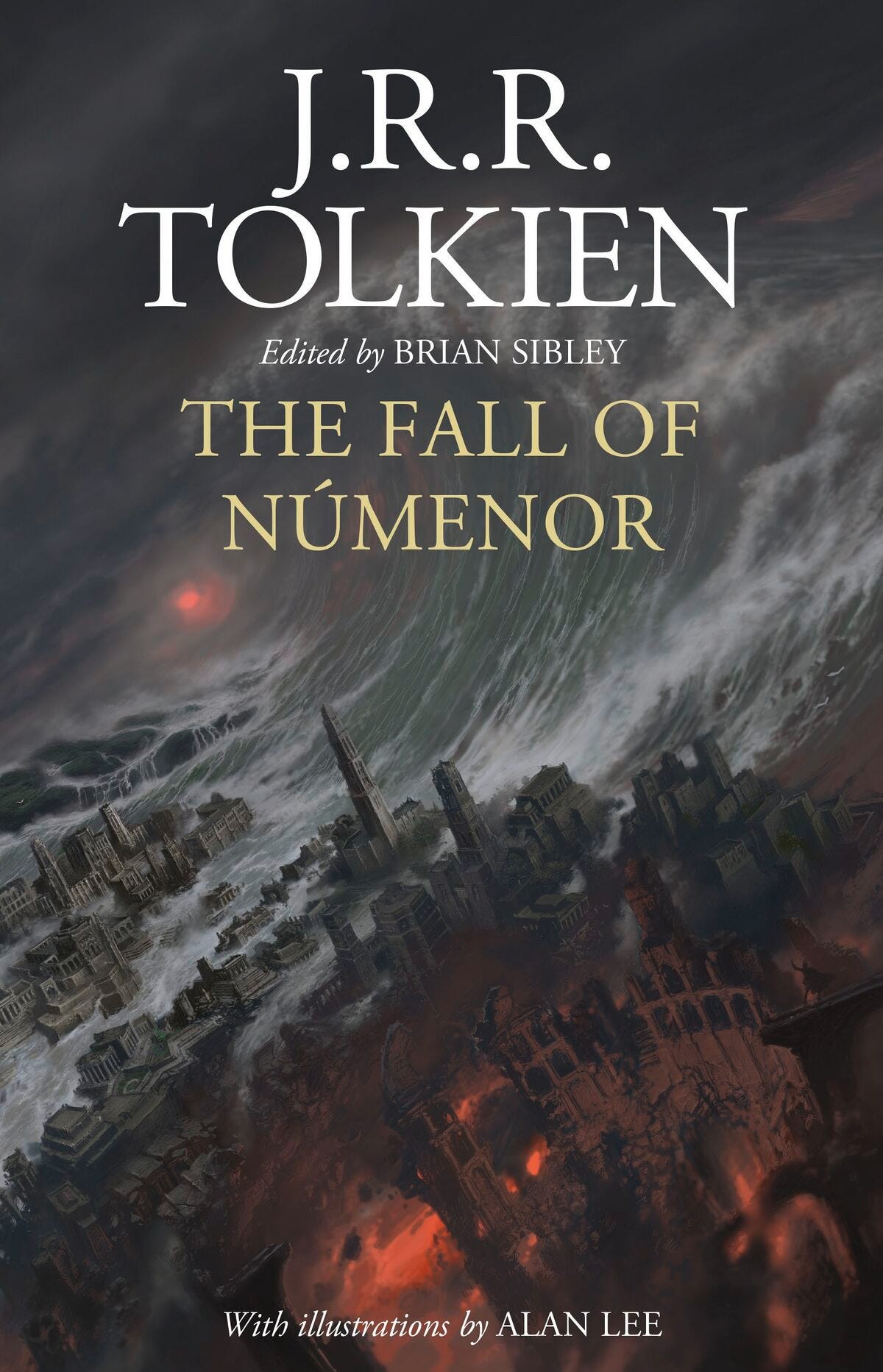
THE FALL OF NÚMENOR is one of three books that expands an entire chapter of The Silmarillion. I have not read it because I wanted to read The Silmarillion first, and I’m glad I did, because—much like these articles here—it gives me a framework within which to operate as I process the finer details of the story.
We Built This City
The Akallabêth tells the story of Númenor and its downfall. But you can’t appreciate that without understanding why Númenor was founded to begin with, what its goal was, and why it was important for so long. Similar to Gondolin, it was a special city, isolated from the rest of the world and the evil that Morgoth had inflicted upon it. It was to be ruled by Men, though these Men were of a special breed, and they eventually came to be known as the Dúnedain—taller, stronger, and longer-lived than any other race of Men.
Númenor was an island in the middle of the sea, far from Middle-earth and partway toward Valinor/Aman. The Dúnedain were forbidden to sail to Valinor so they didn’t go that far west; usually they sailed to the east and did commerce with Middle-earth, maintaining influence among the Elves and Men there.
The Line Of Succession
There were twenty-five kings or queens in Númenor, mostly kings, and the Akallabêth names them in their succession. They could each live to be a few hundred years old. Still not as long as Elves, but again, longer than the average Man by a lot. The final king was named Pharazôn, who wasn’t directly in line for the throne, but rather forced his cousin Míriel to marry him, as she stood to be queen when there was a vacancy.
This marriage was forbidden because they were too close on the family tree. (You couldn’t be any more than second cousins.) It was purely a power move from Pharazôn, the kind of thing Númenor wasn’t supposed to tolerate, but like all civilizations of mankind they were not immune to the lust for power or the limitless reach of ego. As had happened before during Númenorean history, the people were divided over this, and where there is division, there is eventually destruction.
Why, Pharazôn, Why?
At the beginning of the Silmarillion when we were introduced to Sauron, we were told that Melkor’s lieutenant was only surpassed in his evil by Melkor himself because Sauron at least spent time in the service of another. Well, Melkor/Morgoth is now in Super Hell, never to return, so that evil influence is gone from the world, and Sauron remains to suck up the power left in the vacuum.
It’s no surprise that he uses the boss’s playbook, sowing envy among mortals and making them afraid of death. He spends a lot of time disguised in Númenor, meeting with Pharazôn, whispering bad ideas into the man and steering him along a path that can only end one way. Before too long, Pharazôn becomes obsessed with defeating death, with stealing immortality from the Valar, and rising up over the rest of the world. Worship of the Valar is banned in Númenor and the Faithful are to be rooted out.
A Branch Shall Remain…
Monarchal descendance is no less convoluted in Númenor than it has ever been in our own world. Fortunately for this story, Pharazôn has a counselor named Amandil who is a direct descendant of Elros, the brother of Elrond, and founding agent of Númenor. Amandil, then, has a claim to the throne depending on the circumstance, and this is important because of his son, Elendil, and his grandson, Isildur, who you might recognize from The Lord of the Rings.
Amandil is a member of the Faithful. When things go bad in Númenor, he and his line are responsible for salvaging the last relics of the city that will preserve its legacy. As Pharazôn falls deeper into his obsession with his own power, he bans anyone from approaching a certain White Tree in Númenor, a tree that is directly descended from Yavanna’s own creations earlier in the book.
It is a young Isildur who disguises himself in the night and sneaks into the courtyard, bypassing the guards that Pharazôn placed around the Tree so that he could cut a bulb from it and ferry it away to Middle-earth with the other Faithful. The White Tree of Gondor atop Minas Tirith is a result of this effort, which is why that tree is Gondor’s standard.
The Hubris of Man
I’m skipping over a lot of details here, which is fine because this is one of the most readable chapters in the whole book. The short version is that Sauron fully corrupts Pharazôn, who leads a navy to Valinor and steps onto the shore, in violation of the decree of the Valar that mortals don’t belong there. The Valar appeal to Eru Ilúvatar himself for judgment, and he sees fit to open up a crack in the ocean floor that swallows up the entire Númenorean navy, and Númenor itself is sunk and destroyed.
The ensuing devastation even reshapes Beleriand and the northwest coast of Middle-earth. The Faithful remnant of Númenor survives by sailing to Middle-earth and establishing the lands that will eventually become Gondor.
Thirty-nine generations after Isildur, a certain heir of Númenor will range about in Middle-earth, known as Stryder to some, and Elessar to others. His given name is Aragorn, son of Arathorn, and he will one day be the King of Gondor. But that’s a story for the final chapter.
Get your paperback copy of the Silmarillion and read along! This is an affiliate link, so if you buy a copy through here, I’ll get a small commission.