

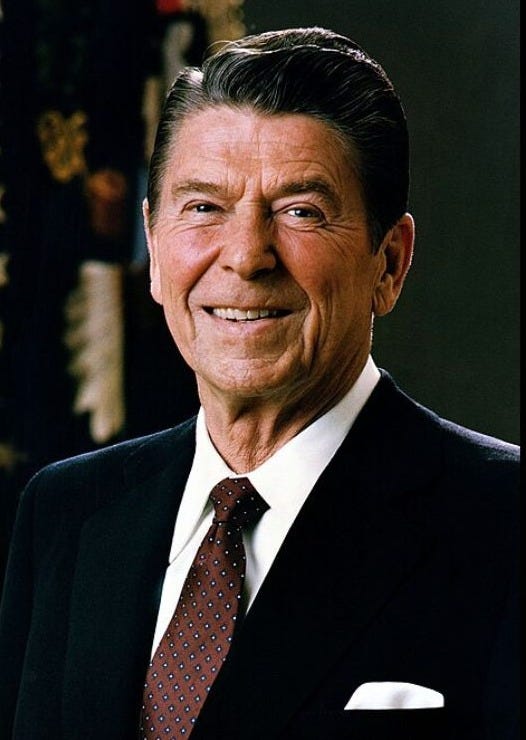
“Electoral Brawlage” examines the first election and inaugural address of each U.S. president from Washington to Trump. This project will conclude in December 2026.
If you like shootouts, car chases, dogfights, and American history, read Heartlanders!
Subscribe to get these articles via email. Become a paid subscriber to help me buy more books.
Jimmy Carter’s presidency was defined by one word: malaise. There is even an unofficial government statistic called the “misery index” which takes basically measures unemployment + inflation to show you how bad things are. Carter used the misery index as a campaign tool against Ford in 1976, only for the index to shoot higher during his presidency, and malaise became the general tenor of his time in office. People were miserable and hopeless, everywhere you looked. This is why the “Miracle on Ice” was such a big deal. Americans finally had something to root for again.
Thus Carter was in a bad position for the 1980 election. It wasn’t the kind where just any candidate could beat him, but with the right candidate you could crush him, and that’s what the GOP aimed to do.
The Primary
Ronald Reagan, who gained party notoriety in 1964 with his “A Time For Choosing” speech, went on to serve as a popular and effective governor of California from 1967-1975. He ran against Ford in the 1976 primary, lost, and spent the next four years in the private sector, where he connected with the nation through weekly three-minute fireside chats that aired on the radio on Sundays. (Read more about these in “Reagan in His Own Hand” and its accompanying audiobook, “Reagan in His Own Voice.”) With that national popularity he entered the primary again in 1980 and quickly became a frontrunner. His primary competition was George H.W. Bush, with lesser challenges from John Anderson (Rep., Illinois) and Bob Dole (Sen., Kansas.)
Bush won the Iowa caucuses by a narrow margin. Reagan walloped him in New Hampshire, and started stacking wins down the calendar from there. He ran away with the rest of the primary, and at the convention he briefly flirted with selecting former president Gerald Ford as his VP, but ultimately chose Bush. This united the populist and establishment wings of the Republican party, and brought a breadth of experience to the ticket.
John Anderson, who was a fiscal conservative but a social liberal, threw a temper tantrum and left the party to start his own National Unity ticket as an independent. He wanted to balance the budget but opposed cutting taxes, because how else was he going to pay for his federally-funded abortion program? Yes that was a real thing. This dude sucked and had a way higher opinion of himself than anyone else did. Third parties are stupid and after every voter fools around with them once, they should learn their lesson never to do it again.
The General
Fortunately Anderson didn’t pull a Teddy and royally screw over the country by paving the way for a Democrat to win. He was just a spaz who racked up under six million popular votes and zero Electoral. There was also a libertarian who didn’t even crack a million. Lmao. Suck it.
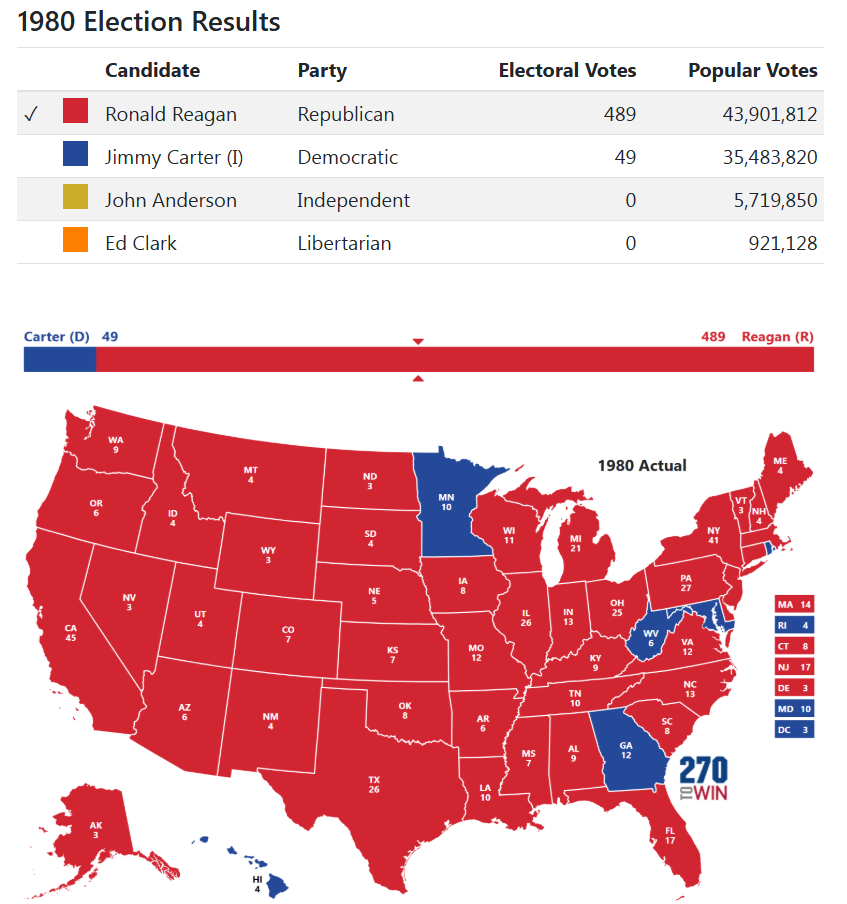
Speaking of sucking it, has Minnesota always been a hellhole? Sure feels like it has. Anyway, WOW. Look at all that red. All that gorgeous, wholesome, American red. Good gravy, that was a beatdown. Makes 1972 look almost merciful. And the hell of it is, Reagan was just getting warmed up. Not only were people ready for a change from Carter, they were one hundred percent on board with the Reagan years. Come 1984, the voters delivered a sequel that was even juicier.
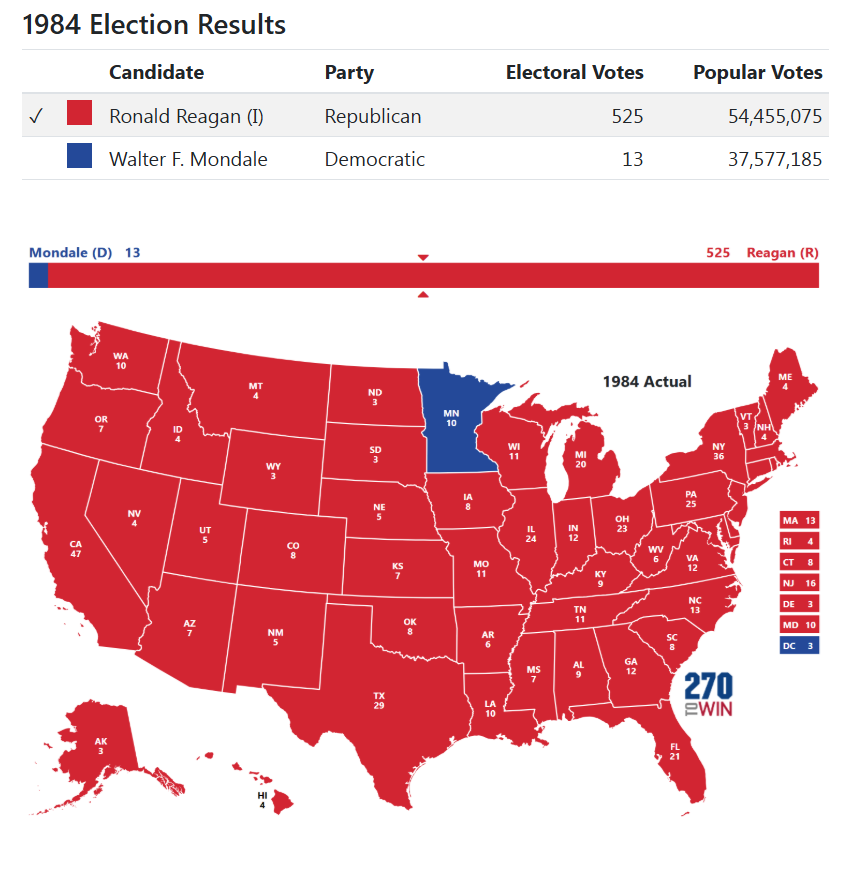
Reagan was never going to win D.C. because it’s full of ideologically inbred swamp critters downstream from Venona, but he actually could have gone 50 for 50 and taken Minnesota if it weren’t an irredeemable cesspool that we ought to invade and retake like it’s sitting on a bunch of unliberated petroleum. Reagan even campaigned there two days before the election. Alas, Minnesota was about 4,000 votes too thick. Alas.
His opponent this time was from Minnesota. That’s right kiddos: Walter F. Mondale, Carter’s vice president, which was…uh, a choice, I guess. I mean I admire the confidence, right? Shoot your shot, boy. Mondale’s main clutch at headlines was his own V.P. pick, Geraldine Ferraro, a three-term congresswoman from New York. She was working-class and focused on gender issues ( the “pay gap”) and was thought to have brought him some widespread appeal but hahahahahahahahahahahahaha. Anways.
The Speech
It’s a good one, you should read it. He directly addressed high taxes, high spending, and the stifling qualities of a too-large government that doesn’t listen to its people. Taxes would be cut, spending would be cut, and regulation would be cut. These will be our first priorities and on these principles there will be no compromise. Love it.
It is my intention to curb the size and influence of the Federal establishment and to demand recognition of the distinction between the powers granted to the Federal Government and those reserved to the States or to the people. All of us need to be reminded that the Federal Government did not create the States; the States created the Federal Government.
Now, so there will be no misunderstanding, it’s not my intention to do away with government. It is rather to make it work--work with us, not over us; to stand by our side, not ride on our back. Government can and must provide opportunity, not smother it; foster productivity, not stifle it.
You know what…I’m not even going to summarize it hear. It’s eminently readable and you can also watch it on YouTube. The man had a gravity to him that he used for good, and there’s a reason the voters loved him so much. Did he make mistakes? Sure. Did he right the ship? Guaranteed. Would that we had another like him who would do even better. Someday. Someday.
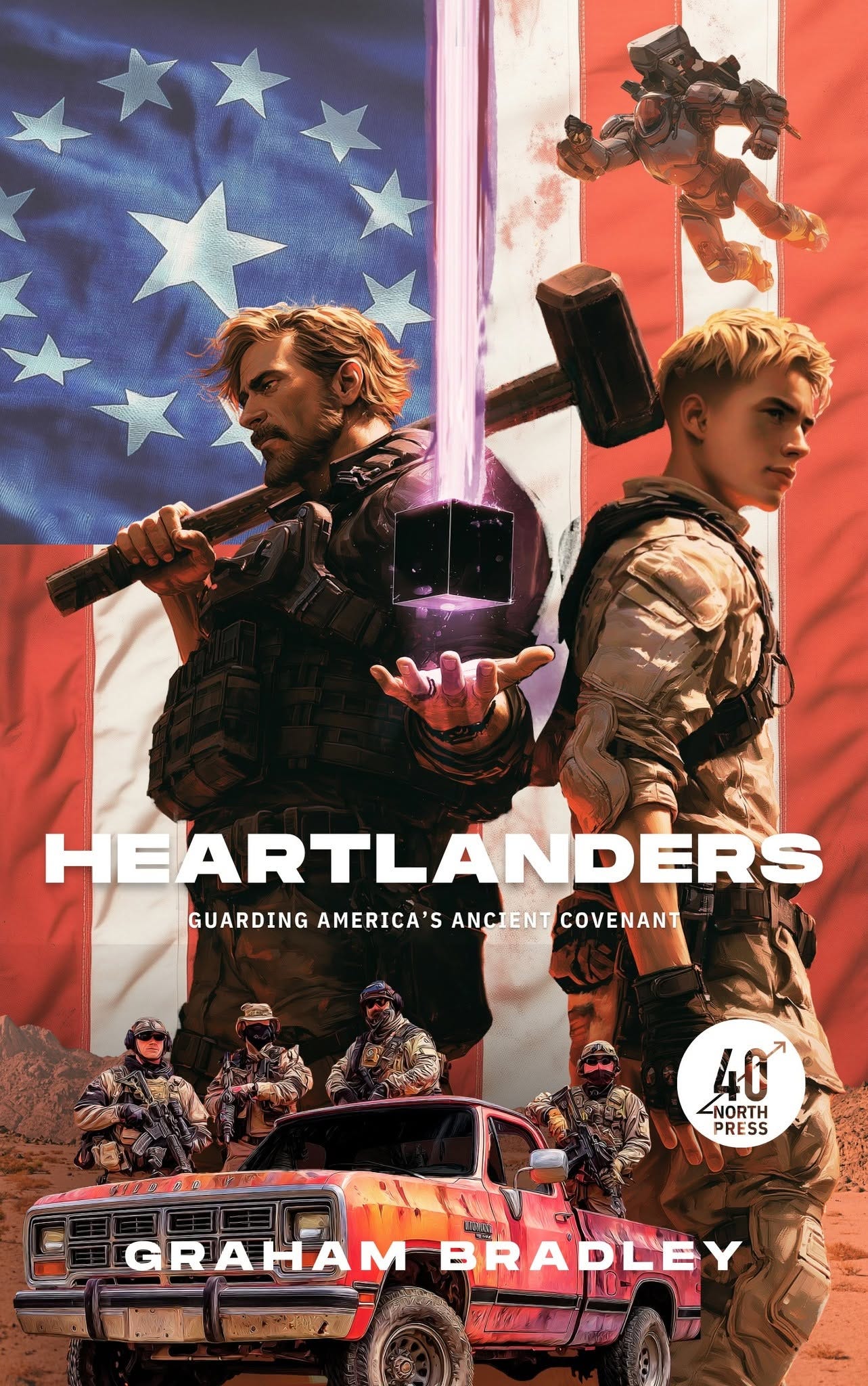
Visit Nauvoo Supply to order HEARTLANDERS, the most American novel I’ve ever written. It’s like if National Treasure happened during Fallout with G.I. Joes.
It’s short, it’s fast, it’s full of smarts and action, and you’ll love the characters.