

The aforementioned Common Sense by Thomas Paine continues to circulate among the colonies, stirring up a spirited debate between Loyalists and would-be Americans. It’s the talk of the town. Paine wasn’t just beefing with King George’s specific brand of overreach: he wanted to do away with monarchy. Plenty of men agreed with him, but there were Loyalists among the Continental Army who found themselves at odds with the idea of separation.
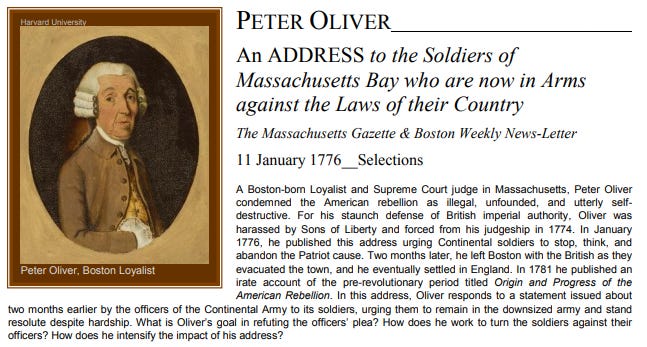
Peter Oliver was a Supreme Court judge in Massachusetts who was forced from his seat in 1774 by the Sons of Liberty. They weren’t quite up in arms at this point, but things were definitely accelerating in Boston; the Tea Party of 1773 had already happened, but bullets hadn’t started flying yet, as that would kick off in April of 1775. Until then, the Sons of Liberty would have to stack wins in other ways, and removing loyal judges was an obvious step.
Oliver, however, would not take the offense lying down, and on the 11th of January, 1776, he published a passionate argument in a Massachusetts newspaper, begging men in the Continental Army to abandon the Liberty cause. (We saw something similar happen in the fall of 2025 as several Democrat politicians subtly urged servicemen to disobey legitimate orders from a Republican administration; targeting the minds of the men on the ground is not a new tactic.)
Granted, Oliver was a more classically-educated man, and so his writing is clearer and his reasoning is more sound than just “Washington Man Bad.” Nevertheless, he was arguing monarchy to a people who were much more enticed by the idea of self-rule. This was a contentious subject in its acceleration phase, and between Oliver and Paine, Paine’s arguments were winning more hearts and minds.
You can tell because Paine and Oliver both—initially—published their works anonymously. Oliver didn’t put his name to his appeal, just signed it “Z.Z.”, because the backlash against his person and property could have been considerable. Within a month or so of publishing Common Sense, Thomas Paine let people know it was him, because he had greater support for it.
Paine had, at first, signed his pamphlet “by an Englishman.” Loyalists took issue with this, because he was expressly advocating a split with England. He’d have to work on the branding later. For now the argument was the only thing that mattered: it was time for men to rule themselves.
And men were buying in.
Paine was born and raised in England, so calling himself "an Englishman" was true and accurate.