

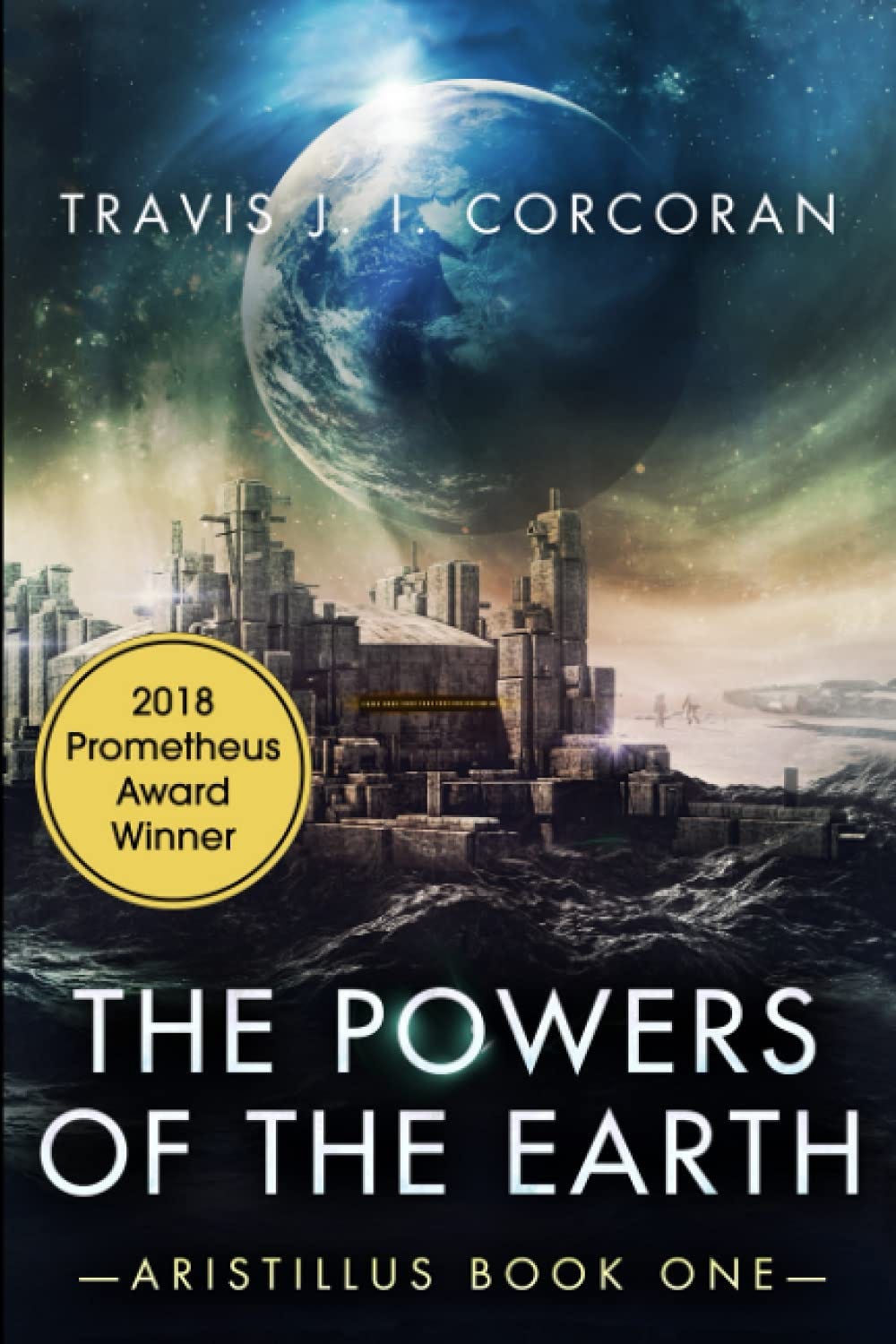
THE POWERS OF THE EARTH is a 2017 sci-fi novel written in the tradition of Ayn Rand: grab your audience with a thrilling premise, then beat them across the face with the metaphorical phone book of your philosophy.
I first read it in September of 2018. While the action was great, the arguments were topical, and the outcome was very likely, my primary takeaway was that I hated the way it made me feel.
This is a hell of a blackpill of a book. It’s written from the standpoint that the government is powerful but run by ideological morons, who just hate everything, and want to either kill or enslave you, whichever makes them more comfortable. I don’t like having that perspective of the world.
Then 2020 happened. “Nothing ever happens, until it does,” and boy did it. The next five years were a rollercoaster ride. No joke, here’s me at the start of 2020:

Here’s me now:

But anyway. Things have happened. My perspective on the world I live in is more…illuminated. And while I’ll never be a blackpilled doompreaching libertarian type, there are harsher realities about the government and huge swaths of the country that I have come to accept for what they are.
I still find THE POWERS OF THE EARTH to be a hard read in certain ways, but it has more to do with its tone and doomerism than it does with the merits of its content. Here’s the skinny:
It’s 2064. Mankind has permanent settlements on the moon. Several powerful entities have moved up there, mostly ex-CEOs, engineers, inventors, makers, etc. Think “Galt’s Gulch” from Ayn Rand. They got tired of being taxed and legislated into poverty simply because they did things nobody else would. They tried playing by the rules, they got burned, so they bought passage to the moon and started doing their work up there.
The USA government has been taken over by populist ideologues who came up through the vlogosphere, making promises to an ignorant public that they couldn’t possibly keep, and placing the blame squarely on capitalists. Despite valid fears of hyperinflation, natural disasters, and political insanity, the Girlboss President decides to pin all of the nation’s woes on the moon’s residents for stealing “productive assets.”
What ensues is a gradual increasing of the temperature as eventually the USA steals an advanced gravity engine developed by lunar engineers and builds a fleet of spacegoing battleships. They invade the moon, and we’re treated to a cliffhanger ending before CAUSES OF SEPARATION—which I have not yet read.
There are a couple of side plots, including an astronaut on the far side of the moon, going on a hike with a pack of uplifted dogs who travel in spacesuits, speak English, and even have thumbs. Other plotlines include sleeper cells on the moon, hyper-litigious tourists who bring Earth problems into orbit, and political machinations between sub-parties of the main governing body.
The science is fascinating, both with the genetics as well as the engineering, and Corcoran’s background as a Cornell grad really shines through. As a piece of science-fiction this story has a lot to offer. As soft philosophy goes, it’s definitely confined to the lens of an anarcho-capitalist who wants to be left alone, but lives in a system that blames him for its own failures.
After reading it a second time, I was surprised at how much I remembered, and how Corcoran was also able to resist steelmanning his protagonist. Mike Martin, a former earthbound business owner, is now building tunnels on Luna, and also building zero-G-capable rifles, but he’s not walking through this world and winning every challenge thrown at him; not only do his iterative inventions often give him basic engineering problems, he also has to struggle with organizing people against the government.
(This is difficult because Mike is an abrasive a$$hole, as many ancaps tend to be.)
In fact, he faces the main problem all libertarians face: you can’t have ten thousand individuals doing their own thing if you want to defeat ten million people focused on one. He has to learn how to organize like-minded individualists before the invasion wipes them out for good.
In the wake of all the lies told to us after the Covid scandal, the FBI’s lawfare against a sitting president, the flagrant money scams disguised as Ukraine aid, and the party machinations that replaced Biden with Harris sans any vote at all, 2025 Graham was far more capable of accepting the face value premise of Corcoran’s book.
Like I said: it’s still a blackpill. I refuse to take the blackpill.
But now I’m interested in reading the sequel to see how he handles the landing. Especially since Corcoran has a book deal with Ark Press, whose stated mission is “the humans win in the end.” His forthcoming title, RED STATE MARS, sounds like a new exploration of this same idea, just on Mars instead of the moon, with more enhanced stakes.
I like Corcoran. I’ve followed him on X for years and years. He’s capable of challenging his own ideas, and even challenging “his own side” if they’re wrong—a quality sorely lacking in many political commentators (myself included—I’m better at it than I used to be, but I think Corcoran is exceptionally honest about bad ideas no matter who proposes them.)
While I remembered what happened in this book, I see it in a new light, and I’m ready to take another crack at his work.
If you’ve read it, let me know what you think. Drive safe, see you out there.