

2026 is America’s 250th birthyear. To celebrate, I’m highlighting 50+ significant American documents from our history. So far I have covered The Mayflower Compact, Patrick Henry’s Speech, The Lee Resolution, The Declaration of Independence, the Articles of Confederation, the Treaty of Paris and the Virginia Plan.
Subscribe to get these articles in your inbox, along with my regular book/comic/movie reviews. I also like money, and if you like me having money, become a paid subscriber. There’ll be special content for you, including original fiction, and early access to posts.
When Britain originally settled Jamestown in the early 1600s, their charter was kind of vague about its boundaries, and the earliest borders of Virginia were hard to define. To this day, people are still arguing about it, and if you looked at a map of Virginia in 1609, you’d see that Britain and Spain were basically laying claim to huge tracts of North America at the same time, but only on paper. For either side to take tangible control of those lands, they’d have to kick a LOT of Comanche butt, and that wouldn’t come until the mid-1800s at the earliest.
In the 150-ish years between Jamestown and the French and Indian War, Virginia’s borders would change (shrink) as more precise definitions were put to paper, definitions that more accurately represented the situation on the ground. Prior to the Revolution, Virginia’s western boundary was the Mississippi River. In the tumultuous decade of the 1780s, with the new American nation trying to figure itself out, Virginia was again divided, probably because it was too freaking huge to be one State.
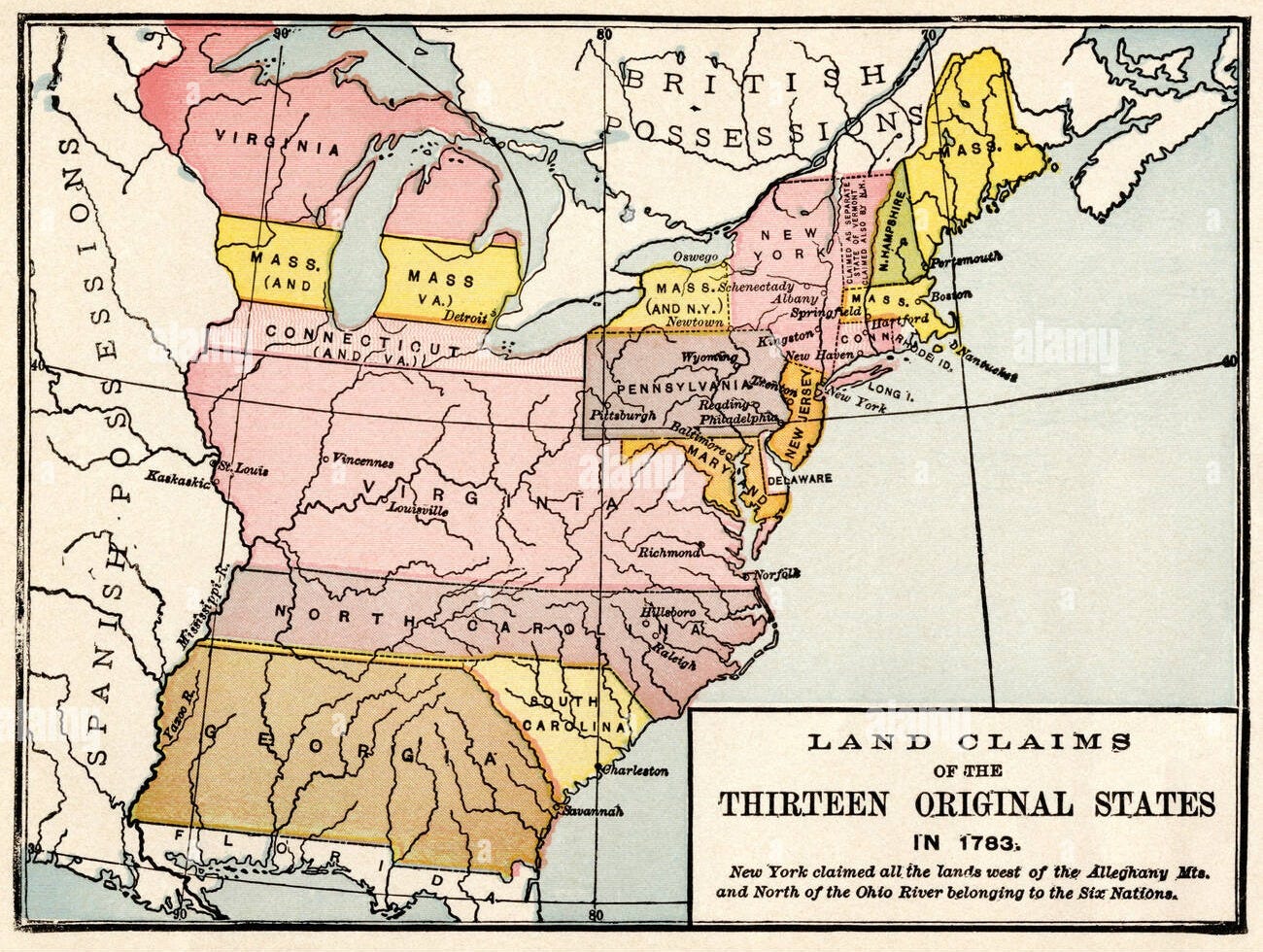
Look at this. What are we even doing?
The problem with breaking up Virginia and the other huge trans-lacustrine states (I know I made you look that up) is that it could easily, rapidly, and irrevocably alter the calculus of the Confederated Congress. (Remember that the Constitution wasn’t ratified until 1789, they still had the Articles of Confederation here.)
It was necessary to determine just how they were going to break up these huge States. If each State got two Senators, how many new States would they make? How would they determine the number of representatives? What about individual rights? What about the militia? What about the Indians?
Enter the Northwest Ordinance of 1787, a document that addressed all these concerns and more. There were to be no less than three and no more than five States carved out of this landmass. They wouldn’t get representation in Congress until there were at least five thousand voting-age males per State, and several other conditions were enumerated that we would later recognize from the Bill of Rights (religious freedom, speech, guns, etc.)
There was a very strict provision on how to deal with Indians and their lands, namely that you weren’t allowed to steal from them, but uhhhhhh some people just uhhhhhh went ahead and did that anyway…I’m gonna read up on more particulars there but that particular rule wasn’t always followed.
There were plans to level up these territories into States as they hit different benchmarks of growth, knowing that they would grow as settlers moved in and cultivated farms on the land.
Ultimately the States created out of the Northwest Territory would include Illinois, Indiana, Ohio, Michigan, Minnesota, and Wisconsin. You might be doing some math and saying “That’s six, which is more than five,” and you’d be right, but there’s more language in the ordinance that says Congress can be flexible if they have a really good reason. Given the size of these States, I’m not surprised they went with one more.
Anyway, this is all a cool glimpse into the earliest days of our nation, and how its borders have kind of always in been flux. We haven’t added a new state since my parents were born (fun fact, they were both born in the narrow eight-month window wherein America had 49 stars on the flag) so historically speaking, we’re overdue.
Looking at you, Alberta and Greenland…