

Recently I told paying subscribers that they could pick a book for me to read, and I would read it and give it the essay treatment. So far 20% of paying subscribers have taken me up on this offer. If you’re a paying subscriber, take advantage of your benefits and get on the list.
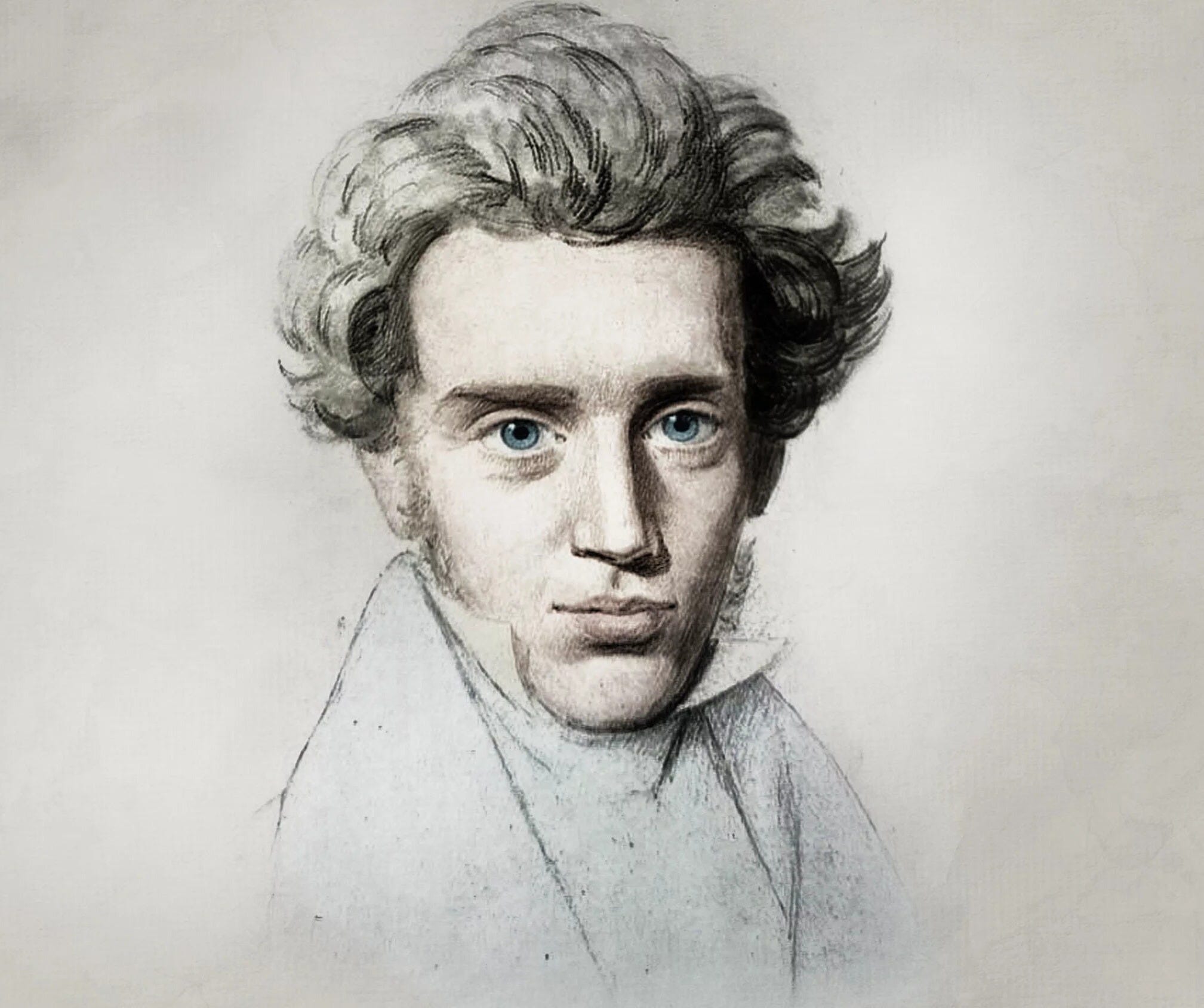
The first subscriber to claim the offer was our good homie Ben, a longtime reader of TMR (and other fine literature by Graham Bradley.) He recommended Fear and Trembling by Danish philosopher Søren Kierkegaard, written in 1843, which examines the Old Testament story of Abraham being commanded by God to sacrifice his only son, Isaac.
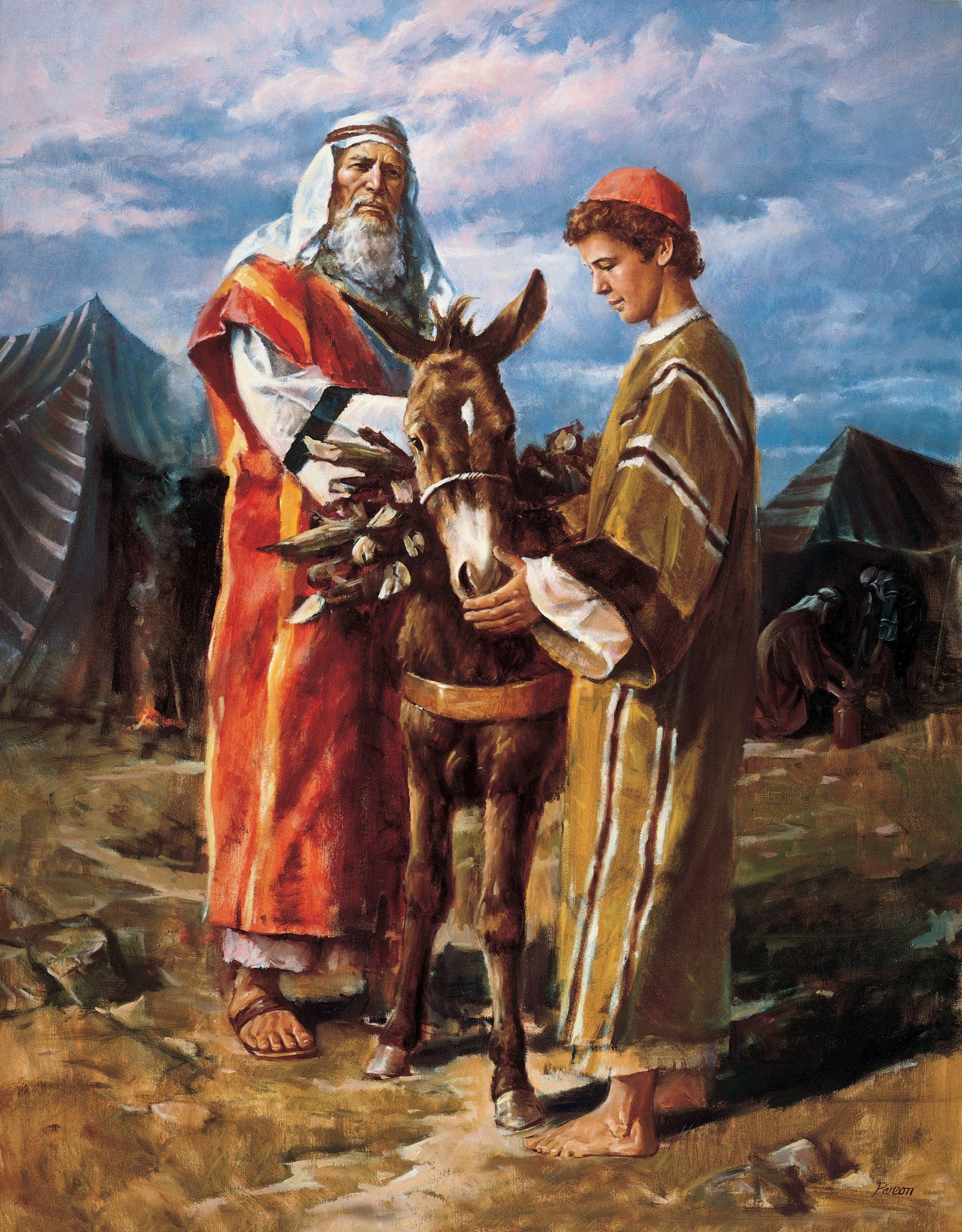
Though I had heard of Kierkegaard before this, it was my first time reading his work and I’ll admit some of it felt impenetrable at times. Overall I got the main points he was laying out, he just has a tendency to descend into a Philosophy Spiral and if he gains too much speed he can’t pull up and save himself.
Before we hit the point of no return, with Kierkegaard gleefully shoving the throttle to the wall and me sitting wide-eyed behind him in the bi-plane, white-knuckling the sides and wondering what was coming next, I had a literary epiphany about Frank Herbert’s sci-fi epic, Dune. See below.
Abraham’s Story
Abraham, the Old Testament prophet, was promised by God that he’d become the father of an innumerable nation. This was impressive, considering his advanced age and his post-menopausal wife, but God is a god of miracles, and the embodiment of You Can Just Do Things. He knew Abraham was faithful and He had a purpose for him.
When Abraham’s wife Sariah gave birth to a son, Isaac, it was the beginning of the promise of a nation. But at some point in Isaac’s young life, God then sent a message to Abraham: sacrifice Isaac the way you sacrifice firstlings of your flock as a demonstration of faith.
One need not be a father to understand the weight of such a command; one simply need not be a woman on TikTok in 2026 be capable of love and compassion. Abraham now had to decide who he loved more: God, or the son God gave him.
The Demands of Faith
This is where Kierkegaard begins his work, analyzing the proposition from Abraham’s perspective, and then from an outside, secular perspective. Faith as a concept can sometimes be reduced to “the belief that something will happen before it does.” As it relates directly to one’s relationship with God, faith becomes a matter of trust. God asks “Do you trust Me enough to believe what I’m telling you? To act on it? No matter what?”
We’re told faith is a prerequisite for miracles—but why? My $0.02: it has to do with agency. In this scenario, God gave us the ability to choose right or wrong and then dropped us in Sandbox Earth where we’d have plenty of chances to do both. Then there are rules to follow (the Ten Commandments, the Beatitudes, etc.) He wants us to choose the right things but He won’t force us; we can always choose. Sometimes that choice is hard because of external factors. Nevertheless, that ability is ours.
If we really demonstrate faith, we’re showing trust. “God said this will work out so I’m going to do it.” God’s not dropping an undeniable miracle in our laps unprompted, then getting right up in our faces and saying “Hey, see this? I did this. I have this power. Do what I say or you’re doomed.” That doesn’t really leave us with agency. There’s nothing to believe in. In a sick twist, you’d actually have to have faith that what you just saw and felt was not from the omnipotent God, and that He was lying.
And so you see the scope of the question.
Universal (Secular) versus Absolute (Religious)
Kierkegaard approaches Abraham’s dilemma through another lens, which he describes as “universal” versus “absolute.” I’ll admit, he kind of lost me here with these terms, only because so-called “universal” values are downstream of thousands of years of “absolute” values; ergo, the secular is a watered-down version of the religious, looking to mimic it while also pretending to be so advanced as to not fall for divine pretensions.
Universal values are the ones that functional societies rely on to become functional. They’re not universal from place to place, but within a place, and once two “universal” systems try to occupy the same place at the same time, something will break. One need only look at current-day Europe and its clash between native in Spain, Italy, France, and England, and the invading masses from Africa and the Middle East. Universal rules aren’t being applied to the residents of those places, even though among their own communities, universal rules exist.
There’s every chance that these terms have some nuanced meaning in 19th century Danish that doesn’t carry over to 21st century English; I can only read them as the man of my time that I am. My takeaway was that Kierkegaard was contrasting an act that clashes directly with secular values but is nevertheless justified because it’s a religious one, tied to a system that predates and supersedes the the laws of man. More on that in a minute.
The Hero and the Poet
Kierkegaard’s most valuable observation, for my money, was the contrast between the actor in Abraham’s story (Abraham himself) and Moses who ostensibly wrote it in the book of Genesis. The value of this account for the masses is that we get to read about an incredible, almost superhuman act of faith, while for the one man who had to carry it out it must have seemed almost impossible to do. Could you do it? Violate the laws of God and nature in order to comply with a command from that very same God?
It is easier for the Poet to say yes, because he is examining the act of the Hero in the abstract, after it’s all said and done. For us Abraham is an example of faith in God’s word, and fidelity to His authority. Yet Kierkegaard goes to great lengths to put himself in Abraham’s shoes and ask hard questions like Could I really do this? Could anyone?
The Poet, then, possesses a luxury that the Hero does not. He gets to consider these things in a vacuum, free from consequence. Abraham had to truly trust God in order to carry out this act, perhaps not knowing that an angel waited just outside of his view to wink in and stop him the second his knife fell down to the altar. For thousands of years, adherents to the Abrahamic faiths (Judaism, Christianity, Islam) have looked to this account as the standard to which we ought to adhere.
We have the Poet’s luxury. We want the Hero’s prize, but few if any of us will ever be tested at that level. Kierkegaard admirably strives to truly grasp the mindset (and devotion) of the one man who was commanded to endure that test.
When Can You Break the Rules?
Much has been written on the hard mechanics of faith, how it works, and how one can try to live by them. Much also has been written by detractors of the Abrahamic faiths as to the so-called contradictions in God’s orders—He says, for example, “Thou shalt not kill,” but then orders Israel to go on a rampage throughout Canaan. He punished Cain for slaying Abel, but then told Abraham to sacrifice Isaac. What are the actual rules?
We can simply look to the incident in the New Testament when the Pharisees tried to trip up Christ over which Commandment was the most important. Christ’s reply was “The one that says to love and serve God.” (Paraphrased.) Elsewhere in the Gospels, Christ declares that He and the Father are one, and that if you love [Christ/God], keep His Commandments. Straight up, the highest commandment is to be obedient to God.
Here’s where we’re opening ourselves up to an entire ecumenical war campaign as to what that means, how we know we’re obeying God or not, and so on and so forth, so let me quash that right now—what I need you to focus on is why this matters, and how it aligns with Kierkegaard’s observations in Fear and Trembling.
In order to have faith in God—faith sufficient for our salvation—we need to have a proper understanding of His attributes, including His omniscience, omnipotence, and omnipresence (He knows everything, can do anything, and is everywhere.) Beyond that we also need to know that He is just, merciful, patient, etc—the things we often see listed in long verses in the New Testament.
Taking all of that together, we can only “break” the rules when He tells us to, whether those laws are spiritual (“Kill that guy”) or even physical (“Go walk on that water.”) He wrote the rules. Those rules serve His purposes. If we believe that He embodies all righteousness, and that He won’t give us an unrighteous command, then we can trust His commands to us, even if we don’t understand them.
And we have Abraham to look to as an example of that. It’s a heavy thing to consider. In the end the question is: do you trust God?
The Dune Connection
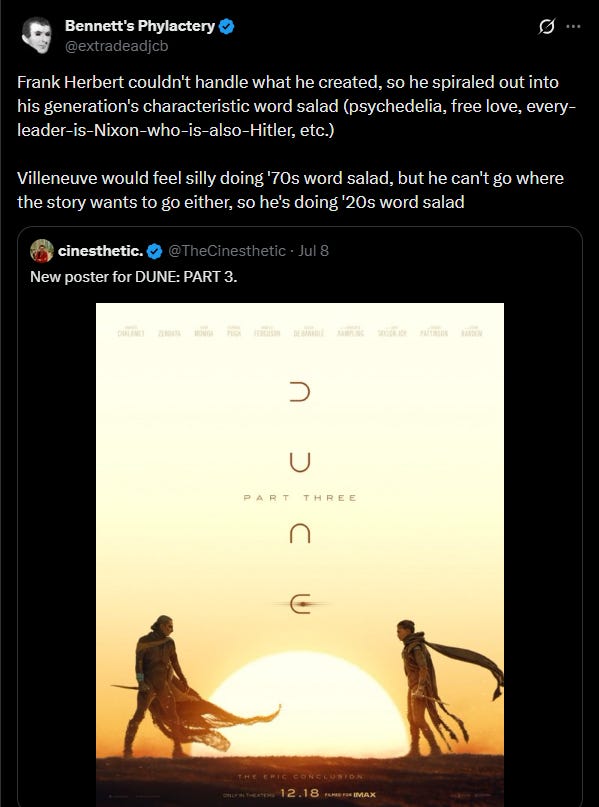
Speedrunning Dune for the uninitiated: 20,000 years in the future, mankind has spread across the galaxy. Major Houses compete for a scarce yet highly valuable resource called spice melange, which is more or less Space Cocaine that makes you trip balls so hard you can see the future. You also gain telepathy and control innate bodily functions with a single thought. It’s good stuff.
There’s a religious order of witches called the Bene Gesserit who use the spice—in conjunction with their feminine wiles—to manipulate leaders of the great Houses and their interests. For centuries they’ve planned the eventual birth of a Messiah figure who they could control and, by extension, rule everything.
Various character motivations come into inimical contact with this plan and the Messianic figure is born a generation early. Nevertheless, the power structures around him are in place and he faces the choice of using them to further his own interests, or ignoring them and letting the galaxy go its own way. The problem is that the locals on the planet Dune, where the spice comes from, are true believers in the religion that the Bene Gesserit made up. If Paul (the main character) takes up the messianic mantle, the true believers will initiate a holy war in his name. Billions will die. Yet if he doesn’t, other Houses will abuse the power anyway.
By the rules of storytelling, Paul, who has severe protagonist armor, is the righteous hero and makes the correct choice: he assumes the mantle of the Kwisatz Haderach (Messiah figure) and topples the enemies of his father’s House. The Holy War ensues, and billions die in his name.
Reader responses to Dune divided broadly into two camps: those who agreed with Paul, and those who thought he did the wrong thing. I would wager that the dividing line was drawn by those readers’ own opinions on the Abrahamic question: when is it right to do an otherwise objectively bad thing?
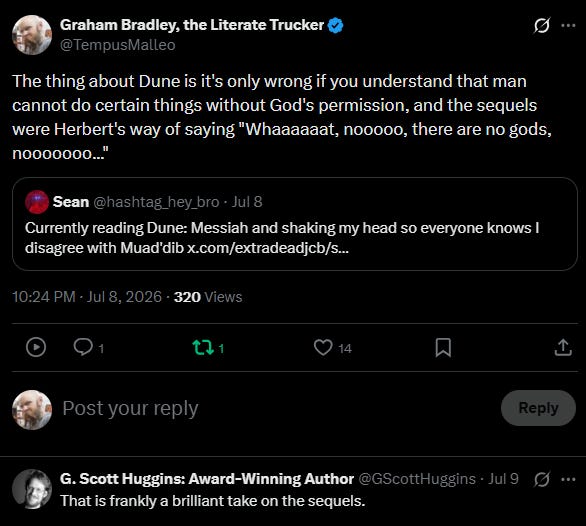
In the follow-ups to Dune, titled Dune: Messiah and Children of Dune, Frank Herbert takes steps to remove any moral ambiguity about Paul’s choice in Dune, casting his actions as wrong and even going so far as to have him work against his own legacy. As the series continued (God-Emperor of Dune, Heretics of Dune, Dune: Chapter-House) Herbert filed away at the edge of this idea, making it ever sharper and more clear that Paul shouldn’t have assumed the role of a Messiah.
Taking the first book on its own, Paul did the right thing: he ended the Harkonnens’ reign of terror, avenged his father, and toppled the Emperor that had first set House Atreides on this suicidal path to the world of Dune. He used power to protect his loved ones and secure the future of his bloodline, which faced unambiguous obliteration. And yet…
In a way, Herbert was right: Paul’s choice caused billions of deaths, which were no less significant simply by being several lights years removed from his immediate awareness. As a family man it’s easy to say that of course, I would choose the lives of my own family over their aggressors, but if the collateral included a third of the known residents in the galaxy, it gets a little more complicated. (Or it should!)
If Paul had been given a direct order from the true and living omnipotent God to do this, it would be a different moral conclusion with no ambiguity—but that wasn’t the landscape that Herbert set up. The Bene Gesserit order was a straight-up (wo)man-made order, a slightly more enhanced version of the MK Ultra program. It just created a unique scenario that Paul exploited to preserve his bloodline from those who would have ended it. He may not have regretted ending the Harkonnens and saving the future of House Atreides, but he had plenty of regret in other areas.
Conclusion
On the specific question of commandments, and being commanded to do something objectively bad by God, Kierkegaard took an admirable intellectual approach to a very challenging idea. Christianity and its tenets are not to be lived in a vacuum, and real faith requires hard choices few of us will ever face. In the meantime, the loudest practitioners of the faith should take care not to live it as a LARP; on paper we can say we’d do whatever the true and living God asks of us. In practice, I dare say we’d struggle to sacrifice our own offspring, and Abraham’s willingness to do so said a lot about his relationship with God.
He must have communed with his Maker to such an extent that he truly understood He was the God of Adam. There are things that man cannot justify doing on his own initiative, things you can’t take back if you were wrong to do them. One of the many lessons of Abraham’s faith ought to be this: make sure you know who you’re following. He did, and that’s why he proceeded.
Paul Atreides knew what he was doing too—and he wasn’t serving the one true God. Otherwise, he could have been in the clear.
Food for thought.