

This is the prologue and the first chapter of HEARTLANDERS, a novel of 2076. Enjoy.
PROLOGUE
Monday, November 20, 2056
7:43 PM, MST
Kimball Junction, Utah
Sam Parsons was seventy-two years old when the sun reached across space and drowned the earth in electricity, destroying eighty percent of technology in the developed world. It didn’t surprise him; he’d known it was coming.
There were others who knew, mainly astronomers who advised the White House. They’d probably spent the last two days scrambling to get as much sensitive material into insulated bunkers as possible. The rare solar storm would spray EMP across the atmosphere indiscriminately and there was no telling what would survive. By now the president was already at NORAD to ride it out. Sam wasn’t worried, or rather, he wasn’t worried for himself.
It came two weeks after the 2056 presidential election, which hadn’t been the ugliest Sam had ever seen, but it had its low points. A junior senator from California challenged the incumbent president, who won comfortably. It didn’t matter. Sam and his network of fellow Kryptonauts had known that the sky would fall tonight, and that the president’s second term would never officially begin. Things were about to get…interesting.
Sam had retired to the Wasatch Mountains in his sixties, spending half his Army pension and cashing out most of his investments to build a basement that could withstand an EMP burst. He’d stocked his storehouses with emergency supplies—generators, diesel, food, and weapons. He had an old truck in the garage with a carbureted engine, and the garage was also shielded. He was ready. And so he sat on his back porch, beanie pulled down over his ears, wrapped in a thick jacket as he leaned back in his chair to watch.
Colors streaked in undulating wavelengths through a cloudless, clear night, like the Northern Lights at an unusual latitude. He could almost imagine the trouble hitting the different corners of the globe. Major cities would catch it the worst, especially the ones that were too far from agriculture. Coastal cities would get hammered. It would take a day or two for food riots to kick off, and a lot of people were going to die. That weighed on his heart, but he completely lacked the means to warn anyone in a position to do anything about it. Governments didn’t listen to crackpots unless they were in office.
Sam rolled a challenge coin over his knuckles repeatedly, fiddling to organize his thoughts. He owned a few challenge coins from his Army days, back when he’d been a Black Hawk pilot in Iraq. He’d been shot at plenty of times, but never shot down. The more it happened, the steadier his nerves became, and he relied on that steadiness to get him through the next few hours.
He imagined the scene out in space: it began hundreds of millions of miles away on the surface of the sun, as solar flares worked through their cycles and spat their ejecta across the cosmos. This cycle was the most intense in two hundred years, and the world had become increasingly reliant on technology in that time. Those coronal mass ejections would spray the earth with scattered electromagnetic pulses, frying just about anything with a current.
Cities would plunge into darkness. Automobiles would die on the road; in fact, with most of them being electric these days, plenty would even catch fire. In urban environments those fires would spread, and without cellular communications, emergency services would have no idea where to go to help, which didn’t matter in the end if their trucks stopped working. Whole cities would burn. Conflagrations would last a week, not just in the United States, but across Europe and Asia as well.
Sam said a prayer for anyone traveling by air when it happened, though this number was lower than he feared. Even with the government’s late response to the phenomenon, the FAA had grounded most civilian flights on Monday. They knew the flares were coming and they weren’t completely soulless; they wouldn’t issue a widespread warning, that could only generate more panic. But they could ground the flights.
Sam’s eyes followed a bright speck moving across the sky, slowly and steadily overhead, like a fishing lure reeled in by an even hand. That would be a space station, most likely America’s. He wondered if the astronauts got out. With all their livestreams and broadcasts, their viewers would have known something was the matter if they suddenly vacated their posts and returned to Earth.
The station floated to the edge of its visible range in the atmosphere and faded away, soon to be a graveyard in the sky. Maybe the astronauts would bail out. The station had an escape pod with parachutes, and they knew when to eject so that they’d land in the U.S. He dared to hope. He needed to believe people wouldn’t die horribly tonight, though he knew many would.
He heard the sliding door open behind him. “Sam?”
He turned around, his thick coat binding him up on the porch seat. His wife, Vanessa, stood inside, her face poking out into the cold.
“I’m here, love.”
“Is this it?”
“Yeah.”
She hesitated, then joined him, dressed in a thick robe and wrapped in a comforter. Forty-five years of marriage had keyed them into each other’s ways, and he read her mood through her tone, her movements, and how her soft lips pressed together. She leaned against him on the bench and watched.
“What did the kids say?” she asked.
“They got ready. They’ll call when it’s over. But…Abby and Greg are still in Vegas.” Sam’s voice cracked as he said it.
Vanessa leaned over to rest her head on his shoulder, and he felt her shake as the tears came. Their daughter Abigail had married well, at least as far as money went; Greg Rammage owned an energy firm and had purchased one of Salt Lake’s oil refineries three years ago, along with two trucking companies and a chain of repair shops. They lacked nothing, but wealth brought its own challenges. Fortunately their sons, Connor and Franklin, had turned out well, showing good judgment in their early adult years.
“Frank made it to Idaho last week, with the others,” Sam added.
Vanessa didn’t respond. She and Sam had five children, all married, and eighteen grandchildren, and had just become great-grandparents for the first time that year.
“Rural is the safest place to be, for now,” Sam went on.
“Tell me what happens next,” Vanessa whispered.
“It gets bad.”
“And then?”
“It can get better,” he said, planting a kiss on her brow. “Good men can make it so.”
The night grew colder, but not darker. To the south, light pollution from Salt Lake stayed steady. Through unbidden impressions and even a few powerful dreams, Sam had predicted that the Mountain West would be spared, and so far that bore out. Above certain latitudes there was less likelihood of getting hit, but it was impossible to nail down certainties. Across the western hemisphere, invisible hammers of electromagnetism rained down from the sky and smashed into fragile digital technology, sending it straight back to the Stone Age.
He kept fiddling with the coin. One side bore the emblem of a saffron flower, six petals open in full bloom, and the other bore an engraving of a theodolite, used in centuries past for surveying land. It was an analog tool, and only of value to a man trained in its use, from a time when men did more thinking than their instruments.
The world was changing, and it would demand that men change with it. Analog would be the way of the future for a while. Everything was slowing down in real time. This solar storm, equivalent to a thousand EMPs over the next thirty hours, would slam the brakes on the world’s engines. Computers, phones, neural links, all of it would be worthless. They were halfway through twenty-first century and they were about to find themselves in the nineteenth. No idea how to do anything without a power tool, how to get food without a grocery store. Something like eighty percent of Americans had never even touched a shovel. Might as well be poodles dropped into a wolfpack.
Sam tried not to think of his daughter Abby in Vegas. She and his son-in-law had gone to a football game that night; they might have flown if Greg’s jet could have gotten FAA clearance, but they drove instead. Sam had told her not to go, that this was the night everything would shut off, but she didn’t believe him. Out of all his kids, Abby was the only one who outright resented his “curious hobby.” I love you Dad, but that stuff is crazy.” And she wouldn’t let him talk to her about any of it.
He closed his eyes and prayed again. Please, let them get out.
There would be riots. Looting. The normal things that happened when civilization broke down. A small percentage of people would start killing because they could, or because they wanted something, first toys, then food. Like a mind-virus the urge would spread, fear leading to panic and desperation, triggering the survival instinct.
Maybe Greg and Abby would make it out. Maybe Las Vegas wouldn’t get hit, and their car would work, and they’d drive home in the morning. The Raiders and Broncos had a Monday night game this year and Abby never checked her phone when she was out with Greg. Sam wouldn’t hear from her for a few hours. It made him sick to his stomach.
“How does it get fixed?” Vanessa murmured, as shimmering waves of green and purple light grew brighter in the night sky, illuminating their quiet back deck.
“Same way it got started,” Sam said. “Find the Shrine. Renew the covenant. Buy us another fifty years. The last few cycles, things have…not gone well. I think this is a punishment for forgetting how to live. The masses will suffer until we get back on the path. When this is all over…I think there might be enough people willing to try. We’ll just have to see.”
“I love you,” Vanessa said, pressing tighter against him.
“Love you back,” Sam said. He rested his cheek on her head and closed his eyes as the sky continued to burn.
CHAPTER 1
CORONA
Friday, June 26th, 2076
10:18 PM, PDT
Prado Dam, California
Frank gritted his teeth as the rough road beat up his suspension like a deafmute in a barfight. He’d built it to take a lot of abuse but this might be the limit; up front in the driver’s seat, his friend Artie did his best to navigate in the dark, bucking over uneven mud and silt, trying to pick a line with only his night-vision goggles to guide him. The headlamps were out of the question. Even the noise of the exhaust might be enough to get them into serious trouble.
There were no other options. They’d scoped this area with maps before making the drive from Utah, and then spent a day surveying the land through binoculars. If they were going to hit their target, they had to be fast in, fast on site, and fast out.
Frank didn’t like how the steering wheel shook in Artie’s hands. Credit where it was due, the little guy never lost his grip. He kept his foot in it, racing down the spillway to the face of the dam, listening to directions on their shared comm channel.
“Halfway there, Artie,” said Frank’s son, Ronan. He was miles away, safely ensconced with their fuel tanker in the San Bernardino foothills, watching their progress on a short-range radar screen. “On target in five…four…three…”
Frank unbuckled his harness. Beside him, his navigator Shep cranked a handle to roll down the rear window of the cab. Normally he’d be the one on the radar, but Frank didn’t want Ronan in town if this op went sideways. Ronan was only eighteen. Back in the day he might still be just a kid at that age. Those days were long gone. Frank trusted him, yet paternal concern prevented him from putting Ronan in the crosshairs.
Artie backed off the accelerator. The truck ran on an old pre-ECU Cummins, swapped into a four-door Dodge that had first rolled off the assembly line ninety years ago. Frank paid his mechanic a small fortune to keep it roadworthy for the type of work he did. Tonight he fully expected to butt heads with Marines, even if he didn’t want to. The truck, God willing, would do the job. The suspension adapted better to the rough conditions as Artie decelerated, gently turning the wheel to the right.
“What’s my line, Ronan?” Artie said into the comm.
“Do a U-turn and back up another…fifty yards, at least. Better have Shep eyeball it, the box keeps glitching on my end,” Ronan said.
“On it,” Shep said. Frank had buds in both ears; even with Shep sitting two feet away, he only heard the digital transmission of his voice. Shep turned around in his seat, NVGs down, and called out the diminishing distance to Artie as he drove the truck backward.
Frank closed his eyes and said a silent prayer. For the next several minutes, they’d be sitting ducks.
Prado Dam was originally built by the US Army Corps of Engineers in the 1940s, and had undergone regular maintenance at least up until the sky fell in 2056. The spillway—a long, flat, concrete construction measuring at least nine hundred feet in length—had been buried under mud and sludge after a generational flood hit Riverside County. More often than not the power was out in Southern California, letting nature run rampant over the very structure that had been built to rein it in. Despite the chunks of mud kicking up from under the truck’s tires, Frank was grateful for nature’s fury: it had preserved the dam, and if he was lucky, he’d find something extremely valuable inside it.
First, he’d have to make some noise, even more noise than the Cummins under the hood. In his youth, Southern California had never been quiet or dark at night. Now, that was all it ever was.
“Good, Artie,” said Shep. “Boss, you’re up.”
“Copy.” Frank awkwardly rolled over the back seat and into the bed, flopping in between two long crates of tools and weapons. He already had a rappelling harness buckled around his waist and thighs, with additional rings sewn into the belt for tools, which he found in the bed and carefully loaded over his hips. Shep also climbed into the bed and hooked a tow-line into Frank’s carabiner. Confirming the connection, Frank stepped over the tailgate and looked out over the edge of the dam.
“Ronan? Thrice?” Frank asked. Thrice was the fifth member of the team, mainly pulling duty as their medic, though he had a wide range of skills, as they all did. He rode shotgun next to Artie, and was now out of his seat, propped up on the windowsill in the passenger’s door.
“Greenlight,” said Thrice, watching the skies through his NVGs.
“Seconded, for now,” Ronan said. “Nothing on radar.”
“On belay,” said Frank.
“Belay on,” Shep replied, and pushed a lever on the winch. Frank jumped off the back of the truck and grunted as all two hundred pounds of him—plus tools—sank into the mud. At the end of the spillway it wasn’t so deep as to cover his boots, at least. He wasn’t as young as he used to be though. His forty-fourth birthday had come a month before Ronan’s. You’re only as old as you feel, he reminded himself for a hundredth time. Today he felt it.
Frank high-stepped it to the edge of the spillway and looked down over the edge. The surface sloped downward and away from him at a forty-five degree angle, steep enough that if he fell, he’d roll all the way to the bottom with half his bones broken before he got there. Shaking his head, Frank spun around with his hands on the cable, and started walking backward down the slope.
It wasn’t a true belay, as he wasn’t rappelling on a free line, but he and Shep knew that and it was part of their lingo. In the back of the truck Shep carefully counted out the yards as he unspooled more line from the drum, hitting the brake when he announced twenty-eight.
“Moment of truth,” Frank said.
“You got this, Dad,” said Ronan.
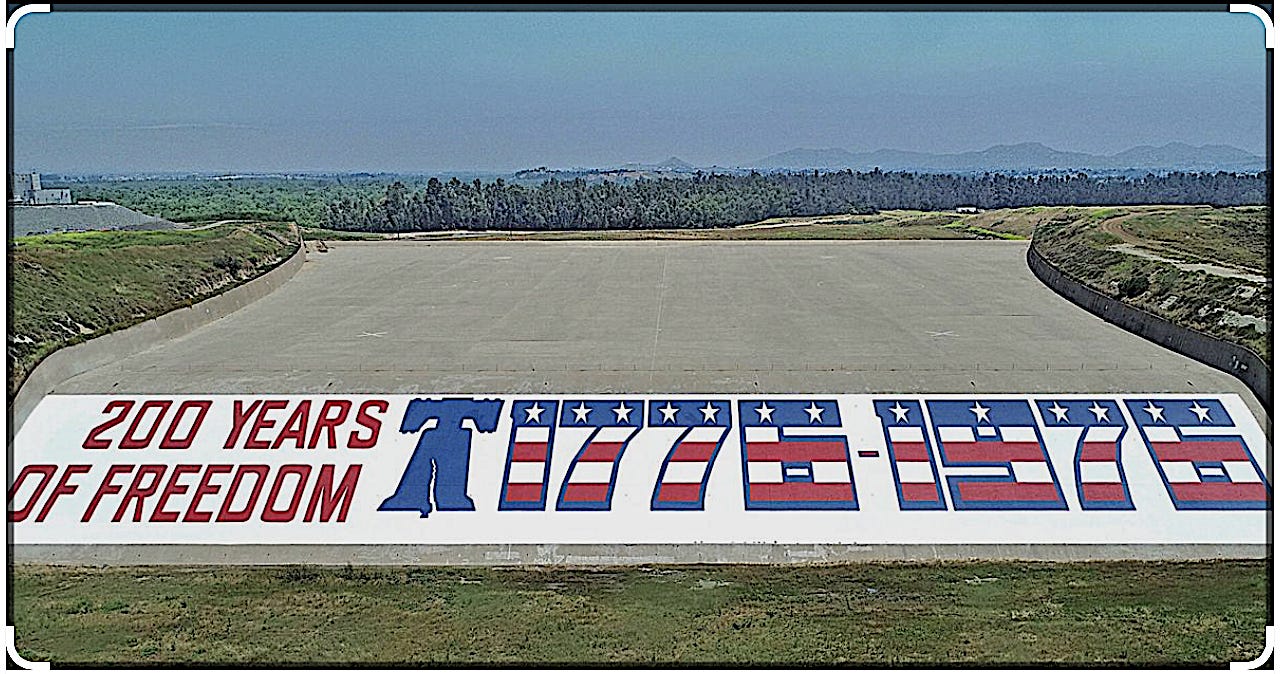
Decades ago there had been a mural painted across the face of this spillway. In 1976, during the country’s bicentennial, hundreds and hundreds of gallons of paint had turned the whole thing red, white, and blue, celebrating 200 Years of Freedom with a silhouette of the Liberty Bell. Star-spangled numbers recorded the years—thirteen stars total, for the first thirteen States. Nestled between two highways, the spillway caught the eyes of ten million drivers a month. Over time the paint faded, but the Army Corps of Engineers had redone it over the years. If Frank was right, one of those engineers had been a Kryptonaut, like him, and had left a very important item buried in the concrete.
Frank, his grandfather Sam, and all the other members of their merry little band were hoping that they’d bet on the correct horse here. Otherwise they’d ridden into the heart of hostile territory for nothing.
“Shep, confirm,” said Frank.
“You’re on it, boss. Paint’s all corroded but what you’re looking for is a line in the concrete itself. It’s a tight seam. If you find one, you can trace the other nine,” said Shep.
Ten lines. A star. Frank wanted the star that represented Virginia, at the top of the first numeral in 1776. Gritting his teeth, Frank lowered himself onto all fours; he’d paid to outfit everyone on the team with the same gear, from their shirts and pants to their steel-toed boots. In addition to that he made them wear kneepads and shin guards out in the field. After a while, nobody asked why. Frank rested his kneepads against the concrete until he could get his goggles just a few inches away from the surface, looking for the seams. It took a minute…
“Shep, you’re the man. I’ve got it.” He stood up.
“Strike up the anvil chorus,” said Artie.
“Here we go.” Frank unsheathed a twenty-pound sledgehammer from his belt and took the three-foot handle in both hands, stepping slightly to the side so that he could strike the star without smashing his cable. The task forced him into an awkward position, toes and calves burning as he raised the hammer overhead. Then he started raining down blows, over and over, pleased when the concrete finally began to yield after several strikes.
“Making a lot of noise,” said Thrice.
“Like what?” Frank asked, panting hard. “Like a big chunk of steel hitting a big chunk of rock?”
Thrice laughed and Artie shushed him.
“Supposed to be a soft spot in the center,” Shep said.
“I’m looking. Ten seconds.” Frank drew in three long, slow breaths, then resumed swinging. On the fourth swing, a chunk of concrete shattered like glass, and he found what he was looking for: a soft recession in the middle of the star. Emboldened by the reward he swung harder and harder until he’d chipped away an area the size of a salad bowl, then sheathed the hammer and brushed away the rubble with his gloved fingers.
“Motion, northwest,” said Ronan.
“I see it,” Thrice said. “Headlights coming down the highway.”
“Could be a routine patrol. Admiral Walsh likes to cover the highways,” Ronan said.
Thrice disagreed. “Timing’s off. I…I don’t like it. They’re fast. I’m popping a drone.”
In California, only the military had functioning vehicles, and they especially enjoyed a monopoly on aircraft. This was bad. “Negative! Nothing will give us away faster. I need two minutes,” Frank said.
“You have one,” said Artie.
Swearing under his breath, Frank drew a thick crowbar from his other sheath and found a two-inch hardened steel eye sticking up out of the hole, strong enough to resist the sledgehammer. He hooked the end of the bar through it and strained, but it was impossible to get enough leverage. He switched his footing twice and was about to scream when suddenly Shep was at his side, steadying himself on Frank’s cable with a gloved hand.
“You’re never going to get it alone. Come on.” Shep grabbed the crowbar and together both men put their full strength into it, pulling the bar until it started to bow, then it gave with a loud pop and collided with Frank’s shin. Even through the armor he felt it, and shouted a word that would have gotten him in a lot of trouble with his wife.
“Sorry Boss!” Shep said, frantic.
“I’ll survive! Go!”
Shep pulled himself back up the line as Frank spun the crowbar, twisting it six full times before it unscrewed from the dam. A four-inch-wide bolt came out of a recession in the concrete, revealing a tiny cavity inside. Whatever else happened tonight, they’d been right about this. Sheathing the crowbar with his left hand, Frank grabbed the only item in the cavity—a small leather pouch—and was just about to call out to Shep when the winch tugged at his harness, reeling him in fast, and it was all he could do to run at speed up the spillway.
“Marines!” Thrice shouted. “Looks like an Oskhosk JLTV. Can’t see the heat it’s packing, but it’s gotta be armed.”
“We got it! Hammer down!” said Frank, vaulting over the back of the truck and into the bed. Artie threw it into first and mashed the gas pedal. Heart hammering hard, Frank stared off at the searing headlights coming south on the 71, disappearing under the 91 as they merged across the empty junction.
Southern California was largely under the control of a Navy admiral who had sailed an aircraft carrier into San Diego a few days before the sky fell. Those who survived it had come to call it the Second Carrington Event, or CE2 for short. Since a lot of military tech was shielded from the resultant EMP, and Admiral Walsh had been on the outs with the president anyway, he’d decided to carve himself a nice little pocket empire on the West Coast, complete with his own small air force and carrier group.
A few other military leaders joined Walsh, assuming that America was done for, and despite twenty years of trying to convince them otherwise, the separatist cabal stuck to their guns. Using California’s farmland they had secured themselves a breadbasket, and after refitting some defunct manufacturing facilities, had been able to make more ammunition. They may not have been the first-world fighting force that they once were, but any band of Marines in SoCal could handle five guys in a truck.
Frank wasn’t willing to test any theories to the contrary. He secured the pouch in his thigh pocket, threw his tools into the bed, and retrieved his AR-15 from its cradle in the middle of the bench seat. Shep did the same.
“Ronan, give us a way back,” Frank ordered.
“Can you take the 91?”
“That’s where they went.”
“Then we’re looking at surface streets until we get to I-15,” said Shep.
“Artie? Do that.”
“They’re gonna drop a bird on us any minute now, Boss,” Artie said. Still, he drove back the way they’d come, until the truck finally hit smooth pavement, and the ride improved considerably.
“We’ll burn that bridge when we come to it,” Frank said.
Artie followed radio instructions from Ronan until they reached the on-ramp for the old Interstate 15. A series of K-rails blocked the ramp’s entrance, and Artie slowly drove up to one of them. He flipped a switch under the dash, dropping the truck’s suspension as low as it would go, then popped the truck into neutral and hit another switch to lock the hubs for four-wheel drive. Finally he pressed the clutch and shifted into the lowest gear.
The truck crawled forward, glued to the ground like it was welded there, and Frank winced as the ram bar crunched into the heavy concrete barrier. A terrible grinding noise shredded the night as the K-rail scraped across the pavement, far enough for the Dodge to fit. Artie backed off, disengaged the low gears, raised his suspension again, and zipped through the gap.
“Lights inbound,” said Thrice, watching behind them.
“We’re ahead of them, we’re okay. Open up that throttle, Artie.”
Artie jackhammered the pedals as he speed-shifted up into fifth gear. Frank watched the tach inch closer to three thousand as the speedometer climbed. The faster they went, the louder the engine roared, as the turbocharger quenched its thirst for more air and slammed it through the intake manifold. The needle whipped past seventy-five and into the eighties.
“Boss, they are closing,” said Thrice.
“Confirmed,” added Ronan. “Dad? What are you going to do?
“Anybody got a box of crayons?” Frank muttered. Before he could decide what to do next, a blindingly bright column of light slashed down at them from the sky, and Artie cried out as he struggled to keep the truck steady. Frank swore as he batted his NVGs upward.
Over the high RPMs of the Cummins and the earbuds in his ears, he hadn’t heard the approaching whump-whump-whump of helicopter blades. An AH-1Z Viper had closed in on them, zipping through the air even faster than the Marines’ ground vehicle. Behind the glaring halo of its spotlight, the chopper’s profile bristled with firepower, all of it more than adequate to blow up an old truck.
The Viper’s PA system howled down at them at an even higher volume than their engines. “We saw you at Prado Dam! Pull over and power down your vehicle NOW!”
“Boss?” asked Artie, eyes flitting back and forth between the road and the rear-view mirror.
Bile rose in Frank’s throat as he feared the worst, and he felt for the leather pouch in his cargo pocket. He had just found it. He couldn’t go out now. Not like this. He reached over the seat and gently swatted the top of Thrice’s helmet.
“Mortars! Now!”
Thrice moved fast, popping open the glove box to expose a built-in switchboard for the truck’s more exotic functions. He flipped one switch to arm a relay, then pressed a button to activate it. Collectively the Kryptonauts held their breath: they hadn’t ever used this one in the field before.
Along either side of the truck bed, six hidden compartments popped open, and powerful percussive explosions sent ball shells high up into the sky. It had cost Frank a pretty penny to track them down, but there were still a few Indian reservations in the southwest desert that knew how to move old stores of fireworks; he’d taken their old stores of mortars off their hands for a good price and integrated them into the truck’s arsenal.
He was glad he and the guys had hearing protection. He could feel the pressure as the mortars shot up and exploded overhead, quickly fading into the distance as they rattled along down the road, but now the Viper had to dodge small explosions in the attempt to keep up.
Potent as they were, they weren’t inexhaustible, and after a dozen or so had gone up, the sound and fury of it all came to a close, and the Viper was still on them, flying angrily as it reeled them in.
“Shep, we gotta open up on ‘em!” Frank tried to shoulder his AR-15 in an odd position.
“Hang on Boss, I packed something special for whirlybirds,” said Shep, picking up a shoulder-mounted weapon from one of the crates. Frank recognized it a split-second before Shep took aim and fired a softball-sized projectile into the air. The sphere exploded with a little pop and kept ascending, spiraling wide into a giant steel net with surprising speed. He only just saw the individual strands of the net against the spotlight’s glare before it collided with the Viper’s tail and instantly wrapped around the rotor there, becoming hopelessly entangled.
The Viper’s tail kicked gently to one side, then accelerated, and suddenly the whole vehicle was spinning in circles without any stabilizing force at the rear. The chopper veered off course as its rotor seized, nosediving straight into the Santa Ana river with a magnificent splash just as I-15 crossed the water.
The Marines in the JLTV behind them opened fire. Shep swore as he belly-flopped onto the bed of the truck. Frank instinctively crouched into the back seat, feeling the high-caliber rounds crash into the truck’s armored tailgate. Damn thing weight five hundred pounds, and it was worth every ounce of it. Frank had taken heavy fire on a search in Oregon a few years ago and had insisted on the truck’s armor ever since.
The burst of gunfire was short-lived.
“Everybody good?!”
“Artie check!’
“Thrice check!”
“Shep check!”
Frank risked a peek over the back seat. “They’re still on us. Shep, punch ‘em in the nose! Artie, Thrice, watch for blowback.”
“Hella.” Shep tossed aside the spent net launcher and picked up another shoulder-mounted toy: an RPG. Checking to make sure it was ready, he rolled up into a crouch and hit the bang switch just as Frank ducked again.
At the exact same instant that Shep fired, the Marines let off another burst, testing the true limits of the Dodge’s armor. The blowback from the RPG filled the cab with flame and smoke, and through the comm it sounded like Shep yelled “Truck!” at the top of his lungs, but Frank was pretty sure that wasn’t it.
“SHEP!”
“Argh! I’m…I’m okay! He grazed me! Little bastard!”
Frank looked over the seat again. Smoke slithered out the end of the RPG. Behind them, the smoldering nose of the JTLV shrank in the distance. Direct hit. Shep had put it right into their grill. Frank flipped his NVGs back down and saw Shep clutching his upper left arm. Dark black liquid flowed between his fingers.
“Grazed you? With a 240?” Frank demanded.
As if to demonstrate his left arm still functioned, Shep flipped Frank the bird with that hand. Frank nodded.
“Hang on…Dad? The radar is glitching again,” said Ronan. “One bogey just split into two and they’re still after you.”
Confused, Frank checked their six. Sure enough the burning JLTV was far behind them, but a second must have been right on its bumper and had overtaken the leader. The headlights got bigger at an alarming rate.
“Artie? Got any horses left?” Frank asked.
“We’re tickling red, Frank! Thermo doesn’t like me right now!”
“Shep? Any more rockets?”
“You gotta open the toolbox to get ‘em,” Shep said, wincing audibly.
Frank understood the implication: right now Artie and Thrice were crouched down up front, and he was keeping a low profile in the back. Shep lay on his back in the bed. Getting anything out of the toolbox meant making a target for the Marines, who seemed plenty eager to fire.
“Frank if we don’t lose this guy we’re gonna hit trouble up ahead,” Artie said.
“Ronan? Shep’s busy, get us off I-15,” said Frank.
“Okay…okay…golf course, neighborhood, north, Limonite Avenue! It’s coming up,” said Ronan. “Next exit.”
“Got that, Artie?”
“Hell with exits, Frank.” Artie jerked the wheel to the right, cutting across the shoulder and straight into a field running next to the interstate. Frank and Shep howled in protest as they bucked across the rough terrain at seventy miles per hour, racing toward a vacant parking lot protected by a rusted chain-link fence. Artie, who had crushed many such fences on these jobs, aimed the ram bar directly at a post and destroyed it at speed, flattening the fence beneath the truck’s tires. Rubber screeched against old pavement and once again they accelerated.
The Marines closed in. Their truck was heavier yet this fact didn’t slow them down. Bullets barked out of the M240 on top and this time they weren’t aiming for the armored parts. Something whistled past Frank’s ear, close enough to hurt, close enough that he felt it cut him without making contact. The windshield exploded into a million pieces. Something else fired, heavy and deep, and a rocket-propelled grenade howled past them, missing by inches as Artie cut to the left to give the Marines a harder target. Through the noise and confusion, Frank heard him muttering the Hail Mary prayer through the comm.
“DAD! I see you guys! I’m coming!” Ronan said.
What the hell was he going to do in the fuel tanker? “RONAN! Do not come down the mountain!”
“But I can—”
“NO, SON! Ah, dammit!” Frank bellowed in pain as a burst of seven-six-two rounds crunched the armored plates inside the cab, testing the material to its limit. A bulge the size of a grapefruit blossomed in the steel and hit him in the small of his back. This is bullshit, Frank thought, grabbing his AR-15. There wasn’t a chance in hell it would do anything except make him feel a little better, but he had to shoot something. Pulling himself up on his seat, he put the stock to his shoulder, scoped the JLTV’s windshield, and flipped the selector to the full-auto position.
It took less than three seconds to empty an entire magazine into the JLTV. Several thoughts ran through Frank’s mind at the speed of light, many of which were oddly based in gratitude. Whatever else had gone wrong in the world for the last twenty years, he was glad to live in a time where he could build a fully automatic AR without asking anyone’s permission. He was glad he could return fire without risk of collateral damage—southern California only boasted a small fraction of its former population—and he was even somehow glad that the JLTV’s windshield was bulletproof. He hadn’t wanted to kill the driver. As a rule, killing people made him feel bad.
Those grateful thoughts evaporated before the last empty casing bounced off the inside of the cab. He was already slamming a new magazine up into the rifle, fumbling for the charging handle, expecting at any moment that the Marine gunner would get another burst off with the 240, which at this range was effectively a death sentence. Then Thrice’s voice sounded in his ear, cutting through the haze of combat.
“Hey! Aircraft inbound!”
No sooner had he said than did a flaming hot projectile slash through the JLTV’s engine compartment with laser precision, raining down from the sky. Something exploded in the motor, belching copious amounts of flame and smoke out through the grill. Its next barrage of 240 rounds went wide, chewing up a sand bunker on Hole Nine. The Marine behind the wheel lost control of the JLTV, crashing to a stop, and once again Artie put a healthy distance between them and their attackers. The JLTV’s doors swung open as the Marines inside staggered out of the smoke-filled cab into cleaner air.
Confused, Frank sensed something overhead, and looked up to see a dark shadow against the pale glow of a full moon night. He didn’t recognize the thing’s profile, though it was clearly an aircraft, diamond-shaped but without any running lights on its fuselage. A stealth drone, maybe? But who had sent it? It had come from the north, over the mountains, and banked hard to go back the same way. The vessel disappeared into the night as swiftly as it had come, like it had never been there at all.
“Did you see that?” Artie called over the com.
“I…think so?” Frank said, his head still swimming.
“Who the hell is running aircraft out here and shooting at Marines?”
“It’s gotta be a short list,” Frank thought aloud. “Ronan! Did you see that thing?”
“Um…sort of? Nothing came up on the radar…”
“There are at least two Air Force Bases in flying distance, depending on the type of fighter,” said Shep, breathing hard. “With any luck…maybe some other commander is in a turf war with Walsh.”
Frank kept an eye on the sky, his breathing returning to normal. “Whoever it is, they did us a favor. Everybody okay? Shep, how’s that arm?”
“Nothing the body shop can’t fix, Boss,” said Shep, sitting up. “I think it stopped bleeding.”
“Ronan, start heading to Point Hotel. We’ll meet you there.”
“Copy that, Dad.”
Point Hotel was the established term for Hesperia, California, a small desert town that had dried up and died after CE2, save for the most stubborn and resilient farmers or ranchers. Frank cut a wide berth around those residents, and instead used an abandoned Amazon distribution center as his rendezvous point with Ronan. Despite his head start, Frank and the guys caught up to Ronan at the top of the Cajon Pass, since the tanker truck was heavy and Ronan still wasn’t good at managing his climbing gears. It would come with time.
We don’t have much time, Frank thought to himself, as Artie parked the Dodge next to the tanker. Ronan got out and went straight to the hoses at the rear of the tanker to refuel the pickup truck.
“You guys okay?” Ronan asked.
“Just a scratch,” said Shep. In truth, Thrice had irrigated a lot of dried blood out of the wound before slathering it with antibiotics and covering it with two gauze pads—it was only a graze by the most generous definition of the term. Shep was lucky it hadn’t gone through the muscle, and had only destroyed two inches of skin.
“Sorry I wasn’t there,” Ronan said.
“It’s good that you weren’t, there were too many of us already,” said Frank. “Jake’s gonna tear me up over the damage as it is. Whatever. That doesn’t matter. We got this.”
He fished the leather pouch out of his pocket and held it in front of the Dodge’s headlight so everyone could see. Shep, Thrice, and Artie crowded in on his right, and Ronan towered over all of them. For Frank, seeing his son was like looking in a mirror twenty-five years in the past, only Ronan was a little narrower at the shoulder and three inches taller. Same blond hair, same light eyes, and eventually he’d have the same thick beard. For now he retained his smooth, boyish face, and the impulsive excitement that always belonged to the young.
Frank untied the pouch and stuck his fingers inside, gripping something sturdy within, and extracted it where they all could see. The object was a flat piece of metal, less than an eighth of an inch thick and perhaps two and a half inches square. Embedded in the center of the plate was a teardrop-shaped piece of obsidian, wide at one end and pointed at the other. Under the glare of the headlamps it seemed almost purple and translucent. They stared, until Artie said what Frank was thinking.
“What the hell is that?”
“It ain’t a whole blossom,” Frank said, annoyed. “It’s a single petal. The color and shape are right…the quantity is off.”
“Should be six, right? Saffron blossoms have six petals,” said Thrice.
“That’s what the diagram said. It’s supposed to be a saffron blossom of obsidian glass, hand-crafted, with a golden stigma. This…this looks like someone broke it apart and stuck it in this square…” Frank trailed off. In the act of examining the square, he’d turned it over in the headlight and caught something, though he wasn’t sure what. Some imperfection in the surface of the metal plate.
Ronan saw it too. “Hang on, put that glare on it again? Look, Dad. Numbers. I see…one, eight, sis, six, five…no, point-five, there’s a decimal. Wonder what that means?”
“Five digits? That’s nothing,” said Thrice. “That’s not even an old phone number.”
“Doesn’t fit a ZIP code with that decimal,” Shep agreed. “If it did, it would be somewhere in…Pennsylvania, maybe? Eighteen, sixty-six and a half…not enough for lat and long either.”
Frank made a frustrated sound, growling and groaning. “We’re running out of time and now we have to solve a riddle so we can waste more time. I didn’t run out here and get shot at so we could keep running around and getting shot at. Dammit!”
“We gotta get it to Sam,” Artie said. “He’ll know what to do. Take it easy, Frank: the petal was where we thought. That’s proof enough and we still have time. Let’s get back to Sam and see what he says.”
“Yeah. Yeah.” Frank sighed, his mind flooding with potential twists and turns and whatever came next. He ordered Artie into the tanker and took over driving duties himself. “Button everything up and let’s get on the road. Stay on I-15 and ride it all the way home.”
Artie paused on his way to the tanker. “The whole way?” What he really meant was Through Vegas? But Frank was not deterred.
“Gotta get home. Come on. Time’s wasting.” Frank replaced the plate in the leather that had protected it for all these years, then climbed in behind the wheel of the Dodge. They had to get going.
He took one last look at the sky and wondered who their guardian angel had been.
**End
So there you have it.
No official announcement yet, the publisher and his wife just had a baby, so they’re dealing with that right now. Subscribe for updates, I’m releasing this beast in June come hell or high water. Bring money and get ready to buy.