

“Electoral Brawlage” examines the first inaugural address of each president in U.S. history, with some commentary and analysis. This is the thirteenth installment. Check back on Mondays for more.
Subscribe to get these articles in your inbox. Become a paid subscriber to give me money, because I like money and I use it to buy books.
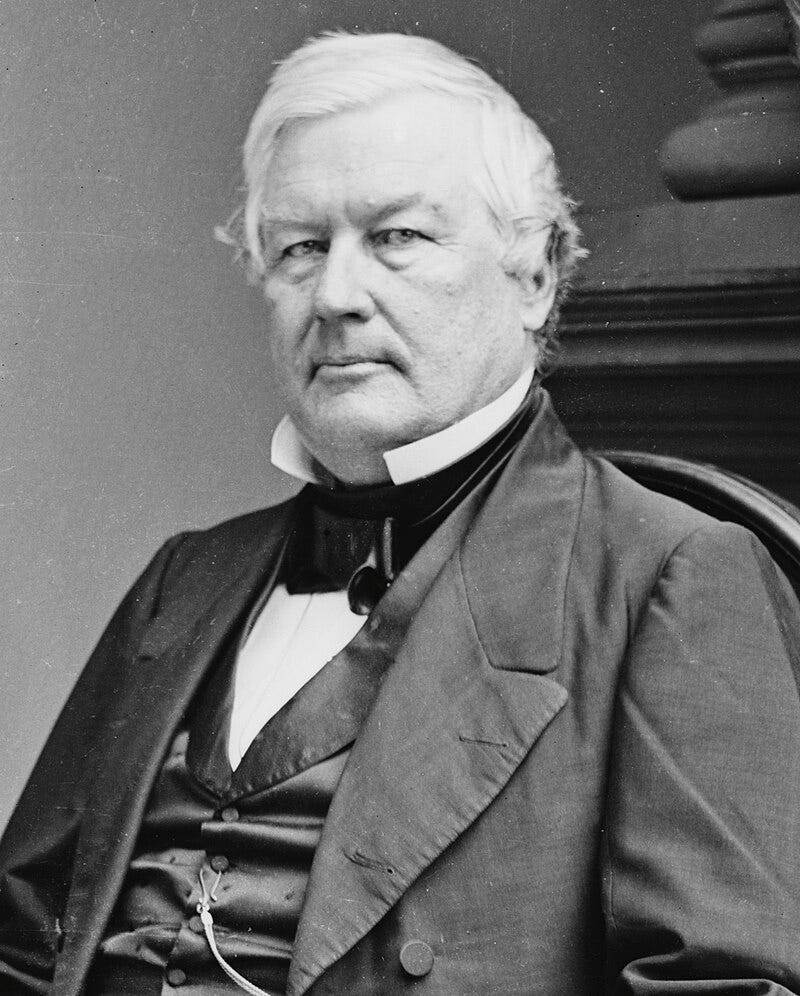
President Zachary Taylor was the second executive (out of only twelve total) to die in office, although he lasted sixteen times longer than William Henry Harrison. He passed on July 9, 1850, and was officially succeeded by Millard Fillmore the next day at noon.
With the nation in mourning, Fillmore didn’t see fit to supply a national address beyond the most formal and technical acknowledgement of his accession to the Big Chair. His first direct address to the States at large wouldn’t come until December, five months after Taylor died.
The speech itself has an extremely powerful opening and I should like to present it here without my own insertions:
Nations, like individuals in a state of nature, are equal and independent, possessing certain rights and owing certain duties to each other, arising from their necessary and unavoidable relations; which rights and duties there is no common human authority to protect and enforce. Still, they are rights and duties, binding in morals, in conscience, and in honor, although there is no tribunal to which an injured party can appeal but the disinterested judgment of mankind, and ultimately the arbitrament of the sword.
Among the acknowledged rights of nations is that which each possesses of establishing that form of government which it may deem most conducive to the happiness and prosperity of its own citizens, of changing that form as circumstances may require, and of managing its internal affairs according to its own will. The people of the United States claim this right for themselves, and they readily concede it to others.
The paragraphs immediately preceding and succeeding this are just as good.
The rest of Fillmore’s remarks are basically a State of the Union address with much technical summarization of goings-on in other countries, and America’s commercial connections thereto. Plans were already underway (or at least in discussion) for a cargo lane across the narrowest points of Southern Mexico, lanes that would ultimately be satisfied by the construction of the Panama Canal more than sixty years later.
But the biggest issue to receive his attention was the Compromise of 1850; since Van Buren, slavery had garnered the attention of executive politics and was only gaining steam. The Compromise was a total of five bills that tried to give equal victories to both pro-slavery and pro-abolitionist powers in Congress, a position that was ultimately untenable in the same body forever; after the Mexican-American War, territories out west wanted statehood, and they sought admission as free states. They needed Senate approval for this, and the South wouldn’t go along with it because then they’d be outnumbered in Congress.
As Compromise, California was allowed in, while Utah and New Mexico were admitted as territories, borders were more clearly defined with Texas, slavery was abolished in D.C., and a stronger Fugitive Slave Act went into effect. Fillmore presided over this, probably knowing that it wouldn’t resolve the issue, and that both sides would keep pushing for what they wanted.
He wouldn’t be the last president to deal with the issue.
My Amazon page has all my novels, including the critically-acclaimed FOSSIL FORCE for young boys, and the Engines of Liberty series for all ages.
I post several times per week on YouTube.
Subscribe here for more book reviews and for articles on what I continue to learn as I read.