

Chapter eight of The Silmarillion is called “Of the Darkening of Valinor,” and it proves that the prison system doesn’t work in Arda any better than it works here, because Melkor finally gets around to re-offending.
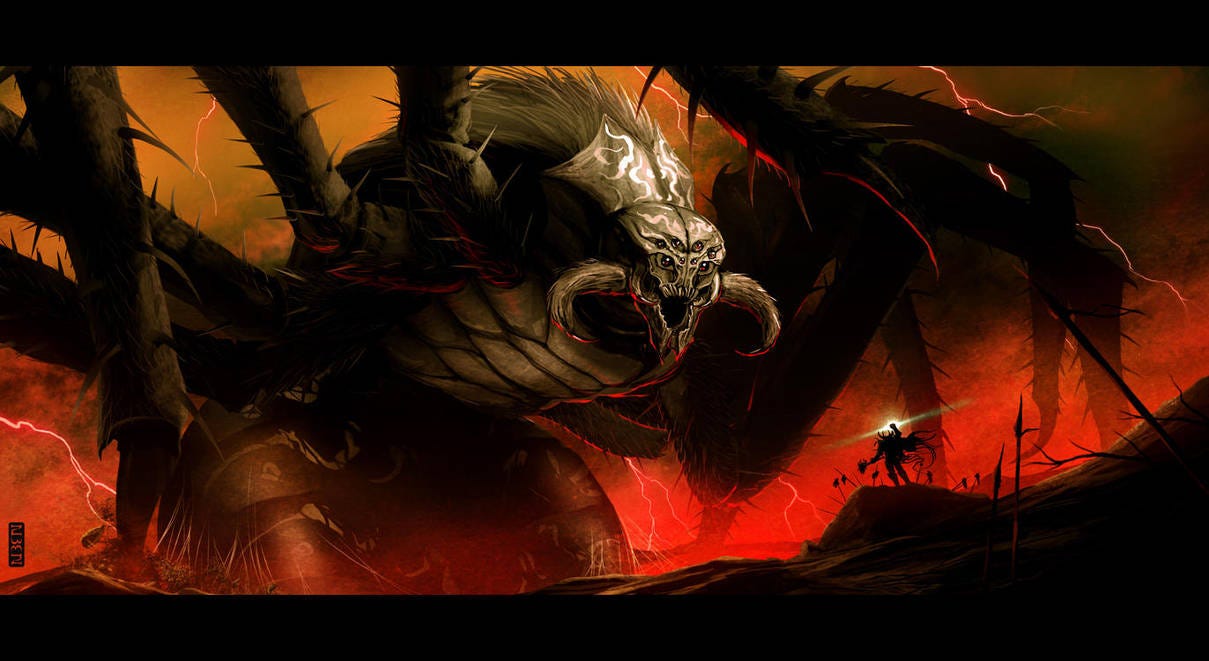
Melkor and Ungoliant by rubendevela
“Be advised, suspect could be in disguise…”
Naturally when you’re running from the cops you want to change your clothes and maybe throw on a wig or something. You gotta change your appearance to beat the allegations, as the kids say. Melkor can do this easily, being a Vala, but he’ll soon lose that power when Manwë gets hold of him and strips him of certain divine attributes.
In addition to the disguise, you need a place to lay low and it couldn’t hurt to have a friend with a spare couch to crash on. Enter Ungoliant, a female entity of some sort who started out as a servant of Melkor long ago, but later broke away to pursue her career or something. She hung out in the darkness, away from the Valar, consuming everything in sight, and eventually she took the form of a huge spider.
It’s unclear based on the text whether Ungoliant is a Maia, like Sauron, or if she’s vaguely something else. Clearly she’s more than a twisted Elf or similar such creature even if the nuts and bolts of her being aren’t laid out in detail. This speaks to the ethereal nature of godlike beings in Tolkien’s work, or in this case, twisted spawn of once deific powers. Ungoliant is simply a different manifestation of Melkor’s work, taking her interests in a different direction from other creations of his, and it seems no other associate of his went to this extreme. She was truly a force to be reckoned with.
Now that she’s a huge fat web-slinging slob, Melkor recognizes her military potential and enlists her help in storming Valinor to consume the light there. Ungoliant can create a sort of anti-light, which consumes Varda’s light, and Melkor shrouds himself with this for his assault.
Ain’t Broke, Don’t Fix…
Similar to the time in which Melkor destroyed the lantern at the top of the world, the Valar are enjoying a time of festival in Valar, and he chooses this time to assault their capital. You know, it’s funny…a man does something so horrible that he earns a three-age prison sentence, he pays lip service to get on parole, and then turns around to repeat the exact same thing that put him away to begin with, almost like there’s a pattern here. Maybe the Valar should have profiled him a little bit harder, but you can’t blame emissaries of the one true god of Arda for believing in rehabilitation.
As Tolkien stated before, the Valar weren’t evil and thus did not understand the mind of evil. Melkor was the ideological kin of the Gadiantons in this regard, recognizing that in the land of the honest, a dishonest person has a chance to pull some strings.
So while the Valar have this festival, and they conduct a little peace summit with the Noldor so that they can all get along, healing the divide wrought by Feanor. Just as Feanor and his half-brother Fingolfin are shaking hands, Melkor and Ungoliant roll up with that Unlight and plunge everything into darkness, and Melkor smites the trees Laurelin and Telperion. Their light literally gushes out like water and Ungoliant drinks it up, like she consumes everything.
The Valar, completely stunned that Melkor could have dared such a thing, and in the middle of a festival no less, try to mount a counteroffensive of some kind, but the total consumption of the light yields an ever-present darkness, and none of them can pursue Melkor. Oromë can’t hunt him, and even Tulkas “stood powerless and beat the air in vain.”
My Thoughts
Previously I have compared the Valar to lesser gods, like in the pantheons of mythologies, but the more I read, the more I think they’re akin to archangels, and the Maia are angels, and the Elves are juuuuuuuust under that level of glory. The Valar can be called “the Powers” because they embody the forces that govern the world of Arda, and they follow the plan (the music) conducted by Eru Ilúvatar.
Whenever I wonder about Melkor, I remember that he was the most like Ilúvatar, and unlike the other Valar he had power over multiple things, and was only exceeded in power by Ilúvatar himself. One of the defining distinctions between the two was that Melkor thought he could overthrow Ilúvatar and replace him, and in his impotent fury he throws the mother of all temper-tantrums, twisting everything Ilúvatar has made into his own dark, abominable creations.
The Silmarillion may primarily be a story of the Elves’ Fall, but that is an echo of Melkor’s own Fall, something that gets reaffirmed in the repetition of his tactics and antics. Melkor, like the Devil himself, has persistence as his only virtue. Not only does he attempt to do the same thing, he even does it in the same way, and the only difference between his attack on the Lamps and his attack on the Trees is that he enlisted help, making the assault more formidable.
Returning to the metaphor of music, Melkor is a reliable chorus or refrain in the overall song that is Arda. You can say the same of the Valar, whose job it is to play certain notes on certain clefs, according to a certain timing, and as the conductor of the music, Ilúvatar can make it all work the way he wants it to.
From this metaphor I’ve extrapolated something I think will have value to the reader: if Ilúvatar is omnipotent and possessed of all glory and beauty, and he created the Valar who have portions of that glory meted out to them, and then the Maiar come along and they get a portion of that, and the Elves get a lesser portion, and then Men…you see this effect of beings who have a little less and a little less all the way down, but in that diminished divinity they gain other attributes. The Elves gained pride, Men had built-in mortality. Their notes in the chorus became simpler and in a way, more distilled, more purified. Yes they are flawed, but they can also play very straightforward notes, the most direct version of Iluvatar’s music, before their time is up and they return home to the god that made them.
I often compare The Silmarillion to scripture, and for the world of Middle-Earth it certainly is, like Genesis in the Old Testament. Tolkien himself being a devout Catholic reinforces my understanding that he set out to write spiritual truths in the undercurrent of this world, truths that would apply to our own and make spiritual things easier for us to ingest.
The benefit, then, is for all of us to remember that despite our flaws, our shortcomings, and the expiration date on our lives, we are still descended from divinity and we have notes to offer to the larger chorus of existence. Let’s perform as well as we can.
Tolkien's Heirarchy also closely follows the Faeth Fiadha of St. Patrick, in the Litany of Angels 💖