

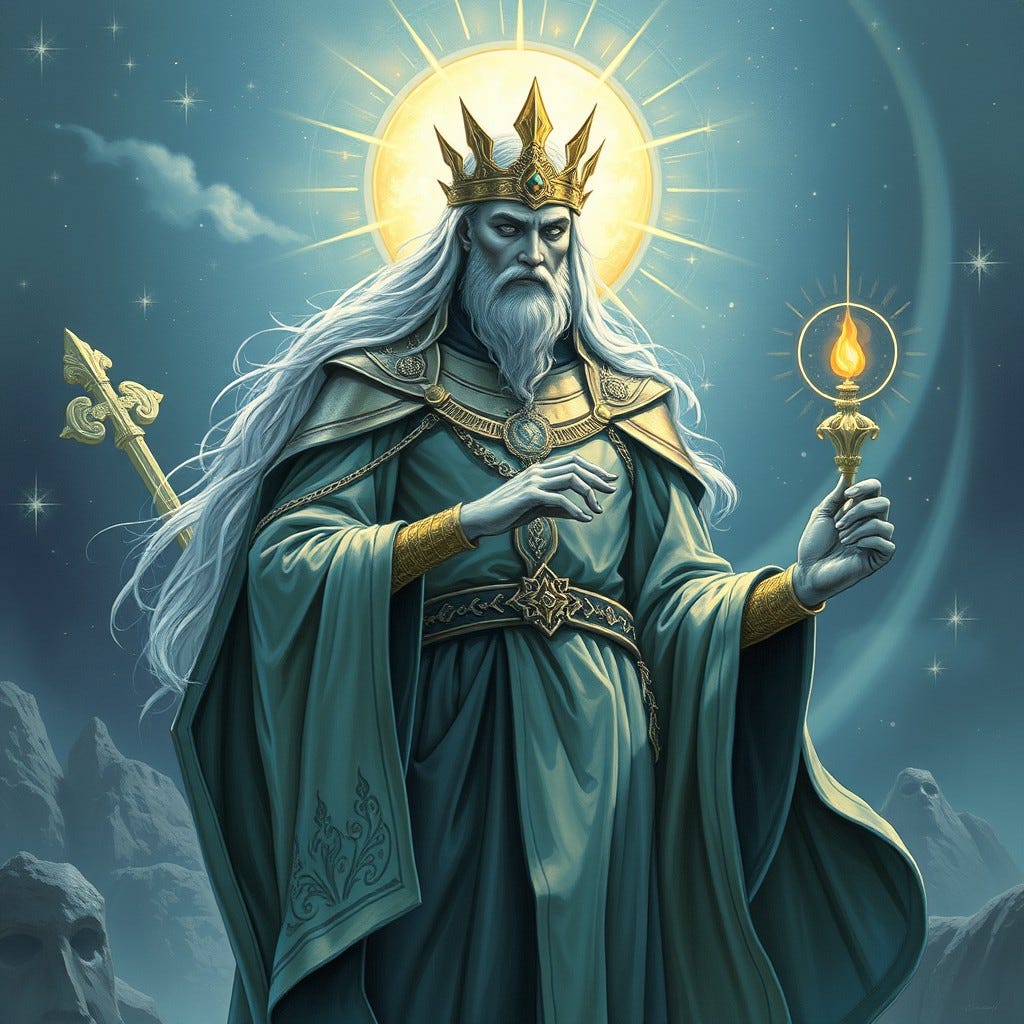
Eru Ilúvatar, rendered by getimg.ai
The Ainulindalë
(Pronounced “eye new lin dah lay”)
Technically THE SILMARILLION is broken into five parts, but these parts are not equal in length. First is the Ainulindalë (12 pages), then the Valaquenta (10 pages), then the Quenta Silmarillion, which comprises the majority of the book (268 pages in the mass market paperback.) It closes with the Akallabêth (32 pages) and “Of the Rings of Power and the Third Age.” (27 pages).
As I said in part 1, we can understand the Silmarillion if we work backwards from what we know in The Lord of the Rings. Thus we get to examine the origins of the world, who made it, and how.
Middle-Earth is just one continent in the world of Arda, which was created and is ruled by the god called Eru Ilúvatar. He also created the Ainur, which are his children, and can be compared to Greek gods in that they each have some of his powers and they specialize in different things. More on that in another installment.
The Ainulindalë is the origin story of the Ainur. The mightiest of them is Melkor, who doesn’t just specialize in one thing, but has a little bit of everything, making him similar to Iluvatar but not as powerful. He’s proud and dangerous, and prone to rebellion against his maker.
After Iluvatar creates the Ainur, he sets out with them to build things. They do this by putting their power into beautiful music, singing things into existence with the Song of Creation. However, Melkor tends to be a contrarian, so he blares loud music that goes against the harmony of the other Ainur, completely throwing off the beat and ruining the vibe.
However, no matter how many times Melkor tried to screw up the music, Ilúvatar was always able to salvage it and make something great of the result. He even flexed on Melkor to drive that point home.
Once Arda was established, Ilúvatar created Elves and Men, who started to create things of their own, mimicking the Ainur, who were always off to create some new thing. In Tolkien’s work it’s rare for something to have one single name, which can make it confusing when you’re trying to understand who is what, so here’s a simplification:
Another word for the Elves is the “Eldar,” and their language is the “Eldarin” language. They refer to the Ainur as the “Valar,” which is their word for “Powers.” The Ainur who created Arda then descended from the heavens to live in it, and are constantly moving around it to make things work inside it, hence they are the Powers of the World.
As they did this, Melkor also went about to muck with things, and the Ainur regularly found themselves fighting with him to make the world right again. Thus the forces of divine opposition were established in Arda, the mortal world.
Quickie Guide:
Arda is the world.
Eru Ilúvatar is the god of that world.
The Ainur are his children, kind of like lesser gods. They’re also called the Valar.
Melkor is the mightiest of the Ainur, but not as powerful as Ilúvatar.
The Ainur used music to create Arda.
The Elves and Men were the first races on Arda. They’re also called the First-born and the Followers, showing that Ilúvatar has a preference for the Elves. The elves are also called the Eldar.
Language note:
So far Tolkien shows that when he wants to make a word plural, he drops an R at the end instead of an S like we have in English. Ainu, Vala, Elda, etc. are all pluralized as Ainur, Valar, Eldar, and so on.
Why should you read this?
Tolkien being the master of prose that he was, all of this is laid out with more beautiful language in his text, and in reading his words you can glean more of the subtleties and nuance of what he’s saying. There’s a reassuring sense to Ilúvatar’s calmness when he corrects Melkor’s violence, for example. Tolkien explains the presence of divinity in his world just as well as he demonstrates the opposition to it in the form of Melkor, and all those who follow him. Good and evil, beauty and ugliness exist in their absolute forms here, and with this bedrock understanding, the rest of the happenings in Arda will always make sense.
So ends the Ainulindalë. Next up: the Valaquenta.