


2026 is America’s 250th birthyear. To celebrate, I’m highlighting 50+ significant American documents from our history. Find them all under the American Documents tab!
Subscribe to get these articles in your inbox. They’re free. Upgrade to paid and there will be additional perks, including essay subjects at your request.
This’ll be a short one, short enough that I can copy the full text of the document right here:
Sir:
Some recent work by E.Fermi and L. Szilard, which has been communicated to me in manuscript, leads me to expect that the element uranium may be turned into a new and important source of energy in the immediate future. Certain aspects of the situation which has arisen seem to call for watchfulness and, if necessary, quick action on the part of the Administration. I believe therefore that it is my duty to bring to your attention the following facts and recommendations:
In the course of the last four months it has been made probable—through the work of Joliot in France as well as Fermi and Szilard in America—that it may become possible to set up a nuclear chain reaction in a large mass of uranium, by which vast amounts of power and large quantities of new radium-like elements would be generated. Now it appears almost certain that this could be achieved in the immediate future.
This new phenomenon would also lead to the construction of bombs, and it is conceivable—though much less certain—that extremely powerful bombs of a new type may thus be constructed. A single bomb of this type, carried by boat and exploded in a port, might very well destroy the whole port together with some of the surrounding territory. However, such bombs might very well prove to be too heavy for transportation by air.
The United States has only very poor ores of uranium in moderate quantities. There is some good ore in Canada and the former Czechoslovakia, while the most important source of uranium is Belgian Congo. In view of this situation you may think it desirable to have some permanent contact maintained between the Administration and the group of physicists working on chain reactions in America. One possible way of achieving this might be for you to entrust with this task a person who has your confidence and who could perhaps serve in an unofficial capacity. His task might comprise the following:
a) to approach Government Departments, keep them informed of the further development, and put forward recommendations for Government action, giving particular attention to the problem of securing a supply of uranium ore for the United States;
b) to speed up the experimental work, which is at present being carried on within the limits of the budgets of University laboratories, by providing funds, if such funds be required, through his contacts with private persons who are willing to make contributions for this cause, and perhaps also by obtaining the cooperation of industrial laboratories which have the necessary equipment.
I understand that Germany has actually stopped the sale of uranium from the Czechoslovakian mines which she has taken over. That she should have taken such early action might perhaps be understood on the ground that the son of the German Under-Secretary of State, von Weizsacker, is attached to the Kaiser-Wilhelm-Institut in Berlin where some of the American work on uranium is now being repeated.
Yours very truly,
Albert Einstein
In 1939, Albert Einstein wrote this letter to FDR (near the end of his second term) to offer his qualified scientific opinion on government action as regarded the acquisition of key sources of uranium. Nazi Germany had their own supply in Czechoslovakia, but they couldn’t completely control the supply in the Congo. It behooved the U.S. to corner as much of the supply as they could and—this may have been unspoken in the letter, but the implication was there—develop such a bomb before the Germans did.
All of this is clear if you saw Oppenheimer (2023), which did a fair job of putting most of the facts on screen, provided you understand that it was Nolan adapting a book written by apologetic communists about one of their own venerated figures, and thus they smoothed some of the edges off of his mistakes. Nonetheless, the film accurately depicted the nature of the race between America and Germany to develop a bomb first.
However, the plan didn’t completely come to the conclusion that minds like Oppenheimer and Einstein anticipated when setting out. The Manhattan Project advanced well ahead of the Nazis in the iterative engineering phase (good), but the war in Europe was over before the atomic bomb could be of any practical value in that theater. As a result, the government decided to use it on the Japanese, targeting population centers that included women and children (bad).
I’m not here to litigate the past; frankly given what I’ve read, I’m of the opinion that Imperial Japan needed numerous kicks to the nuts like that in order for them to finally surrender, and it’s more likely than not that the story of them being on the brink of surrender anyway is postwar cope. I’m open to persuasion in the face of evidence. As concerns the Manhattan Project and its intended application in Europe, it would be nice if the atomic bomb hadn’t been dropped anywhere, but we don’t always get to live in the world that we want.
Einstein advised Roosevelt to pursue the acquisition of uranium for an atomic bomb based on the world that he lived in on August 2nd, 1939. And thus, here we are.
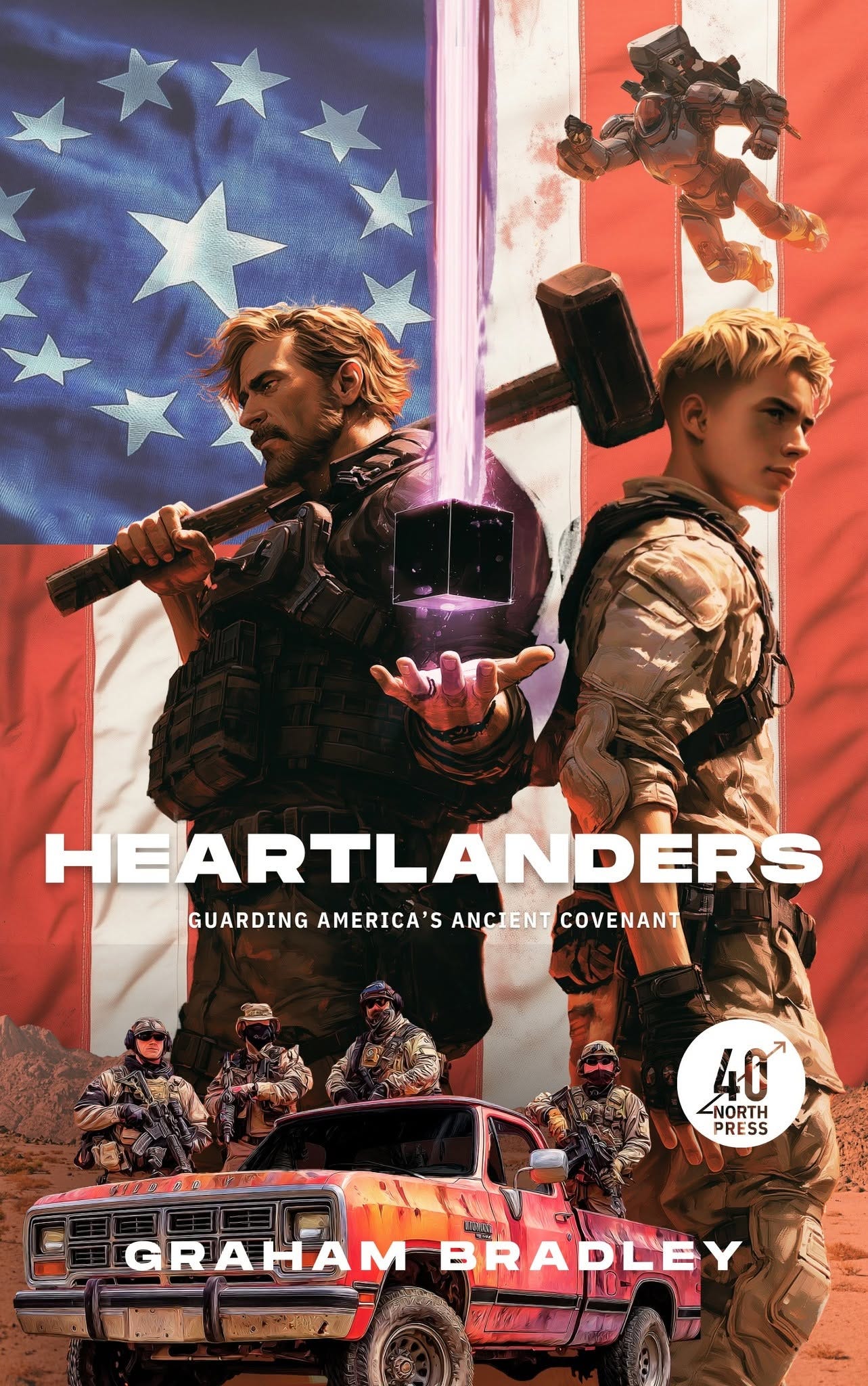
Visit Nauvoo Supply to order HEARTLANDERS, the most American novel I’ve ever written. It’s like if National Treasure happened during Fallout with G.I. Joes.
My Amazon page has my other books, including FOSSIL FORCE for young boys and Engines of Liberty for all ages.
I post several times per week on YouTube.
Subscribe here for more book reviews and for articles on what I continue to learn as I read.