

“Electoral Brawlage” examines the first election and inaugural address of each U.S. president from Washington to Trump. This project will conclude in December 2026.
If you like shootouts, car chases, dogfights, and American history, read Heartlanders!
Subscribe to get these articles via email. Become a paid subscriber to help me buy more books.
I’m just now realizing that I neglected to cover the 20th Amendment, which was ratified in FDR’s first term; among other things, it moved Inauguration Day from March 4th to January 20th, shortening the president’s “lame duck” period by six weeks. Given that the national election precedes Thanksgiving, Christmas, and New Year’s, this puts a huge dent in what a lame duck government can accomplish. Every president from FDR onward has been inaugurated on January 20th.
The 22nd Amendment came in 1951, under Truman, and established the two-term limit that we know today. There are some stipulations, but that’s basically it.
I’ll mention here too that the 25th Amendment was ratified in 1965, during Johnson’s only full term as President; it established the succession of the presidency in formal terms (whereas in previous instances where the president died, the V.P. took over under uncodified mechanisms) and also established how a V.P. might be replaced in the case of vacancy. Fitting that it should happen under Johnson, the eighth (!!!) executive to ascend to the presidency in such conditions (and wouldn’t be the last—Nixon would resign in the 70s.)
Isn’t that wild? 9 presidents out of 45—20% of them—weren’t elected. At least not at the top of the ticket, so yeah, asterisk. But still. Wow.
Assumption
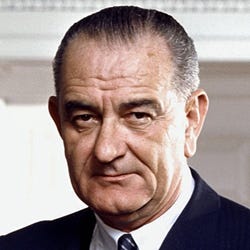
Before JFK Jr’s body was even cold, the government had mobilized to get LBJ sworn in on November 22, 1963. Succession and continuity are important and this was one of the more dramatic instances of a V.P. assuming the office of President.
Here’s LBJ’s national address from the 27th, five days after the assassination. It’s mournful and optimistic in a balanced way, and like Chester A. Arthur in the wake of Garfield’s murder, Johnson committed to carrying out Kennedy’s ambitious vision for the future: explore space, empower the United Nations, proliferate education, and avoid war unless necessary.
Election
A year after JFK’s assassination came the 1964 election. LBJ was the momentum candidate so the party rallied behind him, and he picked Hubert Humphrey to be his V.P.; Humphrey had challenged Kennedy in the last primary (1960) so choosing him was a unification move for the party’s sub-factions. Humphrey was a Senator from Minnesota, because Minnesota sucks.
The GOP ticket was represented by Barry Goldwater, a libertarian-leaning conservative Senator from Arizona, and William Miller, a Congressman from New York. Goldwater remains a popular figure in the old guard conservative factions, even though his chance at the Oval Office went up in flames come Nov. 1964. I have a book about that election that I still need to read. I’ll get to it.
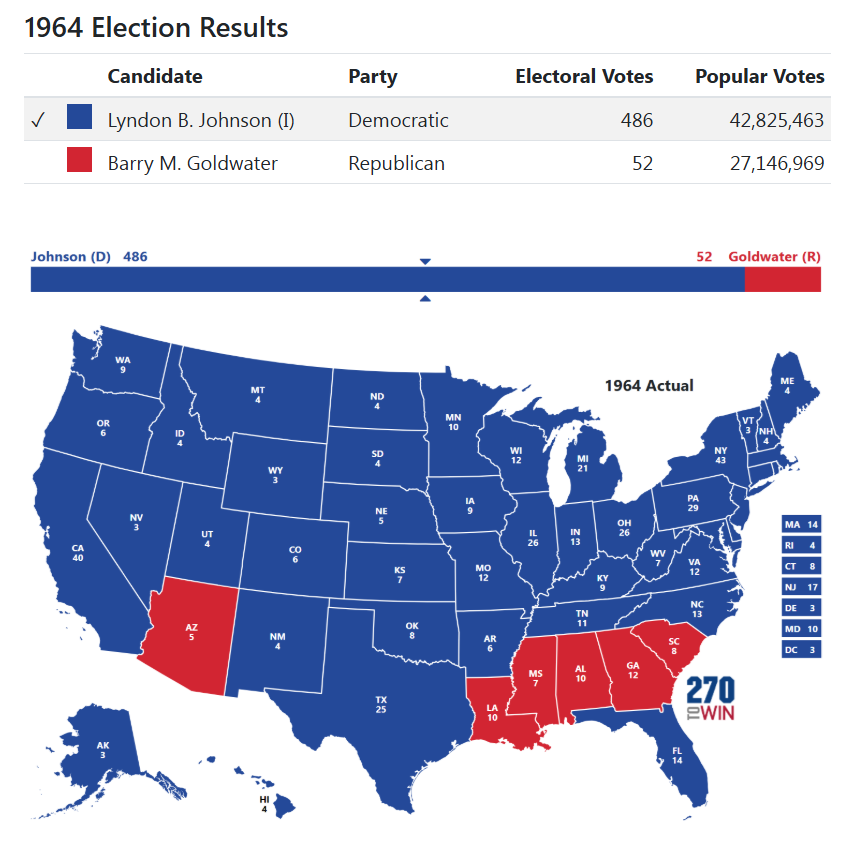
Goldwater only won his home state and the deep South. Johnson flogged him everywhere else. This was one of the bigger landslides in American history. It was also the first time D.C. got to have Electoral Votes, which should never have been allowed, and only serves to enslippen the slope toward other things that they shouldn’t have and don’t deserve, like Senators. The Left loves to cry about D.C. deserving Senators, but they only do this out of ideological inconsistency; suppose you gave a Senator to every county in America, instead of two per State, just to “make it fair.” See how fast they’d run screaming from that idea. I digress.
Anyways. LBJ won, and Goldwater joined the ranks of the more humiliated losers, which isn’t to say that his policies were bad; people like continuity, they liked LBJ, and they wanted the stability of a retained incumbent.
Inauguration
Here’s Johnson’s inauguration speech. He has a strong opening wherein he mentions something that one of his Kryptonaut staff members must have let slip:
THE AMERICAN COVENANT They came here--the exile and the stranger, brave but frightened--to find a place where a man could be his own man. They made a covenant with this land. Conceived in justice, written in liberty, bound in union, it was meant one day to inspire the hopes of all mankind. And it binds us still. If we keep its terms we shall flourish.
That’s all well and good, but then he says this, which gets tricky:
JUSTICE AND CHANGE First, justice was the promise that all who made the journey would share in the fruits of the land.
The promise wasn’t that if you “made the journey” you’d get everything you wanted. That stuff was only at the other end of hard work and sacrifice, which were natural obstacles. Nowadays they are also artificial, imposed by bad policy and bad market decisions, but there’s also no shortage of politicians insisting that some people who “make the journey” should get free stuff, as long as The Big Guy gets they/their cut. Yes, I’m editorializing, no, I’m not wrong. Anyways.
LBJ’s presidency coincided with the Civil Rights Act, which was noble in intent and had many positive impacts, though its application has been…uneven. To thoroughly summarize my thoughts on that would go beyond the scope of this article. Nevertheless I don’t take issue with Johnson’s stance here:
Justice requires us to remember: when any citizen denies his fellow, saying: "His color is not mine or his beliefs are strange and different," in that moment he betrays America, though his forebears created this Nation.
Rejecting beliefs simply because they are “strange and different” is worth examining; rejecting beliefs because they are incompatible or antithetical with Western values and/or the Constitution’s guarantees is thoroughly justified, as the written law of our immigration code reflects. We can argue ‘til we’re blue in the face about whether “American” is a single skin color (it’s not), but beliefs, culture, and laws are absolutely essential components thereto, and can only be diluted to our detriment.
Yes, I’m taking a contrarian approach to Johnson’s first few points—not without grounds, make no mistake. That said, I don’t think his entire platform was a hidden dagger. Take for example:
No longer need capitalist and worker, farmer and clerk, city and countryside, struggle to divide our bounty. By working shoulder to shoulder together we can increase the bounty of all. We have discovered that every child who learns, and every man who finds work, and every sick body that is made whole--like a candle added to an altar-brightens the hope of all the faithful.
Again we go back to the things that cause us to work “shoulder to shoulder,” and those things are our culture, laws, and customs. Admitting too many subcultures that won’t assimilate to that mindset will ultimately dismantle that mindset (could this be the objective, hmmmm)…
In each generation, with toil and tears, we have had to earn our heritage again. If we fail now then we will have forgotten in abundance what we learned in hardship: that democracy rests on faith, that freedom asks more than it gives, and the judgment of God is harshest on those who are most favored.
Not wrong at all.
For we are a nation of believers…in justice and liberty and in our own union. We believe that every man must some day be free. And we believe in ourselves… Each time, from the secret places of the American heart, came forth the faith that they could not see or that they could not even imagine… this is what America is all about. It is the uncrossed desert and the unclimbed ridge. It is the star that is not reached and the harvest that is sleeping in the unplowed ground. Is our world gone? We say farewell. Is a new world coming? We welcome it, and we will bend it to the hopes of man…
I don’t dislike it as much as I expected. I’ve encountered bits of Johnsonian policy in the past and haven’t been the biggest fan of his, but I also haven’t made an in-depth study of his career. That will have to come later. Overall it was a good speech. Go check it out.
Visit Nauvoo Supply to order HEARTLANDERS, the most American novel I’ve ever written. It’s like if National Treasure happened during Fallout with G.I. Joes.
It’s short, it’s fast, it’s full of smarts and action, and you’ll love the characters.