

2026 is America’s 250th birthyear. To celebrate, I’m highlighting 50+ significant American documents from our history. So far I have covered The Mayflower Compact, Patrick Henry’s Speech, The Lee Resolution, The Declaration of Independence, the Articles of Confederation, the Treaty of Paris, the Virginia Plan, The Northwest Ordinance, The Constitution, the Bill of Rights, the Louisiana Purchase, the Star-Spangled Banner, the Monroe Doctrine, the Indian Removal Act, and the Knickerbocker Baseball Club rules.
Subscribe to get these articles in your inbox, along with my regular book/comic/movie reviews. I also like money, and if you like me having money, become a paid subscriber. There’ll be special content for you, including original fiction, and early access to posts.
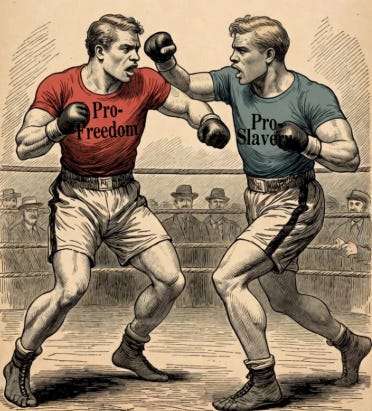
If you’ve been following the Electoral Brawlage series on Mondays, you know that the 1856 election resulted in James Buchanan being elected president, and he had an aggressive “I don’t want to deal with this” approach to resolving tensions around slavery. It was the eminent question that needed an answer in the United States and nobody wanted to Get It Wrong. Bad laws and bad court decisions kept stymying bad executives. Like the open reactor core at Chernobyl, the problem wouldn’t go away until it was actually resolved. That meant hard, unpopular decisions, which were also right.
Much has been said in the negative about Abraham Lincoln’s governing style and the precedents he established. Much of that is even right. By the straightest definition of the term he was a tyrant; what needs to be clarified is whether he was right to govern how he did, and that is a question that exceeds the focus of this article.
What matters is that he not only saw the problem, but saw that the proposed (and enacted) solutions were not working. American leaders had kicked this can down the road for decades, perhaps even from the beginning. The United States were in their second, maybe third full generation from the Founding, and many of its sentiments and writings were still well-known and oft-discussed. Even the Founders disagreed on slavery and they had to compromise on what they wanted just to establish the nation.
All the while, the slavery problem persisted. It wasn’t fading out over time. Industrialization most likely would have killed it as a cost-effective practice, but the Industrial Revolution was still a solid fifty years away and they didn’t know that at the time. On top of that, no issue exists in a vacuum; the proliferation of slavery had a very real impact on other political and cultural aspects, and this would only get worse if it spread with the borders of the nation.
Like a store-brand bandage on a knife wound, all the laws put into place until 1858 had done nothing to solve the problems around slavery. Martin Van Buren mentioned slavery in his inaugural address and that only opened the floodgates to slavery as a presidential issue. Every president after him mentioned it, and when James Buchanan was inaugurated, it was the very first issue that he addressed—poorly. Two years into his presidency, someone needed to make common sense observations about the efficacy of public policies pertaining to slavery and how they not only had failed, but would continue to do so.
Lincoln rightly framed the issue as an impossible status quo: we could not have a half-slave and half-free country. One side was clearly winning out. The paperwork “free territories” had slavery implemented by violence. Those who were proponents of it would not easily give up the practice or the trade. This speech, and the fact that Lincoln could plainly see the problem for what it was, garnered him no friends in the pro-slavery South while unifying his support in the pro-abolition North.
Finally, in a nod to Lincoln as being a True Noticer, he saw how a procession of events—whether intentional or coincidental—resulting in a final product that was indistinguishable from an orchestrated effort ought to receive the same caliber of pushback as the concerted effort itself. He explained this using a construction metaphor:
We can not absolutely know that all these exact adaptations are the result of preconcert. But when we see a lot of framed timbers, different portions of which we know have been gotten out at different times and places and by different workmen--Stephen, Franklin, Roger and James, for instance--and when we see these timbers joined together, and see they exactly make the frame of a house or a mill, all the tenons and mortices exactly fitting, and all the lengths and proportions of the different pieces exactly adapted to their respective places, and not a piece too many or too few--not omitting even scaffolding--or, if a single piece be lacking, we can see the place in the frame exactly fitted and prepared to yet bring such piece in--in such a case, we find it impossible to not believe that Stephen and Franklin and Roger and James all understood one another from the beginning, and all worked upon a common plan or draft drawn up before the first lick was struck.
Next week when I cover Lincoln’s first speech in Electoral Brawlage #16, I’m going to have more to say about this. For now, read the speech. His words will surpass my own on this subject.
My Amazon page has all my novels, including the critically-acclaimed FOSSIL FORCE for young boys, and the Engines of Liberty series for all ages.
I post several times per week on YouTube.
Subscribe here for more book reviews and for articles on what I continue to learn as I read.