

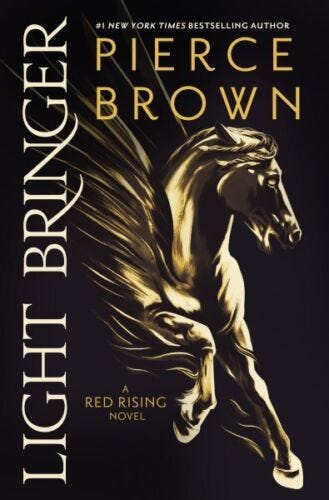
There’s no need for me to recap the series here, I already did that on my channel. This is the 6th book in a series so if you’re reading this, you should probably already know what’s going on.
I finished reading LIGHT BRINGER earlier today at work. It was a roller coaster but probably not in the good way. I had about a million thoughts and I have no real idea of where to start, so I’ll say that generally it did a few things well but overall I was extremely pissed off when it ended.
Why? Well, let’s list it off. Spoilers, you’ve been warned.
Tight Focus versus Protracted Wandering
The hard shift in tone between the first three books and the second three isn’t just about adding more POV characters. While Darrow remains the most compelling narrator (it is, after all, his tale) I’ve still enjoyed huge portions of Lysander’s perspective, and some of Virginia’s. Lyria is annoying and Ephraim is just a whiny mope whose only speed is “I’M SAAAAAAAAD LIFE IS HAAAAAAAARD!!!” without making any real progress toward overcoming that, until he gets brutally murdered in book five.
Ephraim’s suffering and loss aren’t unique by any stretch. Darrow lost his wife and overthrew the government. Ephraim lost his boyfriend and just became a dick to everyone for the next ten years. I could write an entire post on why his character was annoying to read, but that’s not the focus. The focus is tight in this essay. No protracted wandering here, sir.
No, the focus and narrative progression of the first trilogy was natural and logical according to the character of Darrow as established. Revelations about the world were made with a delicate and timely hand, in a way that kept the pages turning without bogging the reader down in drudgery and navel-gazing.
The same cannot be said of the second trilogy. Where RED RISING covered two years, GOLDEN SON covered two more after a three-year gap, and MORNING STAR covered another year after a year gap, the next three books (which are significantly longer) cover only a two-year stretch. The flow, the natural progression of scenes and character moments and actual story development is sacrificed so that we can watch these characters go on long walks or long space flights or long battles or long walks again, and chop our way through chapter after chapter after chapter after chapter of the same damn battle or debate or conflict ad nauseum.
The swollen girth of these books is not justified by the end result of the story. It’s verbosity for its own sake. A twenty-episode TV show that could have told its story better in twelve episodes. Consider the following:
RED RISING. Darrow is a miner. He’s married. He finds out the government has been lying to his people and they’re all slaves. They kill him and his wife, but he’s recovered by rebels and made into a sleeper agent. He’s inserted into their leadership institute and has to learn the hard work of empire-building. The bulk of his time at the Institute is about learning the intricacies of interpersonal management and how to lead by example, and how to work within the confines and an established system to gain loyal followers and earn power. Each interaction with another character is a unique example, a unique challenge of how to do that, all the way to the end of the book, where he wins his year at the Institute. Two years. 382 pages.
LIGHT BRINGER. Darrow has been getting his ass kicked in space for ten years. Even when he wins, he loses. He conquered Mercury in book four, then lost it in book five. Conquered Venus in book four, then lost it in book five. Earth has fallen. He’s far from home with few friends around him and enemies closing in on all sides. The only free planet remaining is Mars, and it’s under siege. He manages to recover his friend Sevro, then fly to Ilium (the moons of Jupiter) while training with Cassius. The entire time, he reads a book on philosophy that basically teaches him everything he’s done for the last sixteen years is wrong and stupid. He fights people, people switch their allegiances, people are revealed to be other people, this process repeats six or eight times, and by the end of the book, Cassius is dead and Lysander is now Darrow’s greatest enemy. Mars is still the only free planet, still under siege, and oh, he now has to provide food for Ilium, since Lysander sacked their bread basket. Three or four months? 682 pages.
75% longer to cover one-eighth of the time span, with little to no real change in Darrow’s situation. Some friends die, some allies die, some enemies die, he gets some new allies, and some more powerful enemies, the end. Now cough up the royalties and wait for yet another book which we promise is the final one in the series, like this one was supposed to be. Bruh.
The Hardship Cheat Code
Whereas the original trilogy dealt classic, legendary hardship that felt natural and earned, the sheer grind of reading the sequel trilogy is not unlike trying to ride a bike uphill with someone behind you holding onto the seat. You know it’s harder than it has a right to be and yet it just keeps happening. All tension is gone out of the fight scenes because you know the good guys aren’t going to win, they haven’t won anything for three books, they just keep getting brutalized and humiliated no matter what. Without that tension, reading epic battle scenes becomes a chore. You already know how it ends.
There was one battle on Phobos where Virginia and Victra managed to eke out only a partial loss, and Victra killed Ajax au Grimmus, which offered a modicum of relief from the otherwise endless slog of forced hardship on the protagonists. This is grunge fiction merely for the sake thereof. Defeat without hope. Nihilism, hiding under a fake nose and mustache of prior accomplishments. Even when the protagonists accomplish something big, you know the leg sweep is coming, and at some point you stop caring.
The fact that book six had to get split in two, and that there’s a seventh coming next year, is just infuriating. “But you won’t get the complete story if you don’t finish it!” Why hasn’t the complete story happened already? He certainly had the space to do it. If the last three volumes had offered any significant change or progress or development of the story that might be something, but everything from book four to book six has been the same battle.
Not the same war, or the same campaign. Understand what I’m saying. It’s all been the same $@%#ing battle. Okay? The Republic is crumbling, Darrow left home, he’s fighting on Venus and Mercury and now Ilium and it’s all just the same damn thing. He lost Sevro, he got him back. He got Cassius back, then he lost him. There was a bit of progress with the Obsidians, so yay, we resolved a subplot while leaving the main plot largely untouched. Oh cool, Lysander ascended by stealing Darrow’s huge ship, and Darrow is laid low by having to take Lysander’s small ship. Wooooo.
“It’s Just Too Smart/Gritty For You”
Kiss my absolute ass with this take. A couple of retards have dropped it in my comments on YouTube and it’s pointless. “Go read YA books if you’re so sensitive!” Please. You know nothing about who I am or what I do or what my threshold is.
This series is not “too smart” for me. The depth and intelligence and rich classical roots of Red Rising are what drew it to me to begin with. I understand what it’s saying about empire and revolution and government, these are things I’ve been reading and studying for literally twenty-five years of my thirty-nine year life.
“Too gritty” doesn’t fit either. The same Internet Tough Guys telling me this are the ones that’d have a meltdown if they had to deal with drunkards sneaking up on them at 2am in a downtown back alley while making food deliveries (happens to me often.) Or 300-lb Gulf War vets cussing you out when the equipment fails in the middle of a pump delivery and you wonder if you’re about to take a knuckle calzone to the teeth (also happened to me.) Or they’ve never had to hammer pins on a crane in a Vegas summer with a sixty year-old Georgia boy calling you a “little bitch pussy faggot” for taking more than five strikes with the sledge. #ISurvived.
Too gritty…dude. I have read (and am reading) numerous ongoing series from Monster Hunter International to The Dresden Files to Walt Longmire and more that feature heavy violence, the likes of which would put an R-rating on any screen treatment. And that’s not even touching the history/nonfic that I read.
The point is that this second trilogy of RR novels are pointlessly and excessively violent for the sake thereof, and nothing more. Slow down the camera, zoom in a little bit, let’s spend three pages writing about the heroes getting smashed to death under ten-ton obelisks and having their gore hosed off in between executions. Enlightening. We’ll hack up a noble, beloved character and bounce his head around like a volleyball, then cremate him and run his ashes through the sewer because oh boy, this is a mature book. Hows about we take a newborn baby and nail him to a tree for some character motivation yeeeeeaaaaaah let’s go, this is entertainment now!
It’s hardcore gore-nography, enjoyed and defended by small minds who equate maturity with angry masturbation. You’re not grown-up for enjoying that shit, you need help, and I’m not the problem for saying so. Pay your mom some rent and quit being stupid.
Arc versus Circle
I’ve touched on this already, but it’s worth highlighting again, especially in the instance of incredibly long fiction that doesn’t need to be so: the first RR trilogy was a series of wonderful, fulfilling arcs that happened in a credible and satisfying succession. The second trilogy is almost obsessed with changing as little as possible from volume to volume, doing what it can to keep the characters in the same spot at the end of the book that they were in at the beginning.
Not geographically, but tactically. We showed up for book four and got no real resolution. We showed up for book five, got an extra ten hours on the audiobook, and got senseless murder with even less resolution. We waited four years for book six, and by the end…far too little has changed. These aren’t arcs. These are circles, designed to sell the next book.
And I’m seriously debating whether I’ll read the final one. Even knowing that it’s the final one. I don’t think I have it in me to care anymore. Not after this.
Victim Of Its Own Success?
I don’t think this is completely the case here, but it has to play a role. Disney bought Lucasfilm and immediately had to make good on its investment, so it milked the hell out of that cow until the udders were chapped and bleeding and nothing came out but pus, and the fans didn’t like the taste, and now the brand is ruined, maybe forever. Paramount has been flogging Star Trek content since 2009 and while they made 1.5 moderately enjoyable movies, almost nothing of real quality has been produced under that banner for a while. Stranger Things was really cool for season 1, but then the producers tried a backdoor pilot for a spinoff show in season 2 and most fans hated it. Season 3 was trash. I’ve heard S4 was good but I haven’t watched it.
This same thing happens with a lot of series. Avatar: The Last Airbender was a perfect trilogy. The Legend of Korra had something going for it with its first season, and it was so well-received that the studio wanted more and more and more and more and the seed of the idea just wasn’t there beyond season one. Terminator. Aliens. Predator. Pirates of the Caribbean. All of these huge properties have sequels that the fans would prefer to strike from the record, but because there was at least some guaranteed money to be made, the business got what it wanted and the art suffered for it.
I have at least enough confidence in Pierce Brown’s talent to think that this wasn’t the case with the Red Rising sequels. As an author myself, it’s clear that he loves this series and these characters, and that a lot of his readers do too. I just wonder if they love it so much that they see virtue in the sequels reflecting off of the original trilogy. Value that isn’t there. Blinders, if you will.
At the end of the day, if he writes it and the publishers publish it and the readers throw mountains of cash at it, then it’s a success and I salute him. Great work, we should all be so lucky, yeah? I’m happy for him.
But I need to be honest about how these last three books have gone, what my own experience has been with them, and whether I’m going to finish it when he does. As things stand right now, probably not.
Alas, and oh well. You guys have fun, I’m gonna go look for something else.